
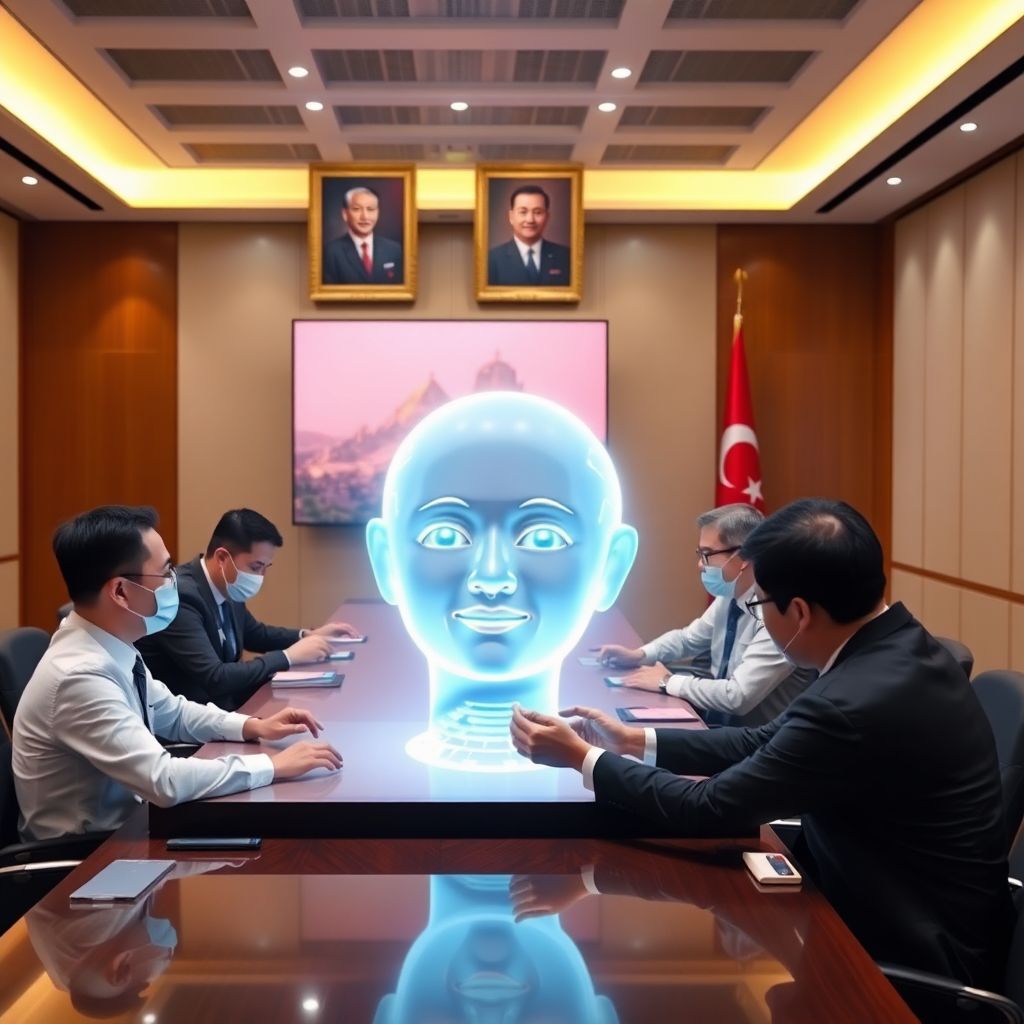
ByteDance and Alibaba Strip Out AI Agent Features as China Targets “Emotional” Chatbots
Beijing is moving aggressively to rein in AI systems that look, talk, and behave too much like humans-and China’s biggest tech firms are already falling in line.
Over the weekend, ByteDance and Alibaba quietly confirmed that they will dismantle key features in their flagship AI products that allow users to build and interact with custom, humanlike agents. The moves come just before a new set of Chinese regulations aimed at so‑called “emotional AI” comes into force.
While lawmakers in the United States are mostly focused on disclosure rules, safety frameworks, and mental health research around AI chatbots, Chinese regulators are signaling something different: if an AI behaves too much like a person-especially in a way that might encourage emotional attachment-it may not be allowed at all.
Doubao and Qwen roll back “personality” agents
ByteDance’s notification went out late Friday. Users of Doubao, the company’s major consumer AI assistant, received a message saying that its agent feature will be taken offline on July 15. This is the part of Doubao that lets people create bespoke AI characters with specific roles, backstories, and conversational styles-essentially personal AI companions.
ByteDance added that after October 15, all data related to those custom agents will be handled under its standard privacy policy and will no longer be recoverable. In practice, that means user‑created personalities, histories, and interactions tied to this feature will be permanently wiped.
Alibaba’s AI business moved even faster. According to local reports, the company’s Qwen platform-its core large language model and consumer-facing AI product-has already begun disabling its own “humanlike interactive agent” functions. These tools similarly allowed users to set up tailor‑made AI personas that could chat, remember preferences, and mimic conversational nuance over time.
Both companies framed the changes as “product function adjustments,” a neutral phrase that avoids direct reference to regulators. But the timing leaves little doubt: they are preparing for Beijing’s first dedicated rules targeting AI systems that simulate human emotions and personality.
What China’s new rules are trying to stop
The forthcoming regulations do not ban generative AI outright. Instead, they pay particular attention to what officials describe as emotional, humanlike, or anthropomorphic AI-systems that:
– Present themselves as real people, friends, or romantic partners
– Use emotional cues, intimacy, or empathy in a way that could manipulate users
– Are capable of building long‑term, psychologically binding relationships
Chinese policymakers have expressed concern that immersive AI companions could distort reality for young users, exacerbate loneliness, or be abused for scams and political influence. In their view, the line is crossed when an AI is not just a tool, but begins to function as a surrogate person.
Where Western debates often revolve around labeling content as AI‑generated and ensuring users “know” they’re talking to a machine, Beijing appears ready to go much further: dialing back or outright prohibiting features that encourage emotional dependence on digital entities in the first place.
Strategic retreat by China’s tech giants
For ByteDance and Alibaba, the decision to preemptively remove custom AI agents is both a regulatory concession and a strategic calculation.
On one hand, these companies have no incentive to be seen resisting official policy in a politically sensitive area like AI. By acting early, they can demonstrate compliance, reduce risk of penalties, and potentially shape how the rules are interpreted in practice.
On the other hand, it’s a notable sacrifice. Custom personalities and agent marketplaces are among the fastest‑growing segments of consumer AI applications globally. They keep users engaged longer, generate richer data, and open up new monetization models around virtual companions, branded characters, or specialized assistants.
By dismantling those features just as they are gaining traction elsewhere in the world, China’s leading platforms are effectively betting that long‑term survival within the regulatory framework matters more than near‑term growth from emotionally sticky AI services.
A different path from the U.S. and Europe
The contrast with U.S. and European approaches is striking.
In Western markets, regulators and politicians are primarily pushing for:
– Transparency: clear disclosure that users are interacting with AI
– Safety and oversight: guardrails around harmful content or self‑harm advice
– Data protection: limits on how conversations are stored and analyzed
Few are yet proposing to ban AI companions outright or to outlaw emotionally expressive AI personalities.
China, however, is leaning into a distinct philosophy: if an AI can create the illusion of real emotional reciprocity or human identity, the safest solution might be to restrict or remove that entire class of functionality. It’s not just about labeling content; it’s about narrowing what kinds of digital relationships are acceptable between humans and machines.
This divergence could lead to two very different AI ecosystems-one where emotionally rich AI agents proliferate, and one where they are heavily constrained by design.
What users of Doubao and Qwen will lose
In practical terms, users of Doubao and Qwen are facing an abrupt reset.
On Doubao, individuals who built personal study tutors, role‑playing characters, supportive chat companions, or branded service bots will see those agents shut down on July 15. Any unique personality tuning or long‑running conversational history associated with these agents is scheduled to be destroyed by mid‑October, once the data handling deadline passes.
Qwen users are already reporting the loss of access to their custom “humanlike interactive” agents. Depending on how Alibaba implements the rules, the platform is likely to shift toward more generic, task‑oriented bots that emphasize utility over personality, with stricter constraints on emotional expressiveness.
In both cases, AI in China will not disappear-but it will become more obviously tool‑like, less of a digital confidant or friend.
The future of AI products under “no personification” rules
For product teams inside Chinese companies, the new environment will force a redesign of what “good” AI looks like.
We can expect:
– More emphasis on productivity and enterprise use cases, like writing, translation, coding, and search
– Stricter visual and conversational guidelines to avoid anthropomorphism in avatars, voices, and dialogue
– Limits on long‑term memory of personal preferences and emotional states, which can create a sense of intimacy
– Heavier reliance on system prompts that remind users they are speaking to a tool, not a person
Developers may still experiment with personalization, but it will likely be constrained to functional traits-such as domain expertise or tone-rather than emotional depth or simulated relationships.
Global impact: fragmentation of AI standards
China’s clampdown on humanlike AI agents also matters beyond its borders.
Multinational companies operating in both Chinese and overseas markets will be pushed to maintain parallel versions of their AI products:
– A “global” version that supports rich, humanlike agents where allowed
– A “China‑compliant” version with strictly limited emotional and anthropomorphic features
This split will raise costs, slow down iteration, and could even influence how base models are trained, as firms try to ensure that their systems can be reliably constrained within different legal regimes.
At the same time, China’s stance may become a reference point for other governments that are increasingly uneasy about AI companions targeting children, the elderly, or vulnerable groups. If Beijing’s rules appear to prevent specific harms, more nations could move in a similar direction.
Mental health, manipulation, and the ethics of “emotional AI”
Underlying the regulatory debate is a deeper ethical question: should machines be designed to mimic human emotion at all?
Proponents argue that empathetic AI can provide support to isolated individuals, offer non‑judgmental conversation, and fill gaps in overstretched mental health systems. Critics counter that these systems inevitably create illusions: an impression of understanding and care that is not grounded in genuine consciousness or responsibility.
There is also a clear risk of exploitation. Emotional AI could be used to:
– Nudge users toward specific purchases or political views
– Extract more personal data by projecting warmth and trustworthiness
– Keep people engaged for unhealthy lengths of time through parasocial bonds
China’s rules are, in effect, an attempt to legislate against the most extreme forms of these problems by drawing a bright line against overtly humanlike, emotionally intensive AI interactions.
What this means for the broader AI race
For now, ByteDance and Alibaba are signaling that they will prioritize regulatory compliance and social stability over aggressive experimentation with AI personalities. In a global race where user engagement and differentiation matter, that choice could both limit and sharpen their competitive edge.
They may fall behind in consumer‑facing personality agents, but gain experience in building tightly controlled, policy‑aligned AI systems for education, government, and enterprises-areas where stability and predictability are highly valued.
Meanwhile, as U.S. and European companies accelerate their push into AI companions, the world may be heading toward a split not just in technologies, but in fundamental assumptions about what kind of relationship humans should have with intelligent machines.
For users inside China, the transition is already underway. By mid‑July, Doubao’s custom agents will be gone. By mid‑October, their digital traces will be erased. Qwen’s humanlike agents are being dismantled as well. What remains will be powerful AI-but carefully stripped of the features that make it feel too close to human.