
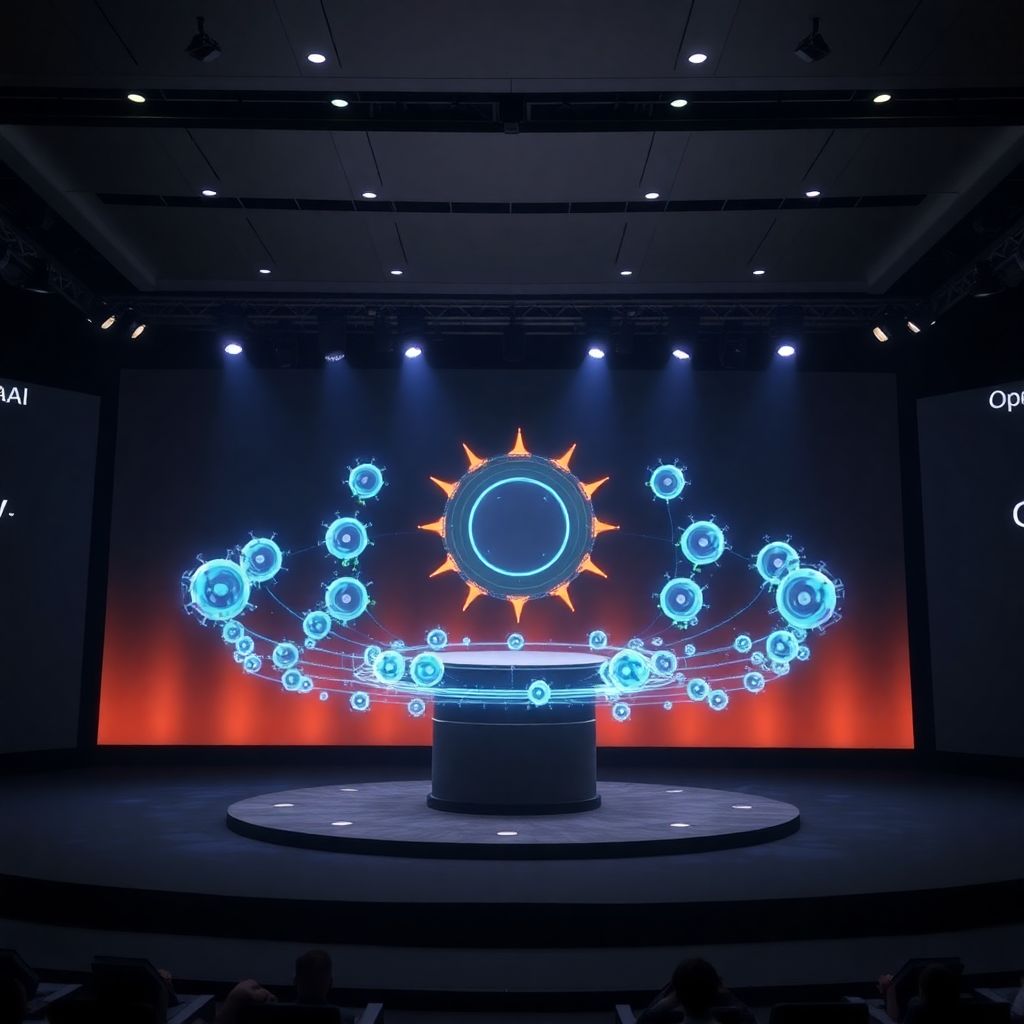
OpenAI unveils GPT‑5.6 Sol with multi‑agent reasoning and new enterprise focus
OpenAI has rolled out its latest model family, GPT‑5.6, across ChatGPT, Codex, and the public API, headlined by a new flagship model called GPT‑5.6 Sol. The release introduces a four‑agent reasoning system, new coding and workflow tools, refreshed enterprise capabilities, and an updated, tiered pricing structure as availability expands worldwide over the next 24 hours.
New three‑tier model lineup: Sol, Terra, Luna
With GPT‑5.6, OpenAI is shifting from a single-name frontier model to a three‑tier family built around capability levels:
– Sol – the top‑end flagship focused on advanced reasoning, coding, and complex knowledge work.
– Terra – a mid‑tier model aimed at strong performance with more moderate costs.
– Luna – a lighter‑weight option optimized for affordability and speed.
Instead of tying everything to one monolithic model, OpenAI now separates generation from intelligence, speed, and price. This capability‑based framing is meant to make it clearer for businesses and developers which model best fits a given workload, from high‑stakes research through to high‑volume applications where cost per token dominates.
Four‑agent reasoning: from single pipeline to parallel thinking
The most distinctive feature of GPT‑5.6 Sol is its support for a multi‑agent reasoning system, particularly in the new Ultra operating mode. In the default Ultra configuration, four separate AI agents work in parallel on different subtasks before aggregating their outputs into a single result.
Instead of one model running through a long, sequential chain of thought, Sol can:
– Split a complex assignment into smaller, specialized components.
– Have different agents tackle analysis, verification, writing, or code implementation independently.
– Combine the partial results into a more robust, cross‑checked final answer.
This architecture is tailored for complex, multi‑stage projects where parallelization and internal debate can outperform a single linear reasoning path-for example, a large‑scale code refactor, a deep technical report, or a multi‑document security audit.
New operating modes: Standard, Max, and Ultra
For teams with varying needs, GPT‑5.6 Sol supports three main compute modes:
– Standard – the default mode, optimized for responsiveness and cost, suitable for everyday chat, content generation, and typical coding tasks.
– Max – grants the model more time and compute to reason, cross‑check, and refine answers before returning them, improving reliability on hard problems.
– Ultra – enables the multi‑agent approach, typically with four agents reasoning in parallel for the most demanding, intricate workflows.
Max and Ultra are designed for users who care less about response time and more about accuracy, coverage, and robustness-for instance, legal teams, security analysts, and engineering orgs working on critical systems.
Sol: built for coding, science, and cybersecurity
OpenAI positions GPT‑5.6 Sol as its flagship for technical and analytical work, with a particular emphasis on:
– Software development
– Scientific and data‑driven research
– Cybersecurity
– Complex enterprise knowledge tasks
According to the company, Sol:
– Completes more tasks successfully than prior frontier models.
– Uses fewer tokens to accomplish the same work, reducing effective cost.
– Delivers lower estimated operating expenses than earlier high‑end models.
– Can inspect intermediate results, call and orchestrate external tools, and revise its own output before presenting a final answer.
In practice, this means Sol is better at long, multi‑step engagements such as end‑to‑end feature development, research synthesis over large corpora, and iterative debugging across complex codebases.
Programmatic Tool Calling: lightweight in‑memory workflows
Alongside model upgrades, OpenAI is introducing Programmatic Tool Calling, a workflow feature for developers building on the API.
With Programmatic Tool Calling, GPT‑5.6 can:
– Write and execute lightweight programs in memory to process data or explore solution paths.
– Filter and transform intermediate information before sending it back to the model.
– Decide what to do next-query a database, call an external API, or run another tool-without round‑tripping every step through the core language model.
This design reduces latency and cost for complex flows, since not every intermediate action demands a full model invocation. It also makes agents more capable of autonomous, multi‑step decision‑making while still being controllable and observable by developers.
Coding benchmarks: Sol, Terra, and Luna vs. rival systems
Coding remains a major pillar of the GPT‑5.6 launch. OpenAI reports that GPT‑5.6 Sol:
– Achieved the highest score on the Artificial Analysis Coding Agent Index, a benchmark that evaluates autonomous coding agents.
– Improved performance on Terminal Bench 2.1, which focuses on command‑line task execution.
– Delivered better results on DeepSWE, a benchmark for long‑duration, large‑scale software engineering challenges.
The mid‑tier and budget models also target strong developer value:
– Terra reportedly surpasses Claude Fable 5 on selected coding agent evaluations.
– Luna is said to outperform Claude Opus 4.8 while operating at a lower estimated cost, positioning it as a cost‑efficient alternative for large coding workloads.
For engineering organizations, this tiering creates a spectrum: Sol for the hardest, highest‑stakes problems; Terra for robust day‑to‑day development; and Luna for scalable coding support where throughput and price matter most.
Deep integration with business tools and workflows
GPT‑5.6 is designed to plug into everyday enterprise software, not just developer environments. OpenAI indicates that the new models work across:
– Documents, spreadsheets, and presentations
– Collaboration platforms such as Slack and Notion
– Productivity suites like Microsoft 365
– Cloud storage and document systems such as Google Drive
When given templates or reference files, Sol can generate:
– Editable slide decks aligned with a company’s brand and structure
– Detailed financial models and spreadsheet workflows
– Polished documents such as reports, memos, proposals, and product specs
The emphasis is on producing structured, editable content rather than static text dumps, enabling teams to use the output as a starting point for real work inside their existing toolchains.
Enterprise‑grade safety and risk management
Safety and risk mitigation remain a central pillar of GPT‑5.6’s design, especially as capability grows in sensitive areas like cybersecurity and biology.
According to OpenAI’s internal classifications:
– GPT‑5.6 Sol is rated High capability in cybersecurity, reflecting strong skill at tasks such as code analysis, exploit detection, and system hardening.
– Terra and Luna also reach the High capability level in cybersecurity, even though their overall capabilities are below Sol.
OpenAI’s testing indicates that GPT‑5.6 is more capable in both cybersecurity and biology than earlier models, but still below the company’s Critical threshold in those domains. To keep higher‑risk behaviors within acceptable bounds, the company says it combines:
– Model‑level safety training
– Real‑time safety checks and monitoring
– Account‑level enforcement and rate limits
– Fine‑grained access controls for higher‑risk capabilities
At the same time, GPT‑5.6 is explicitly intended to support legitimate defensive work, including secure code review, vulnerability validation, threat modeling, and patch development-use cases where stronger AI assistance can directly improve security posture.
Pricing and prompt caching: predictable costs at scale
The GPT‑5.6 launch also introduces a new pricing schedule and cache behavior aimed at making costs more predictable:
– Sol:
– $5 per 1 million input tokens
– $30 per 1 million output tokens
– Terra:
– $2.50 per 1 million input tokens
– $15 per 1 million output tokens
– Luna:
– $1 per 1 million input tokens
– $6 per 1 million output tokens
In parallel, OpenAI is expanding prompt caching capabilities, offering:
– Explicit cache breakpoints, so developers can control which parts of a prompt are reused.
– A minimum cache lifetime of 30 minutes, improving cost predictability for repeated or templated workflows.
For enterprises and large‑scale developers, this combination of tiered pricing and caching can significantly reduce the per‑request cost of common patterns such as multi‑turn agents, workflows with large shared system prompts, or repeated calls over the same project context.
What GPT‑5.6 means for developers
From a developer’s standpoint, GPT‑5.6 represents a shift from single‑call completions toward orchestrated, multi‑step systems:
– Multi‑agent reasoning allows building agents that debate, cross‑check, and specialize, improving reliability on complex tasks.
– Programmatic Tool Calling helps implement in‑memory workflows where the model can act more like a smart decision engine than a simple text generator.
– The Terra and Luna tiers make it feasible to scale coding support, annotation, and automation workloads without frontier‑model costs.
Combined, these changes encourage developers to design apps around stateful agents, tool ecosystems, and distributed reasoning, rather than relying solely on single‑prompt magic.
Implications for enterprises and knowledge workers
For enterprises, GPT‑5.6 pushes AI deeper into core business operations:
– Knowledge workers can offload more of the heavy lifting for research, document drafting, financial modeling, and presentation building.
– Security and IT teams get stronger AI support for defensive cybersecurity, from vulnerability triage to code hardening.
– Cross‑functional teams can use the same model family-from Sol at the top to Luna at the bottom-across different departments while maintaining coherent governance and safety controls.
The multi‑agent Ultra mode also opens the door to AI project teams: an internal ecosystem where different agents specialize in analysis, planning, execution, and quality assurance, mirroring how human teams are structured.
Competitive landscape: launches cluster at the frontier
The GPT‑5.6 release lands amid an intensifying race at the high end of AI models. In parallel, Elon Musk confirmed that SpaceXAI will publicly release Grok 4.5 after completing beta testing. He characterizes Grok 4.5 as an Opus‑class system that is faster, more token‑efficient, and lower cost than prior iterations.
The near‑simultaneous rollout of GPT‑5.6 and Grok 4.5 underscores how quickly the frontier model landscape is evolving. For end users and enterprises, the practical effect is a broader range of powerful models to choose from, differentiated by:
– Multi‑agent reasoning capabilities
– Coding performance and tool ecosystems
– Safety posture and governance controls
– Price, speed, and token efficiency
Looking ahead: from single models to AI ecosystems
GPT‑5.6 Sol and its multi‑agent architecture highlight a broader trend: the shift from thinking about “the model” to thinking about systems of cooperating agents. As tools like Programmatic Tool Calling mature and enterprise integrations deepen, the real value will come from how organizations design:
– Agent roles and responsibilities
– Toolchains and data access patterns
– Safety and audit frameworks
– Cost‑aware routing across Sol, Terra, and Luna
In that sense, GPT‑5.6 is less a single upgrade and more a platform transition-from standalone chatbots to AI systems embedded across coding, research, security, and everyday business workflows.