
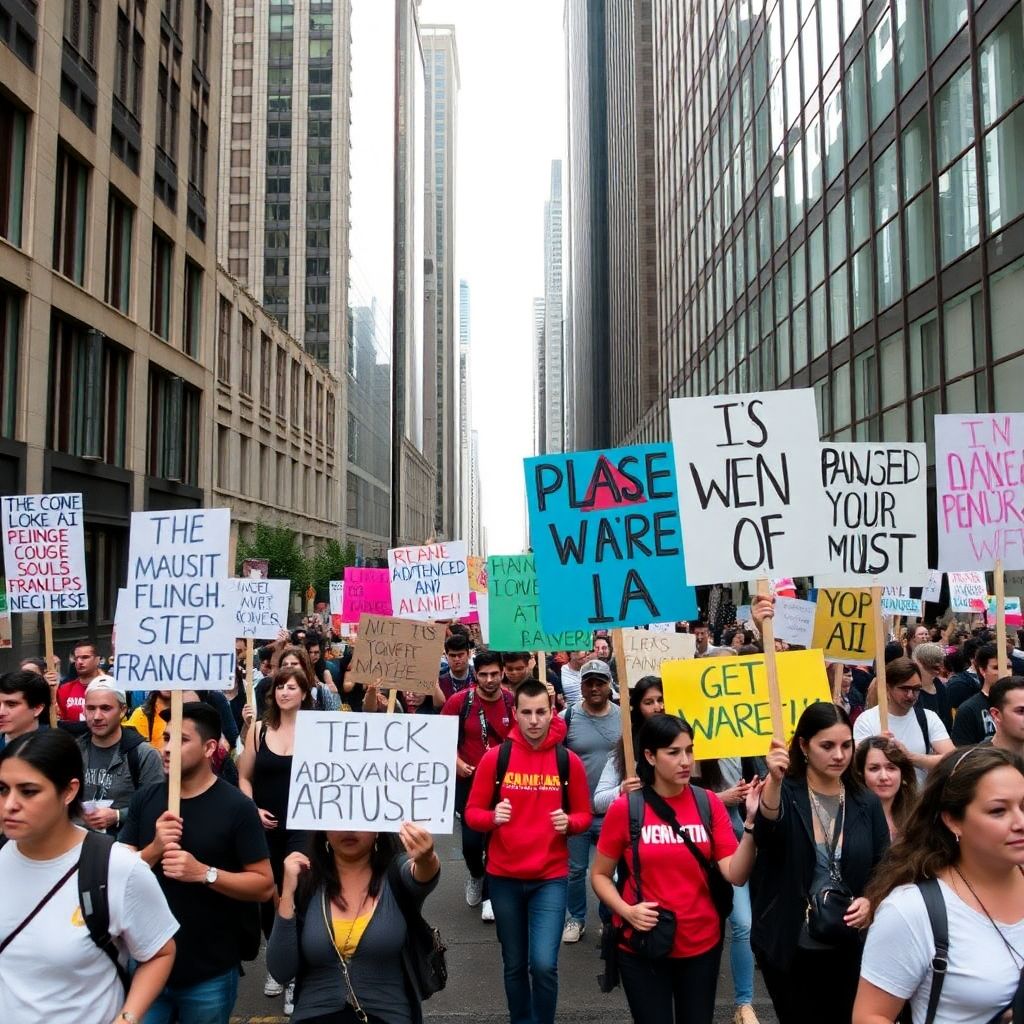
Protesters Demand AI Labs Hit Pause on Next-Gen Models in San Francisco March
Around 200 demonstrators filled the streets of San Francisco on Saturday, marching between the offices of OpenAI, Anthropic, and Google DeepMind to demand a halt to the development of ever more powerful artificial intelligence systems.
The march, coordinated by the group Stop the AI Race, was the latest visible sign of public unease with the rapid acceleration of advanced AI. Participants called for a temporary pause on training new “frontier” models-systems more capable than those currently on the market-until stronger safety measures and regulatory frameworks are in place.
From AI Safety to Housing and Climate
While AI safety was the central theme, the protest quickly expanded into a broader critique of the tech industry’s impact on society. Demonstrators carried signs and chanted slogans that linked cutting-edge AI development to:
– The risk of catastrophic or uncontrolled AI behavior
– Job losses from automation and AI-driven productivity tools
– The growing carbon footprint and resource demands of large-scale AI training
– Surging housing costs in San Francisco, which many attribute in part to the wealth and influence of major tech companies
– The concentration of power in a small number of AI labs and tech giants
By routing the march past the headquarters of OpenAI, Anthropic, and Google DeepMind, organizers aimed to highlight how a handful of actors now wield outsized control over the direction and speed of AI progress.
Who Organized the Protest?
The demonstration was organized by Stop the AI Race, a group that argues current competitive pressures between companies and nations are pushing AI development forward faster than it can be safely governed. The effort was led by Michaël Trazzi, a former AI researcher who has become an outspoken critic of unrestrained AI scaling.
Trazzi and fellow organizers framed the march not as opposition to AI itself, but as resistance to what they see as a reckless race to build systems whose capabilities-and potential failure modes-are poorly understood.
Concrete Demands for AI Labs
Protesters’ demands were relatively specific. They called on leading AI companies to:
– Stop training new, more advanced “frontier” models for the time being
– Keep existing AI systems and tools available to users, rather than rolling back current services
– Shift the bulk of near-term research budgets toward AI safety, robustness, and alignment
– Develop and publicly commit to stricter internal safeguards and evaluation procedures
– Support the creation of binding regulations that would govern the development of highly capable models
The message was not to shut down AI research altogether, but to change its emphasis: prioritize understanding, controlling, and safely integrating today’s systems before building more powerful ones.
Fears About Existential and Systemic Risk
A significant portion of the protest focused on existential and systemic risks-scenarios in which highly capable AI systems could cause large-scale harm, whether through misuse, accidents, or loss of human control.
Participants argued that:
– Rapidly scaling models without robust interpretability and control tools is akin to “flying blind” with increasingly complex systems.
– The combination of powerful AI with weapons, cyberattacks, or disinformation campaigns could destabilize societies.
– Even without science-fiction scenarios, opaque AI systems making high-stakes decisions in finance, healthcare, or critical infrastructure pose serious dangers.
These concerns mirror debates within the AI research community itself, where some experts warn that frontier models could eventually surpass human-level capabilities in critical domains.
Jobs and Economic Inequality
Beyond hypothetical long-term risks, many marchers emphasized more immediate fears about work and inequality. They warned that:
– Generative models and automation tools are already beginning to displace roles in customer service, content creation, software development, and other white-collar fields.
– Without policies such as retraining programs, worker protections, or new forms of social safety nets, the gains from AI will predominantly accrue to a small elite of company owners and shareholders.
– Job losses combined with San Francisco’s already high cost of living could push more people out of the city and deepen existing inequalities.
For some protesters, the call to pause AI development is also a call to slow down long enough for governments, unions, and civil society to respond with meaningful economic protections.
Environmental Impact of AI Scaling
Environmental concerns formed another pillar of the demonstration. Large AI models require enormous computational resources both during training and deployment, which translates into significant electricity usage and associated carbon emissions.
Demonstrators highlighted that:
– Training a single frontier model can consume as much energy as powering thousands of homes for a year, depending on the scale and infrastructure.
– The demand for specialized hardware and data centers is driving new waves of construction, with associated land, water, and energy costs.
– Without strong standards for clean energy use and efficiency, the AI boom risks undermining global climate goals.
Activists argued that AI companies should not be allowed to externalize these environmental costs while racing to claim technological leadership.
Housing, Tech Power, and Local Tensions
Although the protest targeted specific AI labs, it also tapped into long-simmering local tensions about the role of tech companies in reshaping San Francisco. Demonstrators drew connections between the AI boom and:
– Rising housing prices and rents, which many residents attribute partly to high-paid tech workers and speculative investment.
– The displacement of lower-income communities and small businesses as neighborhoods gentrify.
– The growing political and cultural influence of large technology firms in local and national policymaking.
By marching across a city that has become synonymous with both innovation and inequality, protesters sought to situate AI not as an abstract technology, but as a force already reshaping daily life.
What a “Pause” Would Actually Mean
Organizers attempted to clarify that they are not asking for a permanent freeze on AI or a dismantling of existing systems. Instead, they advocated for a time-limited, verifiable pause on pushing the frontier forward.
In practice, this could include:
– Moratoriums on training models above certain compute thresholds or capability levels
– Independent audits and safety evaluations for any system that crosses agreed-upon risk thresholds
– Industry-wide agreements, ideally backed by legislation, that restrict the release or deployment of models with certain dangerous capabilities unless strict controls are in place
The goal, they argued, is to give regulators, researchers, and the broader public time to catch up-to understand the implications of current systems, define red lines, and build robust guardrails.
Tension Between Innovation and Precaution
The march also underscored a fundamental tension facing the AI sector: how to balance innovation with precaution. Many companies argue that ongoing research is precisely what’s needed to make systems safer, more reliable, and more beneficial. Protesters counter that:
– Competitive and financial pressures make it unrealistic to expect self-restraint without external oversight.
– The current pace of deployment leaves little room for democratic input or thorough impact assessments.
– Waiting for clear harm to materialize before acting is risky given the global scale and speed at which AI tools can spread.
This clash of perspectives is rapidly becoming one of the defining policy debates of the AI era.
Growing Global Scrutiny
Although Saturday’s demonstration was local, it reflects a growing global scrutiny of advanced AI. Policymakers in multiple countries are considering or implementing regulations for high-risk AI systems. At the same time, leading AI labs are publishing voluntary safety commitments, risk frameworks, and red-team testing procedures.
Protesters, however, argue that voluntary guidelines are not enough. They are pushing for:
– Legally binding standards that apply to all major players, not just those willing to self-regulate
– Greater transparency around training data, model capabilities, and internal safety evaluations
– Mechanisms for public input and accountability in decisions about how and where powerful AI systems are deployed
From their perspective, the stakes are too high to leave the future of AI entirely in corporate hands.
What Comes Next
Saturday’s march will not, by itself, force OpenAI, Anthropic, or Google DeepMind to pause their research. But it signals that opposition to unrestrained AI scaling is becoming more organized, more vocal, and more visible.
Organizers indicated plans for further actions, public discussions, and policy advocacy aimed at:
– Pressuring companies to adopt stricter internal safety policies
– Encouraging legislators to treat frontier AI development as a matter of public interest and national security
– Building coalitions across labor, climate, civil rights, and tech ethics groups to present a united front on AI governance
As AI systems continue to grow more capable and more integrated into everyday life, confrontations like the one in San Francisco are likely to become more frequent. The core question animating the march-how fast is too fast?-now sits at the center of the global conversation about the future of artificial intelligence.