
Black Forest Labs Launches FLUX 3: From Image Generator to Full‑Stack Video and Robotics Brain
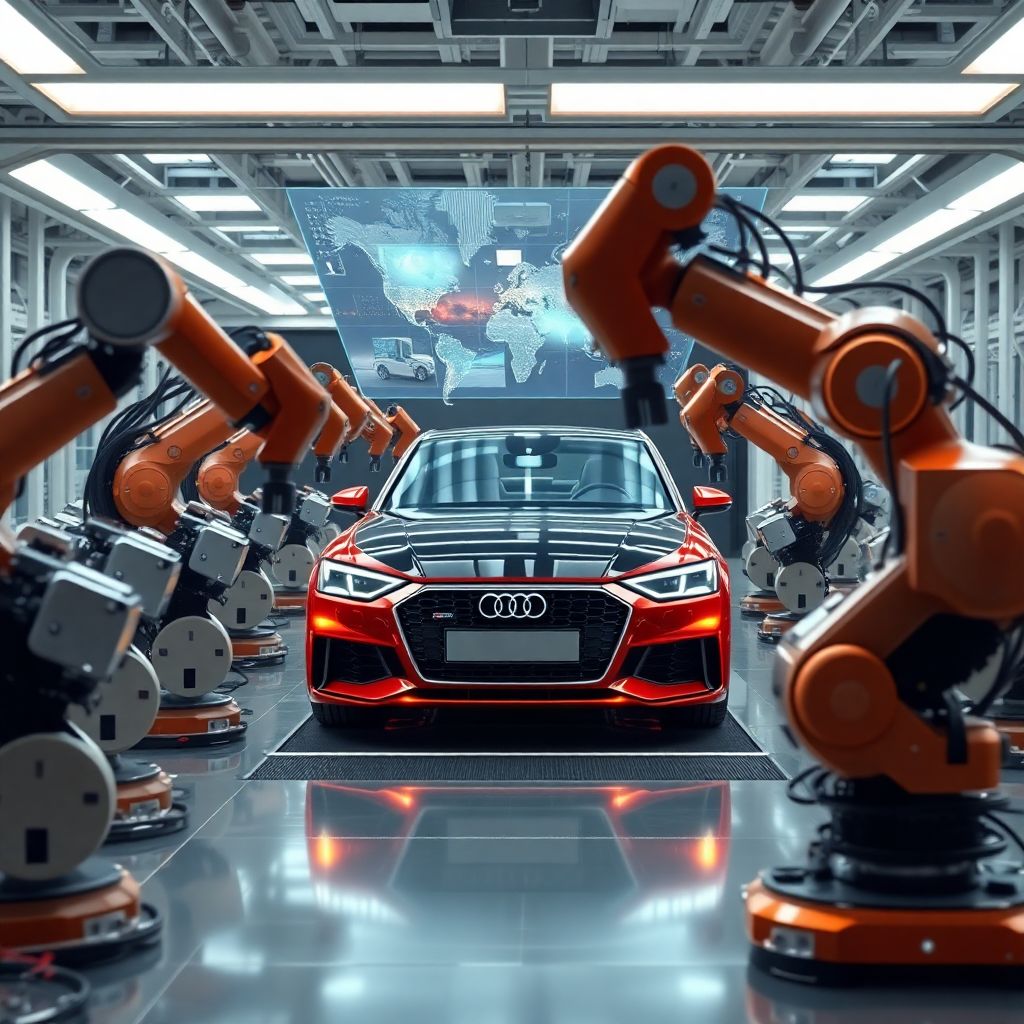
Black Forest Labs has taken a decisive step beyond still imagery. With the launch of FLUX 3, the German AI company has turned its flagship model into a system that not only generates video with synchronized audio, but is already being used to guide robots on an Audi production line.
Unlike previous FLUX models, which focused solely on creating images, FLUX 3 was trained simultaneously on images, videos, and audio streams within a single architecture. This unified approach-known in AI research as multimodality-means that the model doesn’t treat pictures, motion, and sound as separate tasks stitched together. Instead, it learns a shared representation across all three, allowing it to understand and generate scenes that look and sound coherent as a whole.
The most eye‑catching feature for everyday users is video generation. FLUX 3 can create clips up to 20 seconds long, complete with audio that is tightly aligned with the visuals. Spoken dialogue, background ambience, and sound effects are produced in sync with what’s happening in the frame, reducing the disjointed feel that often plagues systems that bolt audio onto video after the fact.
Early comparisons suggest that this shift in architecture is paying off in perceived quality. In controlled head‑to‑head evaluations with human reviewers, FLUX 3’s videos were preferred over those produced by Runway Gen‑4.5 in 77% of matchups. Against Luma Ray 3.2, the advantage was even more pronounced, with FLUX 3 winning favor in 93% of cases. While such tests don’t capture every edge case and may not fully reflect long‑term performance, they do signal that Black Forest Labs is now firmly in the first rank of AI video generators.
What makes FLUX 3 particularly significant is that it’s not just about entertainment, marketing, or content creation. The same model architecture that fabricates photorealistic video is being turned toward industrial automation. The system is already deployed as a control and perception layer for robots working on an Audi assembly line, a real‑world environment that demands precision, reliability, and safety.
In that context, FLUX 3 is not just generating outputs; it’s interpreting visual input from cameras, understanding the state of the assembly process, and instructing robotic arms-sometimes called “robot hands”-how to move and manipulate parts. Multimodality becomes more than a buzzword here: the model can integrate visual feedback, mechanical constraints, and task instructions into a single decision‑making process. This reduces the amount of hand‑crafted programming traditionally required to make robots useful on factory floors.
The leap from still images to video may sound like a simple extension in time, but technically it’s a different class of problem. Instead of producing a single, self‑contained frame, FLUX 3 must generate a consistent sequence of frames where characters, objects, lighting, and motion all remain stable and believable over dozens or hundreds of time steps. On top of that, audio has to follow lips, footsteps, machinery sounds, and environmental cues. This demands a model that can track continuity and causality, not just composition and style.
Training a system like FLUX 3 on images, video, and sound together also gives it a richer “world model.” It learns that certain visual patterns are regularly paired with certain noises-thunder with lightning, engine revs with moving vehicles, crowd noise with stadium scenes. When later prompted to create a video, it can draw on this internal mapping to produce combinations that feel natural to human viewers. That same mapping is repurposed in robotics: a robot can infer that a specific sound or motion pattern likely corresponds to a given state of a machine or a tool.
For creative professionals, FLUX 3 opens new workflows. Storyboard artists can turn static concepts into animated previews. Indie filmmakers or marketing teams can prototype scenes with synced dialogue and sound design without hiring full crews or renting cameras. Although 20‑second clips are short compared to a full production, they are long enough for advertising spots, social content, animatics, and proof‑of‑concept sequences. In many cases, these AI‑generated clips can act as reference material for later high‑end production-or, for small projects, become the final asset.
There is also a strategic angle to the German origin of the model. Much of the generative AI race has been driven by American and Chinese companies. Black Forest Labs’ progress with FLUX 3 highlights an emerging European push not only in AI research, but in industrial application. By placing a multimodal model directly inside a major car manufacturer’s workflow, the company is aligning AI development with the region’s traditional strengths in engineering and manufacturing rather than focusing solely on consumer‑facing tools.
In robotics, the use of a generative, multimodal model is a departure from conventional control systems. Traditional industrial robots rely on tightly scripted routines and rigid sensing pipelines: one system tracks objects, another plans motion, and yet another enforces safety rules. With FLUX 3 at the core, some of these functions can be collapsed into a single learned model that understands what it sees and what it’s supposed to do in a more holistic way. That doesn’t eliminate the need for safeguards or classical control algorithms, but it changes the balance between hand‑coded logic and learned behavior.
Of course, pushing a generative model into a factory raises serious questions. Safety standards are far stricter than in entertainment or advertising. Systems have to behave predictably, handle edge cases, and maintain performance under variable lighting, noise, and mechanical conditions. Black Forest Labs’ decision to use the same core system for both media creation and industrial control suggests that FLUX 3’s architecture has been designed from the outset to be adaptable and robust, rather than tailored only to glossy marketing demos.
From a broader industry perspective, FLUX 3 underscores three important trends. First, video is rapidly becoming the new frontier after the initial wave of image generators: companies that want to stay competitive must move beyond stills. Second, audio is no longer an optional extra; synchronized sound is becoming an expectation for any serious video model. Third, general‑purpose multimodal models are starting to cross over into physical tasks, blurring the line between “creative” AI and “industrial” AI.
The move to video and robotics also has implications for how humans will work alongside AI. In creative fields, FLUX 3 is likely to accelerate ideation, reduce costs for simple content, and force professionals to focus on storytelling, concept, and strategy over manual execution. In factories, the same system may allow robots to handle more nuanced tasks that once required human perception and judgment, reshaping roles on the assembly line toward supervision, system design, and maintenance.
As FLUX 3 matures, the key questions will be less about whether it can produce eye‑catching 20‑second clips and more about reliability, controllability, and integration. Can users specify fine‑grained changes to a scene and have the model respond consistently? Can manufacturers trust a learned system to interpret a complex production environment day after day? And can one multimodal model be tuned for such different domains-cinematic video and robot control-without compromising on either?
For now, Black Forest Labs has clearly signaled that it does not see generative AI as a single‑use tool. With FLUX 3, the company is positioning its technology as a foundation layer: one system that can invent fictional worlds in video form and, in the same breath, help guide very real robotic hands as they assemble cars on a factory floor.