
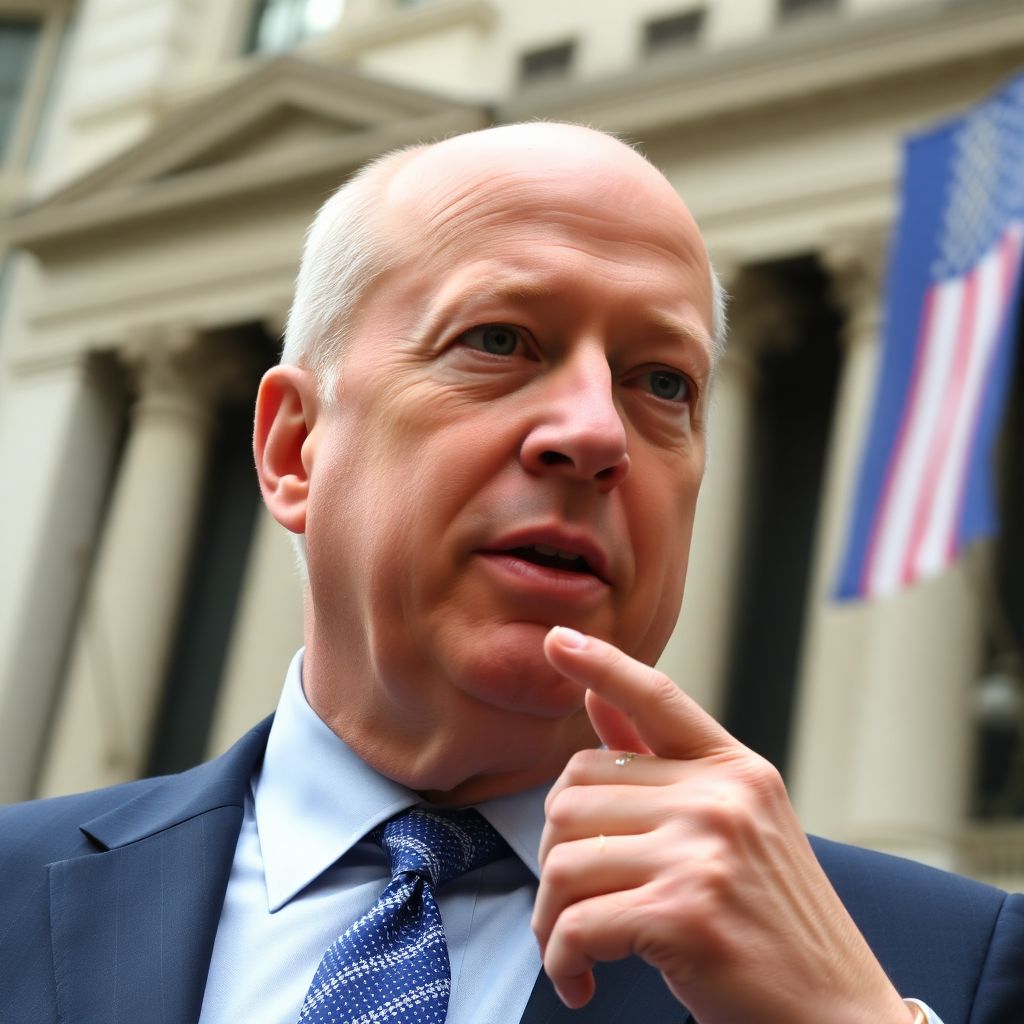
Goldman Sachs CEO Backs Crypto Clarity Act, Defying Wall Street Consensus
Goldman Sachs Chairman and CEO David Solomon has thrown his support behind the Crypto Clarity Act, setting his bank apart from many of its largest peers as Washington inches closer to reshaping how digital assets are regulated in the United States.
In an interview with Politico, Solomon said he is “very supportive of moving the Clarity Act forward,” arguing that the legislation is needed to establish a clear market structure and unlock further innovation in the sector. For one of Wall Street’s most influential executives to publicly endorse the bill marks a notable break from the more cautious – and often hostile – stance taken by other major banking leaders.
If enacted, the Crypto Clarity Act would effectively legalize most mainstream cryptocurrency activity in the U.S. by designating the majority of digital assets as non‑securities. That shift would pull many coins and tokens out from under the Securities and Exchange Commission’s jurisdiction, curbing the SEC’s ability to pursue enforcement actions against crypto firms on the grounds that they are dealing in unregistered securities.
The bill also includes protections for developers of decentralized software and protocols. Under its current language, coders building open‑source tools or permissionless platforms would face stronger legal safeguards, making it harder for regulators to hold them liable simply because others use their code for financial transactions. This point is especially sensitive in the decentralized finance (DeFi) ecosystem, where developers have long warned that aggressive enforcement could chill legitimate experimentation.
Another controversial feature of the act relates to stablecoins and yield‑bearing products. The legislation aims to clarify the framework under which stablecoin issuers and platforms can offer interest or rewards on dollar‑pegged tokens. Supporters say this would bring transparency and rigor to a fast‑growing corner of crypto markets that already operates at scale, albeit under legal uncertainty.
It is precisely these stablecoin‑yield provisions that have alarmed many traditional financial institutions. Critics on Wall Street, including banking trade groups and high‑profile executives such as JPMorgan CEO Jamie Dimon, argue that allowing regulated, interest‑bearing stablecoins to flourish could siphon deposits away from commercial banks. If customers can easily move dollars into tokenized instruments that offer competitive returns and instant, 24/7 transferability, banks fear they may see a structural decline in their core funding base.
Trade associations representing large lenders have warned lawmakers that a rapid migration of deposits into on‑chain assets could complicate credit creation, reduce the stability of bank funding, and add stress to the financial system in times of crisis. They contend that even a well‑intentioned crypto market‑structure bill risks tilting the playing field away from heavily regulated institutions and toward newer players that do not bear the same capital and compliance burdens.
Solomon’s stance suggests a different strategic calculation. By backing the Clarity Act, Goldman Sachs appears to be signaling that it sees regulated participation in digital assets as inevitable – and potentially advantageous – if the rules of the road are finally defined. For a firm that already operates at the intersection of capital markets, trading, and institutional investment, a clearer framework could open up new business lines in custody, tokenization, structured products, and advisory services around crypto.
Supporters of the Clarity Act argue that the current patchwork of enforcement‑driven regulation is untenable. With the SEC and other agencies relying heavily on lawsuits and settlements to shape industry behavior, many companies have chosen either to avoid the U.S. market or to operate in a legal gray zone. Pro‑bill lawmakers claim that this regulatory ambiguity is driving jobs, capital, and technological leadership overseas, while doing little to improve investor protection at home.
The classification of most crypto assets as non‑securities lies at the heart of this debate. If digital tokens used primarily for payments, remittances, or utility functions are clearly placed outside securities law, they would fall under the oversight of other regulators better suited to supervising commodities, payments, or market integrity. That would sharply reduce the risk that routine crypto activity is suddenly reinterpreted as a securities offering years after the fact, a scenario that has fueled high‑profile enforcement actions against exchanges and issuers.
At the same time, the act does not aim to dismantle investor protections altogether. Drafts of the bill and public commentary around it indicate that tokens explicitly structured as investment contracts – for example, those that promise profit sharing, dividends, or ownership stakes – would still be treated as securities. The distinction is intended to separate genuinely financial instruments from general‑purpose or infrastructure tokens that function more like commodities or digital utilities.
For decentralized software developers, the stakes are different but equally significant. Without clear protections, coders who write or publish smart contracts have worried that they could be prosecuted simply because those contracts are later used in lending, trading, or derivative strategies. The Clarity Act’s developer‑protection provisions would draw a line between building open‑source tools and actually operating centralized, profit‑seeking financial intermediaries. That delineation could encourage more engineers, startups, and even established firms to innovate on‑chain without constant fear of retroactive enforcement.
The stablecoin segment is likely to be one of the most immediately affected areas if the bill advances. By spelling out how dollar‑pegged tokens can be issued, backed, and integrated into financial markets, the act could institutionalize stablecoins as a mainstream settlement and savings instrument. Proponents argue this would lower transaction costs, speed up cross‑border payments, and create new ways for individuals and businesses to access yield without going through legacy banking rails.
However, the potential shift of deposits from bank accounts to tokenized dollars is not a trivial concern. Banks rely on relatively predictable, low‑cost deposits to fund lending to households and businesses. If a sizable share of that money migrates to stablecoins paying attractive returns, banks may have to rely more on wholesale funding markets, which are typically more volatile and expensive. This could, over time, affect credit availability and pricing for the broader economy.
Lawmakers weighing the Clarity Act therefore face a delicate balancing act: encouraging innovation and keeping the U.S. competitive in digital finance, while safeguarding financial stability and ensuring that new forms of money and market infrastructure are properly supervised. Solomon’s endorsement gives political cover to those who argue that the risks can be managed through smart regulation rather than outright hostility to crypto.
His position also underscores a widening split within the banking sector on how to respond to digital assets. Some institutions see crypto primarily as a threat to their deposit base, payment franchises, and fee businesses. Others, like Goldman under Solomon’s leadership, appear more focused on how to adapt and build new revenue streams by embracing tokenization, digital‑asset trading, and on‑chain capital markets under a clarified regime.
The timing of Solomon’s remarks is significant. The Clarity Act is moving closer to a possible vote in the Senate, following earlier progress in the legislative process. While passage is not guaranteed and the final language may still change, the mere prospect of a comprehensive framework has already prompted intense lobbying from banks, crypto firms, consumer advocates, and regulators.
For the crypto industry, the bill represents a potential turning point. A legal environment in which most mainstream tokens are clearly categorized, stablecoin operations are defined, and developers are protected could encourage more institutional participation and long‑term investment. That, in turn, might reduce some of the speculative excess and regulatory arbitrage that have characterized earlier cycles.
For traditional finance, the path forward is less about whether digital assets will matter, and more about how quickly they will reshape balance sheets, payment systems, and capital markets. By stepping out in favor of the Crypto Clarity Act, David Solomon has signaled that Goldman Sachs would rather help shape that future than resist it – even if that means breaking ranks with some of Wall Street’s most powerful voices.