
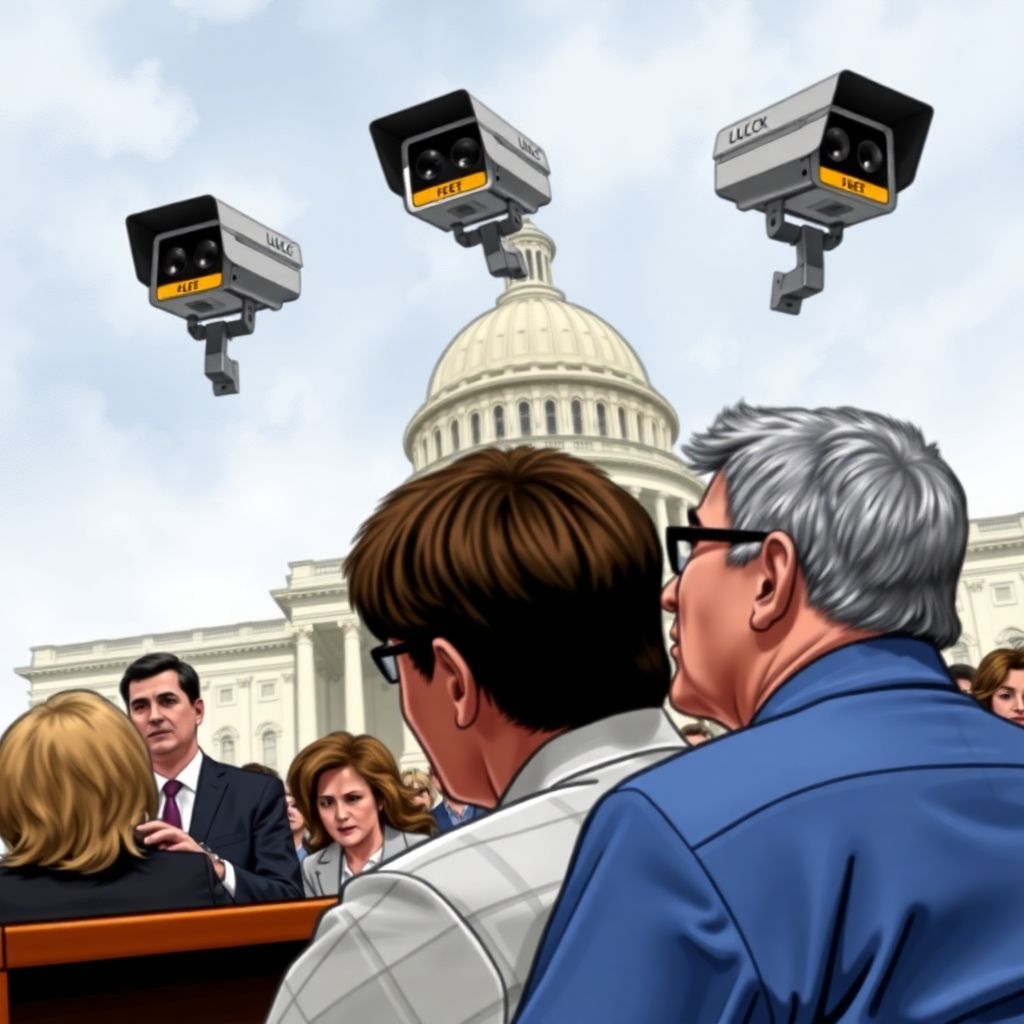
Flock Cameras Face Mounting Backlash as Privacy Fight Reaches Capitol Hill
Public resistance to automated license plate reader (ALPR) cameras from Flock Safety is no longer confined to local hearings and neighborhood meetings. The controversy has now arrived in Washington, where lawmakers are weighing how far a private surveillance network should be allowed to reach when it is heavily financed and used by government agencies.
Representative Thomas Massie has announced plans to introduce legislation that would cut off federal funding for departments and agencies that deploy Flock’s technology. If successful, the move would not ban the cameras outright, but it would make it significantly harder for law enforcement to expand-or even maintain-large-scale ALPR systems backed by federal dollars.
At the heart of the debate is a simple question with far‑reaching implications: are Flock’s cameras a powerful crime‑fighting tool, or a turnkey infrastructure for constant location tracking of millions of people who have done nothing wrong?
From crime‑fighting to constant tracking
Flock Safety markets its cameras as a way to help police solve crimes, recover stolen vehicles, and locate missing persons. The devices capture license plate numbers, vehicle characteristics, time, date, and location as cars pass by. That data is automatically stored in databases that can be searched by law enforcement and, in many cases, shared across jurisdictions.
Critics say the reality goes well beyond targeted investigations. In communities where dozens or even hundreds of cameras have been installed, simply driving to work, taking a child to school, or visiting a doctor can generate a persistent, searchable record of a person’s movements. Once collected, that information can be queried retroactively, building a detailed picture of daily routines, social connections, and sensitive destinations such as houses of worship, clinics, or political events.
Civil liberties advocates warn that such systems invert the traditional model of policing. Instead of identifying suspects and then seeking judicial authorization to gather evidence, the cameras vacuum up data on everyone first-and only later is that data matched to people of interest. That, they argue, edges dangerously close to a form of generalized, suspicion‑less surveillance.
Evidence of misuse is mounting
Concerns about Flock’s cameras have shifted from hypothetical to concrete as more cases of abuse have come to light. A report by the Institute for Justice documented more than two dozen incidents across the United States in which police officers allegedly misused automated license plate reader systems to stalk current or former romantic partners.
In these cases, officers were accused of running searches on vehicles connected to ex‑partners or people with whom they had personal relationships, with no legitimate law‑enforcement purpose. According to the report, the misconduct was serious enough in several jurisdictions that officers resigned, were disciplined, or were arrested.
In one notable episode earlier this year, prosecutors in Milwaukee charged a police officer in connection with alleged improper use of ALPR tools. While details of the case are still emerging, the fact that a misuse complaint led to criminal charges illustrates how seriously some authorities now view the risk of abuse when officers have powerful surveillance systems at their fingertips.
Critics argue that these incidents are almost certainly the tip of the iceberg. Because many departments lack robust auditing, independent oversight, or transparent reporting, improper queries may never be detected-let alone punished.
A private surveillance network with public backing
Another source of unease is the structure of Flock’s business model. Flock is a private company that builds and operates the camera network, but the vast majority of its customers are government entities: local police departments, sheriff’s offices, and, in some cases, federal task forces and agencies.
That arrangement raises difficult questions about accountability and control. The data is generated in public spaces, yet it flows into systems that are partly governed by corporate contracts and terms of service rather than by clear, democratically debated rules. Opponents worry that this blurs the line between public law enforcement and a privately owned surveillance infrastructure.
Because Flock can interconnect participating jurisdictions, data captured in one town can be searchable by officers halfway across a state-or beyond-depending on how sharing agreements are configured. That kind of interoperability may help investigators track stolen vehicles as they cross county lines, but it also increases the scale and permanence of the surveillance net.
Why Capitol Hill is getting involved
The move by Rep. Massie underscores how quickly ALPR technology has traveled from a niche law‑enforcement tool to a nationwide infrastructure with national‑level implications. By targeting federal funding rather than the technology itself, the proposed legislation tries to address what critics see as a perverse incentive: as long as grants are available, agencies may feel pressured to adopt more surveillance hardware than they truly need.
Supporters of the cameras, including many law‑enforcement officials, argue that the backlash is misplaced. They say ALPR systems have helped solve violent crimes, recover kidnapped children, and find elderly people with dementia who have gone missing. In their view, turning off the spigot of federal money would weaken an important investigative resource.
Opponents counter that no technology should be given a blank check simply because it can be used for good. They call for strict limits on how long data is stored, clear rules about who can access it and for what purposes, and legally enforceable bans on sharing data for non‑criminal uses such as tracking people for debt collection, immigration enforcement, or commercial profiling.
The constitutional and legal fault lines
Underlying the policy fight is an unresolved legal question: does mass license plate scanning amount to a “search” under the Fourth Amendment, which protects against unreasonable searches and seizures?
Courts have long held that individuals have a diminished expectation of privacy in their movements on public roads. However, recent Supreme Court decisions have suggested there may be a constitutional difference between an officer seeing your car pass by and a system that automatically records and stores every trip you take for months or years.
Flock and its defenders tend to emphasize that license plates are visible to anyone and that the cameras merely automate what an officer could lawfully observe. Privacy advocates respond that automation at this scale changes the nature of the surveillance. A single officer cannot remember the comings and goings of thousands of vehicles over long periods; a network of cameras, paired with searchable databases and analytic tools, effectively can.
As more local governments adopt ALPR technology, the chances increase that federal courts will be forced to clarify how constitutional protections apply to these systems. That legal uncertainty makes the current push for legislative limits even more urgent in the eyes of critics.
What communities are weighing
Across the country, local officials are reconsidering the trade‑offs of Flock’s cameras. Some jurisdictions have delayed renewals of Flock contracts or declined new installations after hearing concerns from residents, technologists, and privacy advocates. Others have moved ahead, but with tighter internal policies on access, auditing, and data retention.
Typical questions being debated include:
– How long should license plate scans be kept-days, weeks, months, or longer?
– Should searches require a documented investigative reason tied to a case number?
– Which agencies, if any, should be allowed to access shared databases across jurisdictions?
– What penalties should officers face for running unauthorized searches?
The answers vary widely, creating a patchwork of practices. In some places, Flock data is retained for only a short time and heavily audited; in others, it can persist for months and be accessed with minimal oversight. That inconsistency is one reason national lawmakers are now paying closer attention.
The risk of mission creep
Even if ALPR systems are initially introduced for a narrow set of purposes-such as locating stolen cars-there is a persistent fear of “mission creep.” Once the infrastructure exists, the temptation grows to use it for new goals that were not part of the original justification.
Examples of potential mission creep include using license plate data to track people attending protests, identifying visitors to specific clinics, or monitoring the movements of political opponents. While Flock states that its technology is designed to support legitimate law‑enforcement investigations, critics argue that policies and promises can be quietly revised or ignored over time, especially if there is little independent oversight.
The presence of a privately run, rapidly scalable system only intensifies those worries. If ALPR networks become deeply embedded in everyday policing, rolling them back-or even reforming them-may become politically and logistically difficult, regardless of public unease.
Data security and breach concerns
Another layer of risk involves what happens if the data is stolen or leaked. Large pools of location information are attractive targets for hackers, rogue insiders, or anyone seeking to profile individuals based on where they go and when.
If ALPR databases were compromised, detailed travel histories of ordinary people could fall into the hands of criminals, stalkers, or data brokers. Unlike a password, location history cannot simply be “reset.” Once exposed, that information may be impossible to claw back.
Critics argue that any serious discussion of ALPR policy must account for the possibility of data breaches and the long‑term consequences of exposing large‑scale movement patterns. They urge mandatory security standards, independent audits, and clear notification requirements when data is improperly accessed.
What reform could look like
As the backlash grows, a spectrum of reform proposals is emerging rather than a single, all‑or‑nothing solution.
Some advocates want strict, nationwide rules governing how ALPR data is used, retained, and shared, while still allowing police to maintain limited networks. Others argue that the only way to avoid abuse and mission creep is to phase out systems like Flock’s entirely, except in very narrow contexts such as temporary deployments during active Amber Alerts.
Potential compromise measures include:
– Short data‑retention windows, such as 7 to 30 days, with longer retention allowed only by court order.
– Mandatory logging and regular independent audits of every search, with penalties for unauthorized queries.
– Explicit bans on using ALPR data for immigration enforcement, political intelligence, or civil matters unrelated to serious crimes.
– Transparency reports detailing how often the systems are used, for what kinds of investigations, and with what outcomes.
Whether Rep. Massie’s funding proposal gains traction or not, the growing clamor around Flock’s cameras makes clear that the era of largely unregulated automated license plate surveillance is ending. The next phase-figuring out what guardrails should replace it-will determine how much privacy Americans can retain while driving on roads that are increasingly watched, logged, and analyzed.
The broader question: what kind of infrastructure do we want?
Ultimately, the Flock debate is less about any single company and more about the kind of technological infrastructure societies choose to build. ALPR cameras are just one piece of a much larger puzzle that includes facial recognition, ubiquitous CCTV, smartphone tracking, and vast commercial data markets.
Once a country installs always‑on systems that document the movements of nearly every vehicle, dialing back that capability is difficult. The decisions being made now-in city halls and on Capitol Hill-will shape whether the default condition on American roads is anonymity in motion or perpetual traceability.
As lawmakers craft funding rules and communities reevaluate contracts, they are not only deciding how to regulate one company’s cameras. They are setting precedents for how far surveillance technology can reach into everyday life, and what, if any, meaningful limits will protect the privacy of ordinary people going about their daily routines.