
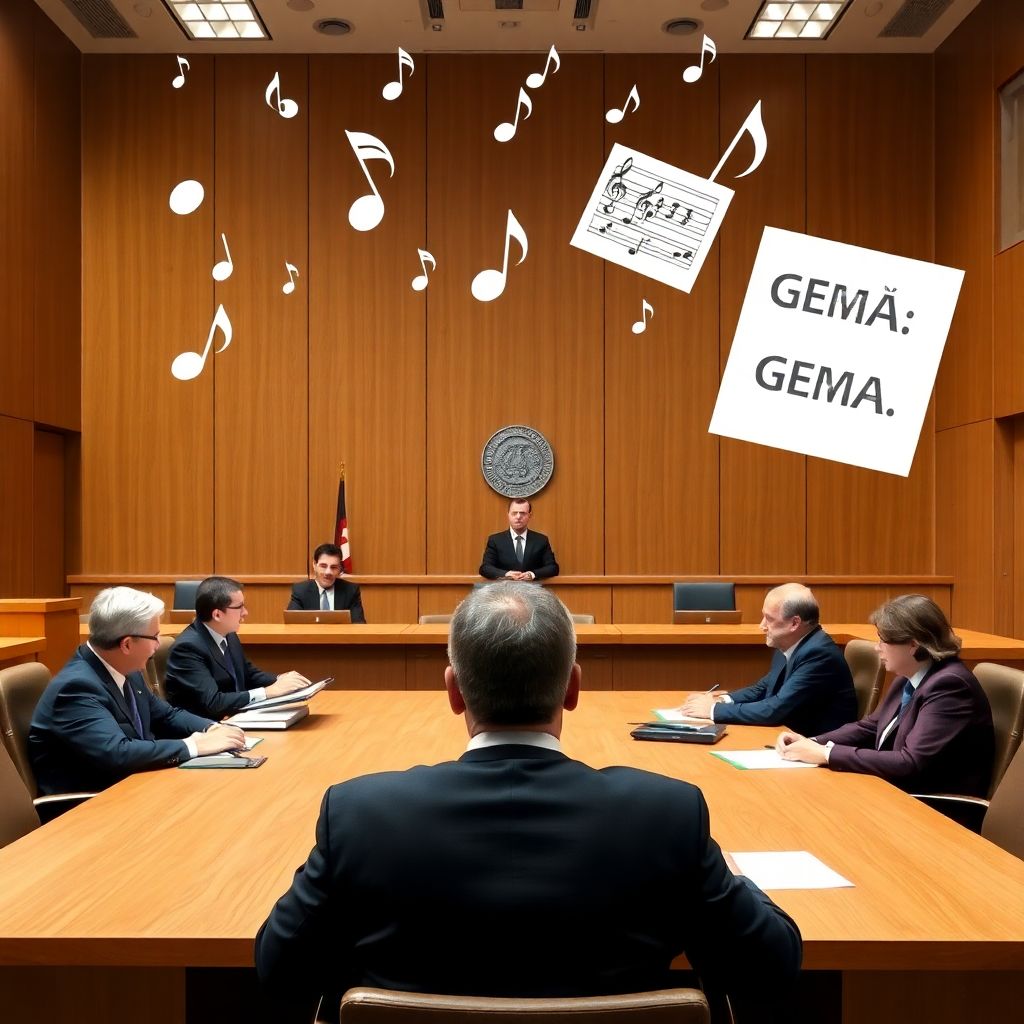
AI music generator Suno suffers legal setback in Germany as court backs rights holders
A regional court in Munich has ruled that AI music startup Suno infringed copyright law by training its models on protected works and generating new tracks using material from the catalog of German rights organization GEMA without permission. The decision significantly raises the bar for how AI music companies operating in Europe must handle licensed content, effectively confirming that commercial AI systems cannot freely ingest copyrighted music for training or output generation without proper authorization.
According to the ruling, Suno unlawfully used songs represented by GEMA in two ways. First, by feeding works from GEMA’s repertoire into its training pipeline without a license. Second, by allowing its AI to reproduce elements of protected compositions and recordings in the music generated for users. The court concluded that both training and output stages constitute uses that fall under copyright law and therefore require explicit licensing when done for commercial purposes.
The lawsuit focused on six well-known tracks, including “Daddy Cool,” “Rasputin,” “Forever Young,” and “Mambo No. 5.” These songs were cited as examples of works whose rights GEMA administers and which, according to the complaint, were used by Suno to build and refine its AI models. GEMA argued that Suno never obtained the necessary permissions to make such use of its catalog, despite directly benefiting from the creative labor embodied in those songs.
GEMA’s core claim was straightforward: Suno allegedly trained its AI system on copyrighted music without any contractual agreement or payment to the creators and rights holders. By doing so, the organization argued, Suno effectively built a commercial product on top of a body of protected work, then allowed users to generate new tracks that could echo or reproduce important elements of those originals. The court sided with this interpretation, emphasizing that the lack of a license was not a technical or minor oversight but a direct violation of copyright rules.
Suno, for its part, tried to frame its technology as a tool for creativity rather than a mechanism for copying. The company has maintained that its platform is designed to help users compose and produce original songs, not to recreate existing hits or clone the work of famous artists. It has argued that AI systems, when properly configured, generate new outputs rather than direct reproductions, and that the innovation they enable should be recognized and protected. However, the Munich court found that this general intention did not override the legal requirement to license protected content used in training and output.
A crucial element of the judgment is its explicit statement that AI companies must secure licenses for both stages of their business: the ingestion of copyrighted works for training and the commercial use of those models to generate new music. In practice, this means that simply claiming “transformative” or “innovative” use is not enough. If the training data includes copyrighted songs and the service is offered commercially, a license must be in place. This mirrors an increasingly clear trend in European jurisprudence: training data is not outside the scope of copyright.
For music rights holders, the decision is a substantial win. Organizations representing songwriters, composers, and publishers have long argued that AI systems are building vast, valuable models on top of their catalogs without compensation. By reinforcing that GEMA’s repertoire cannot be freely mined for training, the court has effectively strengthened the bargaining position of collecting societies and labels when negotiating with AI music platforms. It also sends a signal that “data scraping” of music for AI is not a legal gray zone in Germany-at least not when commercial use is involved.
For Suno and similar AI startups, the implications are serious. The ruling suggests that any company training large-scale generative models on third-party music will have to invest heavily in licensing deals if it wants to operate in Germany-or, by extension, in other European markets that may follow a similar line of reasoning. That could dramatically increase operating costs, limit the scope of available training data, or force AI developers to rely on smaller, fully licensed datasets and partnerships with specific rights holders.
The decision also highlights a broader fault line between tech companies and the creative industries: whether training on copyrighted material can be considered a form of fair or permitted use, or whether it is more akin to large-scale, unlicensed copying. While some AI advocates claim that models learn “patterns” rather than storing songs, many rights holders argue that the distinction is artificial when the resulting tool can generate music that strongly resembles existing works or exploits the same melodic and harmonic ideas in a commercially valuable way.
From a regulatory perspective, the German ruling slots into a wider European push to subject AI development to stricter controls. Even before this case, policymakers in Europe have been moving toward rules that require transparency around training data and stronger protections for creators whose works are used by AI systems. Court decisions like this one give those efforts more legal weight, demonstrating that existing copyright law can already be used to constrain unlicensed AI training and that new AI-specific regulations will not emerge in a vacuum.
The case also underscores a growing practical challenge: how to prove that a particular AI model was trained on specific copyrighted works. In this instance, the lawsuit targeted a small set of famous songs and linked them to Suno’s training practices. Going forward, rights holders may push for greater technical disclosure, including logs, documentation, or model audits that show which catalogs were used. AI companies, in turn, will likely resist extensive transparency on the grounds of trade secrets and competitive advantage, setting up further legal battles over access to training data details.
For musicians and songwriters, the judgment may be seen not only as a legal victory but as a symbolic affirmation that their work retains economic and moral value in the age of AI. Many artists worry that AI-generated tracks will flood digital platforms, undermine the earning potential of human-made music, and dilute the distinctiveness of original creativity. By insisting that AI developers must pay to use professional catalogs, courts are effectively recognizing that creative labor cannot simply be treated as free fuel for algorithms.
At the same time, the ruling does not ban AI music outright. It instead sketches out a more constrained path: AI companies can still innovate, but they must do so within a licensing framework that compensates rights holders. This opens the door to new business models, such as fully licensed AI co-writing tools, label-backed AI composition platforms, or “safe” training environments where only cleared content is used. For startups willing to engage with the industry rather than bypass it, the result could be a more stable and predictable environment for AI-driven music creation.
The judgment will likely resonate beyond Germany. Other European courts and regulators are watching high-profile AI copyright disputes closely as they shape their own approaches. While legal standards may differ across jurisdictions, a clear pattern is emerging: the more commercial and large-scale the AI system, the stronger the expectation that it must respect existing intellectual property rules. Suno’s setback in Munich may therefore influence how investors, developers, and rights organizations negotiate in other key markets as well.
In practical terms, AI music platforms now face strategic decisions. They can attempt to negotiate broad, multi-territory licenses with collecting societies and major rights holders, though that path may be costly and complex. Alternatively, they might pivot toward user-generated or royalty-free catalogs, which are cheaper but offer less appeal to users who want AI tools informed by the sound of mainstream hits. Some companies may also explore hybrid approaches-combining licensed catalogs with original stems, loops, and instrument libraries to reduce exposure to litigation.
Ultimately, the Suno case illustrates that the collision between rapid AI innovation and long-standing copyright frameworks is far from resolved. Courts are being asked to decide whether the benefits of generative AI justify new exceptions or whether existing law already provides the right balance between innovation and protection. In Germany, at least in this instance, the answer is clear: if AI is built on top of copyrighted music and used commercially, those underlying works cannot be treated as free raw material.