
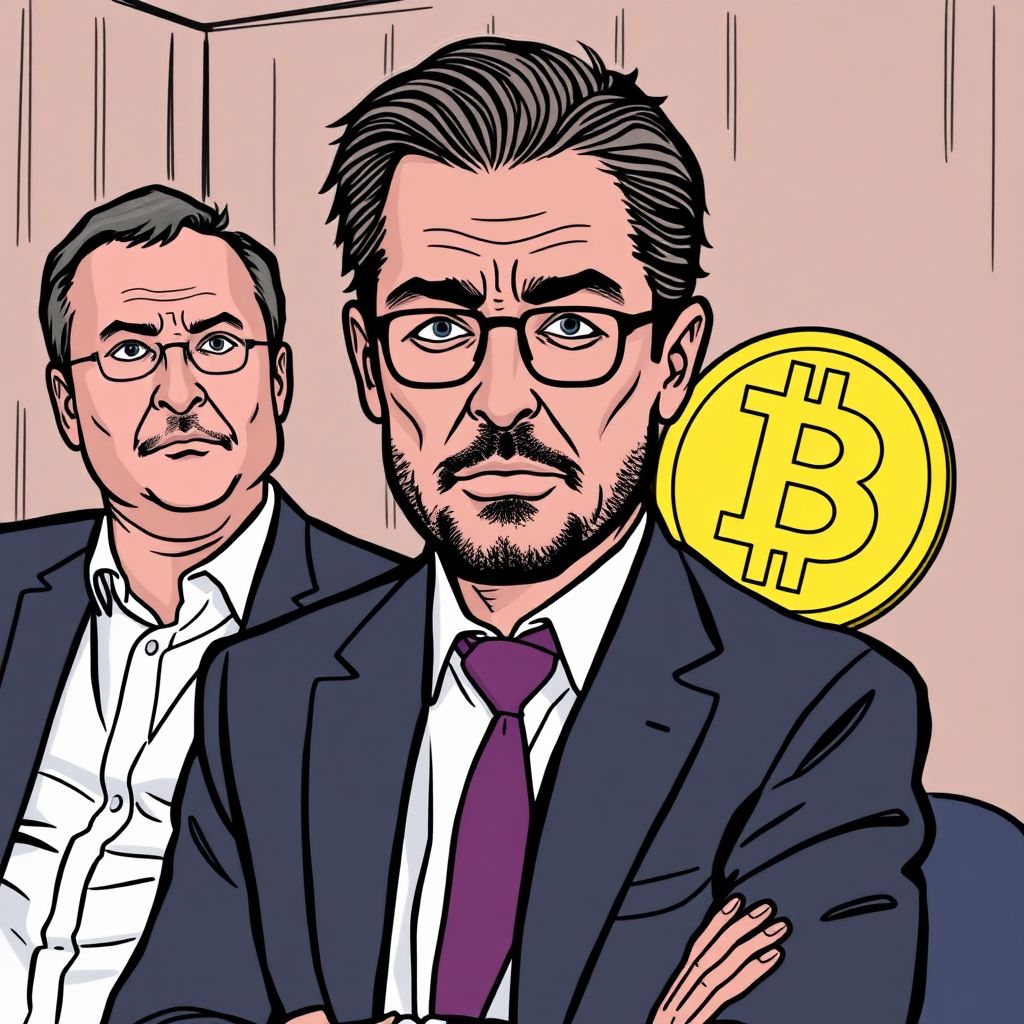
DAT Went Wrong: Satsuma Dismantles Its Bitcoin Treasury and Prepares $43 Million BTC Sell-Off
Shareholders of Satsuma Technology, a United Kingdom-based Bitcoin treasury vehicle, have voted to completely unwind the firm’s Bitcoin holdings and close the business, effectively killing off one of the more high‑profile digital asset treasury (DAT) experiments of the past few years.
In a decisive outcome, more than 90% of voting shareholders backed a pair of resolutions: to liquidate Satsuma’s entire stash of 668 BTC-valued at roughly $43.5 million-and to remove the company from the London Stock Exchange. The results were disclosed in a regulatory filing on Monday, confirming that investors chose to override the wishes of most of the company’s own board.
Despite opposition from four of Satsuma’s six directors, the shareholder bloc carried the day. That rebellion underscores just how swiftly sentiment can turn when market conditions, expectations, or business narratives stop aligning with investors’ priorities. For Satsuma, it marks a full reversal from its earlier ambition to position itself as a long‑term Bitcoin balance‑sheet play.
The decision effectively brings an end to Satsuma’s experiment as a DAT-the shorthand used for listed companies whose primary function is to hold digital assets like Bitcoin on behalf of shareholders. DATs were promoted as a way for traditional investors to gain exposure to crypto via familiar equity market structures, especially in jurisdictions where direct access to spot Bitcoin products was limited or heavily regulated.
Satsuma’s path to becoming a Bitcoin treasury vehicle was anything but linear. The company originally launched as TAO Alpha, a modest artificial intelligence firm. Only later did it pivot away from AI and rebrand as Satsuma Technology, recasting itself around a Bitcoin-centric strategy and treasury narrative rather than a conventional operating business.
As part of that transformation, Satsuma brought in Mark Moss in August 2025 as its Chief Bitcoin Strategist. Moss, an American Bitcoin commentator with a large online following-more than 700,000 subscribers on his video channel-built his profile by analyzing macro trends and advising institutions on integrating Bitcoin into their portfolios. His appointment was intended to lend credibility to Satsuma’s thesis that a listed company could function primarily as a professionally managed Bitcoin balance sheet.
Notably, Satsuma had raised around $218 million less than a year before shareholders opted to pull the plug. That capital, raised on the promise of building out a Bitcoin treasury and related strategy, now stands in stark contrast to the company’s rapid change of direction. With only about $43.5 million in BTC remaining, investors are voting to reclaim what is left rather than continue the experiment.
The unwinding of Satsuma’s treasury will mean a structured sale of 668 BTC into the market. While this amount is small relative to Bitcoin’s total daily trading volume, such liquidations can still influence short‑term liquidity conditions, depending on how and over what timeframe the sales are executed. The company has not publicly detailed the exact schedule or methods it will use to offload the coins, but a gradual approach is typically favored in order to avoid unnecessary slippage.
For shareholders, the resolution to liquidate is fundamentally about exit value. Many likely concluded that simply holding Satsuma stock as a proxy for Bitcoin no longer offered a compelling advantage, especially as direct access to Bitcoin products and spot-based instruments has expanded globally. In that context, winding down the DAT structure and distributing value directly is an attempt to close the discount between the firm’s net asset value and its share price.
The board’s pushback against the liquidation suggests that Satsuma’s leadership still believed in the long‑term viability of its Bitcoin treasury strategy. Boards often argue for patience, positioning digital asset treasuries as multi‑year plays tied to broader macro and adoption cycles. But when a supermajority of shareholders opt for an immediate payout, governance norms give their preference priority, even over strategic visions championed internally.
Satsuma’s collapse is emblematic of a broader cooling of enthusiasm for the DAT model that surged in popularity around 2025. In the early days, these entities were marketed almost like publicly traded Bitcoin vaults, allowed to raise capital on stock exchanges and then deploy that capital into BTC as a core treasury reserve. The pitch was straightforward: buy the stock, get exposure to Bitcoin plus professional management and regulatory oversight.
However, in practice, many DATs struggled with persistent discounts to net asset value, inconsistent communication about strategy, and unclear value propositions beyond simply “holding Bitcoin.” When investors can access Bitcoin more directly-through regulated exchanges, ETFs, or institutional custodians-the advantage of an intermediary company becomes far less obvious. Satsuma now joins a growing list of DATs that have either quietly pivoted, downsized, or wound down entirely.
The shareholder revolt at Satsuma also highlights a critical risk for anyone betting on publicly listed Bitcoin treasuries: governance can be just as important as market conditions. Even if Bitcoin’s long‑term outlook appears promising, the structure of a DAT leaves the fate of its holdings in the hands of shareholders who may choose to liquidate at a time that does not align with maximal price appreciation or with the stated long‑term thesis.
For institutional investors who were drawn to Satsuma’s premise, the episode offers several lessons. First, exposure route matters: being “indirectly” long Bitcoin through a corporate vehicle is not the same as holding Bitcoin directly or via a dedicated fund. Second, alignment between management and shareholders must be clear from the start-especially around time horizons, risk tolerance, and what circumstances could trigger a winding‑up event. Third, market cycles can challenge even well‑articulated narratives, and capital raised on the back of one narrative can quickly become restless when reality diverges.
For retail investors, the story underscores the importance of understanding what sits behind a ticker. A company that appears to offer Bitcoin exposure through its balance sheet may also be subject to corporate shifts, governance fights, or strategic pivots that are not immediately visible from day‑to‑day price movements. Reading filings, tracking shareholder proposals, and monitoring board composition become crucial when a company’s primary asset is volatile and controversial.
Looking ahead, the demise of Satsuma in its current form does not necessarily spell the end for all Bitcoin treasury strategies. It does, however, raise the bar for what investors will accept. Companies that simply promise to hold Bitcoin and ride the cycle may find it harder to justify their fees, structures, and listing costs. To survive, similar entities may need to combine Bitcoin holdings with clear operational businesses, yield‑generating strategies, or differentiated services that go beyond passive accumulation.
Regulators and market operators will also be watching how the Satsuma liquidation unfolds. The process will provide another data point on how effectively digital asset exposures can be unwound within traditional capital market frameworks. Smooth execution and transparent communication might help keep the door open for more sophisticated, better‑designed Bitcoin vehicles in the future. A disorderly or controversial unwind, by contrast, could make regulators and exchanges more cautious about similar listings.
For the Bitcoin market itself, Satsuma’s exit is more symbolic than systemic. The quantity of BTC involved is too small to materially affect long‑term supply dynamics. Yet symbolism matters. Each high‑profile retreat from experimental Bitcoin corporate structures can influence how conservative capital views the asset class-either as a maturing market shedding weak models, or as a sign of continuing instability in the ways crypto integrates with traditional finance.
Ultimately, Satsuma’s journey-from AI startup TAO Alpha to Bitcoin treasury vehicle and now to dissolution-captures the volatility not just of crypto prices, but of crypto‑driven business models. The DAT trend that seemed so compelling in 2025 is now facing a reality check, and Satsuma’s shareholders have delivered a clear verdict: when the thesis breaks down or the structure no longer offers an edge, cashing out whatever is left can look more attractive than holding the line.