
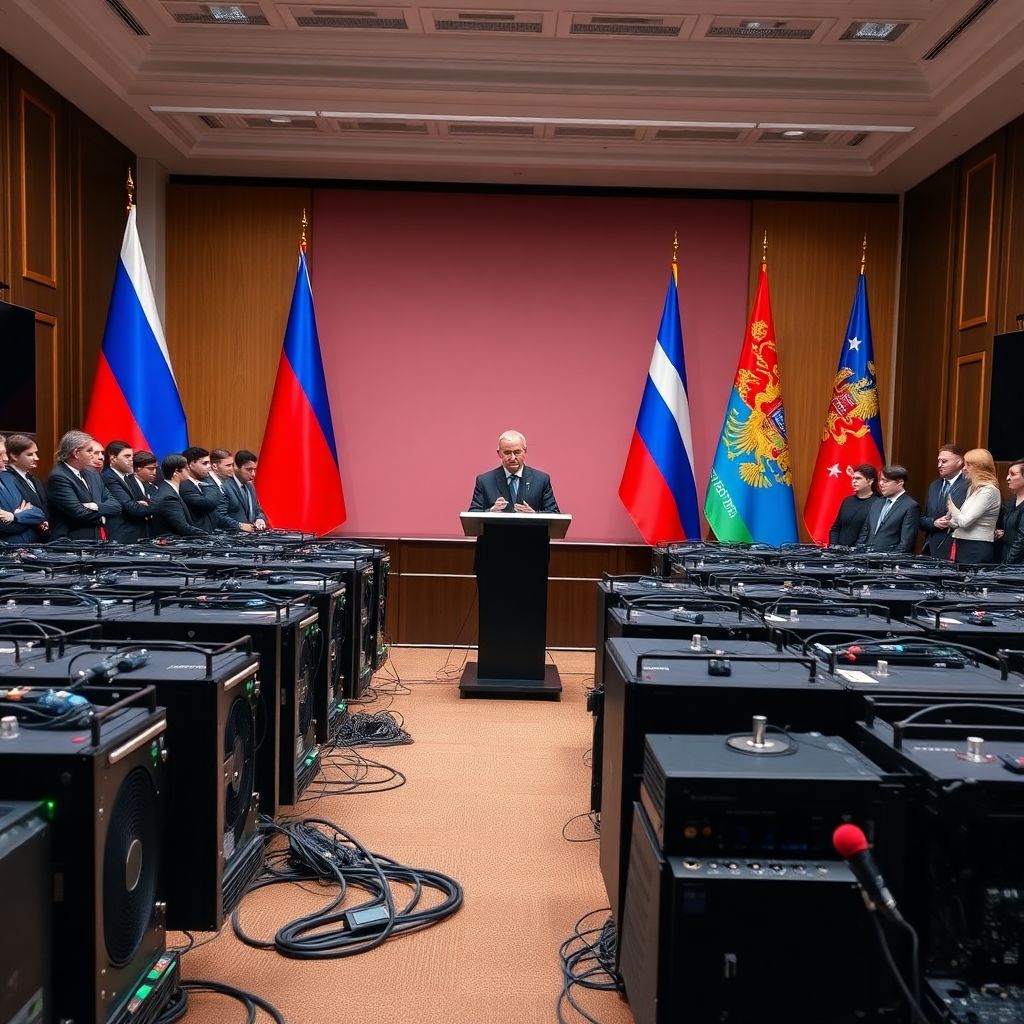
Russia will halt industrial and retail crypto mining in Moscow, the wider Moscow Region and nine territories in the Kursk Region starting Aug. 15, 2026, extending the country’s regional clampdown on energy‑intensive mining operations until at least the end of 2032.
The new restrictions are formalized under Government Resolution No. 936, signed by Prime Minister Mikhail Mishustin on July 25 and officially published on July 31. The act modifies Resolution No. 1869 of December 2024, which first introduced territorial curbs on crypto mining in selected Russian regions.
Under the updated rules, mining of digital currencies and participation in mining pools are banned throughout the city of Moscow and the entire Moscow Region. In the Kursk Region, the prohibition targets the Belovsky, Bolshesoldatsky, Glushkovsky, Korenevsky, Lgovsky, Rylsky, Sudzhansky and Khomutovsky municipal districts, as well as the city of Lgov.
Rather than creating a blanket, nationwide ban, the government has opted to expand an existing list of restricted regions. Moscow, the Moscow Region and the specified Kursk territories are simply added as new entries within the same regulatory framework that already applies to other parts of the country. This preserves Russia’s hybrid approach: mining is legal in principle, but can be shut out of regions where authorities see a risk to the power grid.
The Energy Ministry, in its explanatory notes to the decree, warned that allowing large‑scale mining facilities to operate year‑round in these areas could produce a “shortage of power capacity.” Crypto mining farms draw continuous high loads, which complicate grid planning and leave less reserve capacity to cover peak demand, emergencies or new industrial projects.
Energy officials in the Moscow Region had actively pushed for the ban before it was adopted. By their estimates, miners already account for roughly one gigawatt of consumption within the broader Moscow power system. At the same time, data center capacity in Moscow and surrounding areas is projected to climb to 3.6 gigawatts by 2032, equivalent to around 17% of the system’s maximum expected load. That 2032 figure is a forecast, not a current metric, but it illustrates why planners are nervous about further strain from mining.
Local authorities in the Kursk Region voiced similar concerns, requesting restrictions for eight districts and the city of Lgov to protect regional electricity infrastructure. The final version of the decree mirrors the earlier proposal, indicating that federal officials largely accepted the regional assessment without major changes.
These new measures build on a policy direction set after Russia formally legalized crypto mining in 2024. Legalization was quickly followed by geographically targeted limitations aimed at managing chronic electricity shortfalls and smoothing out seasonal consumption spikes. Officials have repeatedly argued that permitting mining everywhere would force costly grid upgrades or heighten the risk of blackouts during peak loads.
Prior rules already covered several republics in the North Caucasus and other territories, with restrictions there running until March 15, 2031. From April 1, 2026, the government also imposed year‑round bans across parts of Buryatia and Zabaykalsky Krai. According to the Energy Ministry, those measures apply to 20 municipalities in Buryatia and 31 in Zabaykalsky Krai, confirming that the list of restricted zones has been growing steadily since 2025.
In May, a federal commission overseeing the power sector backed the proposal to extend the mining ban to Moscow and parts of the Kursk Region. That endorsement effectively cleared the way for Cabinet approval, even as lawmakers debated separate measures to penalize mining operations that fail to register with the state.
Russia has been building an official registry of miners designed to distinguish between compliant, registered businesses and unregistered or “shadow” operations. The registry underpins a dual strategy: mining remains legal for entities that disclose their operations and meet technical requirements, while unauthorized facilities are increasingly targeted with caps, inspections and now geographic bans.
For operators already active in the newly restricted regions, the timeline is tight. Mining businesses must halt local operations or relocate their equipment by Aug. 15, 2026 – just 15 days after the regulation’s publication. The prohibition applies both to direct cryptocurrency mining and to participation in mining pools routed through facilities in the affected territories, closing an obvious loophole.
The order is currently set to expire after Dec. 31, 2032, unless the government decides to amend or extend it. The resolution does not include an official estimate of how much mining capacity will be impacted, how many companies will need to move, or how much hardware will be redeployed to other regions or countries.
Because of this lack of concrete data, it is not yet possible to accurately assess how much the Moscow‑area shutdown will influence Bitcoin’s global hash rate or network security. Russia is a meaningful player in global mining, but the share specifically attributable to Moscow and the targeted Kursk districts is unclear. Any claims that the ban will significantly reshape global mining metrics remain speculative until there is hard evidence from mining pools and network statistics.
For Russian miners operating in or near the capital, the decision forces difficult choices. Large industrial players may try to shift their rigs to regions that remain open to mining, both inside Russia and abroad. Smaller operators, especially those who set up equipment in residential or office buildings to take advantage of subsidized electricity, face a higher risk of simply shutting down, given the costs of moving and re‑installing hardware.
The policy may also accelerate a broader geographic realignment of Russian mining. Regions with surplus generation capacity, particularly those near large hydroelectric or thermal plants, could become more attractive as official “mining hubs” if local authorities welcome new investment. At the same time, areas already complaining about grid stress may push for their own restrictions, using the Moscow and Kursk bans as precedent.
From the state’s perspective, concentrating mining in energy‑rich regions has several advantages. It simplifies grid management, makes it easier to monitor and tax mining businesses and reduces the chance that overloaded distribution networks in major cities will fail. It also aligns with the country’s ambition to develop data centers and other digital infrastructure in a more controlled, planned way instead of allowing mining to compete for capacity in the most economically active regions.
For residents and traditional businesses in Moscow and Kursk, the authorities are framing the ban as a protective measure. Officials argue that limiting mining ensures more stable electricity supply, lowers the risk of emergency outages and frees up capacity for households, industry, transport and public services. In a city like Moscow, where demand is already dense and rising, even a few percentage points of freed capacity can be politically and economically significant.
On the regulatory front, the evolving restrictions highlight Russia’s attempt to strike a balance between harnessing mining as a source of investment and foreign currency, and maintaining control over its energy system. By allowing mining in some territories and blocking it in others, the government retains flexibility to respond to both economic conditions and power‑sector constraints, without committing to a full nationwide ban or unconditional liberalization.
Internationally, Russia’s approach fits into a wider pattern. Many countries with cheap energy or excess capacity initially welcomed crypto mining, only to tighten rules once grid stress, environmental concerns or public backlash emerged. The Russian case stands out mainly because the country is simultaneously building a formal regulatory architecture for mining – including registration and possible taxation – while aggressively fencing off its largest metropolitan area.
In the months following Aug. 15, observers will watch not only how strictly the new rules are enforced, but also where the displaced capacity goes. If a significant share of Moscow‑based mining relocates within Russia, the overall national hash contribution may remain stable while certain regions gain new economic activity. If operators choose instead to move abroad, the shift could further bolster mining clusters in countries already courting Russian miners with lower costs and clearer rules.
For now, the decisive milestone remains the enforcement date. Once the ban takes effect in Moscow, the Moscow Region and the specified zones of Kursk, the practical impact on local miners, the Russian power grid and, potentially, the global mining landscape will become clearer through actual shutdowns, relocations and future regulatory guidance from federal and regional energy authorities.