
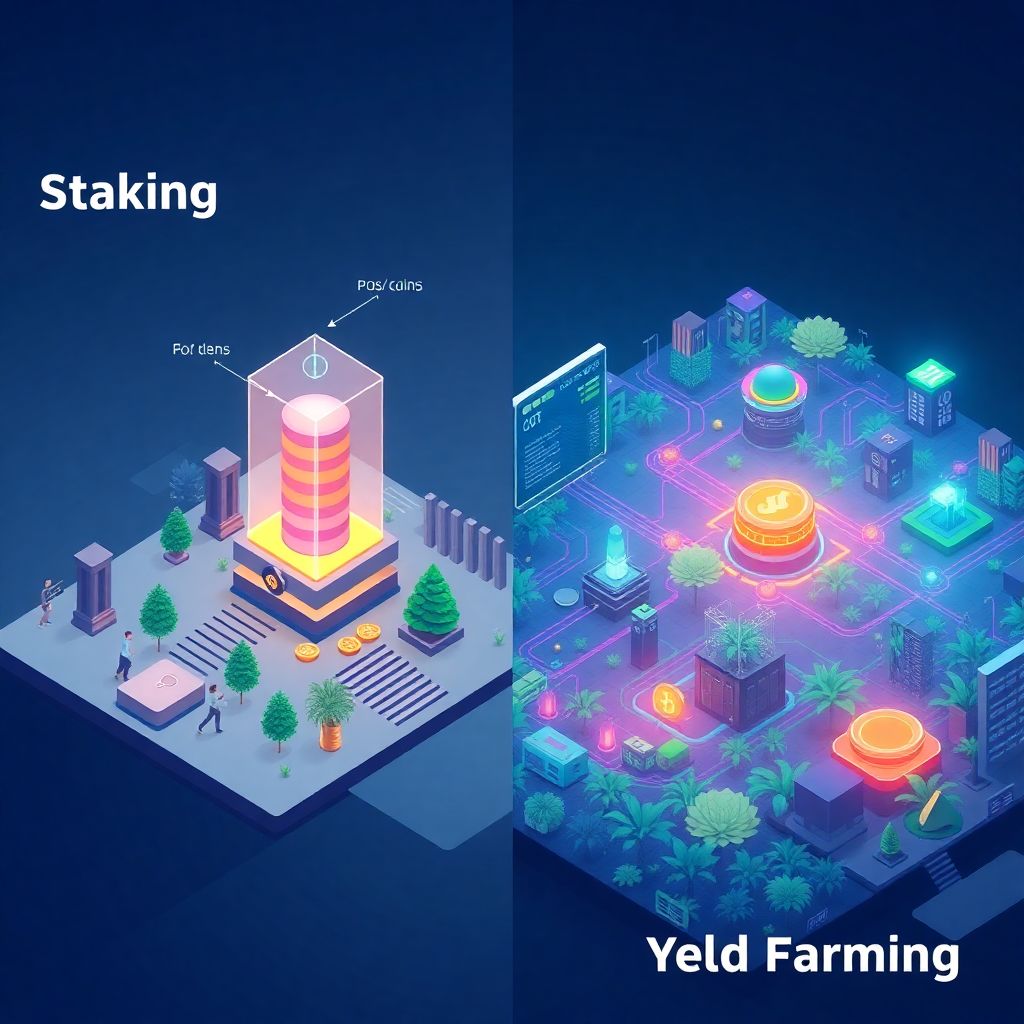
Before you throw money into any DeFi pool, it’s worth answering a simple question: is it smarter to start with plain staking or jump straight into yield farming crypto investment strategies? Both promise passive income, both use smart contracts, and both are heavily marketed. But the level of complexity, risk, and attention they demand is very different.
Below we’ll walk through how each approach evolved, how they work under the hood, where you can actually use them in practice, and where people most often get confused when comparing yield farming vs staking for the first time.
—
Historical Background: How We Got from Staking to Yield Farming
At the beginning, earning on crypto was simple: either you mined coins with hardware or you just held them, waiting for the price to grow. When Proof-of-Stake (PoS) and Delegated Proof-of-Stake (DPoS) networks appeared, they brought a new model: instead of burning electricity, you “lock” tokens to help secure the network and get rewarded. Early best crypto staking platforms were often native wallets or on-chain mechanisms like Tezos baking or early Cosmos and EOS validators. The process was relatively transparent: you delegate your coins, they participate in block validation, you get block rewards minus validator fees.
Yield farming arrived much later as DeFi exploded in 2020. Protocols like Compound and then Uniswap and Curve started rewarding users not just with trading fees or borrowing interest, but also with governance tokens. Liquidity mining campaigns multiplied, APR numbers shot up, and capital flooded into pools. What used to be a boring “stake and forget” model turned into a game of chasing incentives across different chains and protocols. That’s why when people talk about defi staking vs yield farming returns, they usually refer to this wave of aggressive token emissions and complex strategies built on top of basic staking mechanics.
—
Basic Principles: What Actually Happens Under the Hood
What Simple Staking Really Is
Simple staking is basically a contract between you and the network: you promise not to move your tokens for a certain time and, in return, the protocol shares part of its inflation or fees with you. The core idea is that your staked coins add security or governance weight. On a technical level, your tokens are either locked in a staking contract (self-staking) or delegated to a validator who operates the node for you. You earn a predictable yield based on network parameters, validator performance, and sometimes lockup period. Risks exist — slashing, validator misbehavior, smart contract bugs in liquid staking derivatives — but the mechanism itself is relatively straightforward and the rewards are usually easier to estimate and model.
Centralized exchanges later turned this into “one-click staking,” hiding all validator complexity behind a simple button. This added convenience but raised new trust assumptions: now your rewards and even your principal depend not only on the protocol rules, but also on the solvency and honesty of the platform. Still, for a newcomer comparing yield farming vs staking, this model feels intuitive: pick a coin, lock it, watch your balance grow over time, no need to rebalance positions every few days.
—
How Yield Farming Stacks on Top of That
Yield farming is more like building a small portfolio of interacting DeFi positions rather than placing a single bet. At the simplest level, yield farming uses your assets to provide liquidity to automated market maker (AMM) pools or to lending protocols. In exchange, you collect trading fees, interest, or incentive tokens — often all at once. For example, you might deposit stablecoins into a lending market, receive interest-bearing tokens, and then stake those tokens somewhere else to earn yet another layer of yield. Each step introduces a new smart contract, a new set of parameters, and usually a new risk vector.
When people advertise “best yield farming platforms,” they usually mean aggregators and dashboards that help automate this stacking of positions. Underneath the polished interface you’ll typically find several integrated protocols: AMMs, money markets, auto-compounders, and sometimes leverage. The core principle is to route your capital where incentives are temporarily highest. As those incentives change, farmers rebalance to maintain competitive returns. Compared to simple staking, you’re no longer just securing a network; you’re also taking on market-making risk, borrower risk, governance risk, and the risk that incentives suddenly dry up or token prices dump.
—
Practical Implementations: Where and How People Use Each Approach
Where Simple Staking Fits Best
For a lot of users, staking is their first meaningful step beyond just holding coins on an exchange. The most accessible implementations are often integrated directly into wallets and large exchanges that present curated lists of assets and estimated APRs. Common examples include staking ETH through liquid staking providers, delegating ATOM or SOL to validators, or using exchange-based staking for major PoS coins. This is where the best crypto staking platforms compete: they try to offer higher yields, smoother UX, institutional-grade validators, and sometimes extra perks like fee rebates or boosted APY.
In practice, this means a user can choose a network they already believe in, lock their tokens, and treat the yield as a bonus on top of long-term price appreciation. There is no need to constantly watch liquidity pool ratios, manage impermanent loss, or jump across chains. For long-term holders, staking turns idle assets into a kind of “crypto dividend.” That’s also why risk-averse investors often view staking not as a speculative tool, but as a natural extension of their conviction in a given ecosystem, especially if they also participate in governance or community initiatives around that chain.
—
How Yield Farming Plays Out in the Real World
Yield farming, in contrast, tends to attract users who are more comfortable managing a portfolio that changes frequently. Real-world scenarios often start with providing liquidity in volatile or stablecoin pairs on a DEX, then staking the liquidity provider (LP) tokens in a reward contract. The farmer collects trading fees and additional reward tokens, which may then be auto-compounded back into the pool. Some protocols add leverage on top, allowing you to borrow against your LP position to amplify returns — and, naturally, losses. This is where yield farming crypto investment becomes a lot closer to active trading than to passive saving.
The best yield farming platforms try to hide some of this complexity, offering “vaults” that automatically reinvest rewards and optimize fees. Under the surface, though, these setups remain multi-layered. Each extra stacked protocol is another dependency. When liquidity shifts or new farms launch, capital migrates quickly, and yield profiles can change within days. Farmers must also consider impermanent loss when providing liquidity for volatile pairs: if the price of one token diverges strongly, you might end up with more of the underperforming asset even if the pool’s total value in dollars looks healthy at first glance.
—
Common Misconceptions: Where People Get Misled
1. “Staking Is Completely Risk-Free”
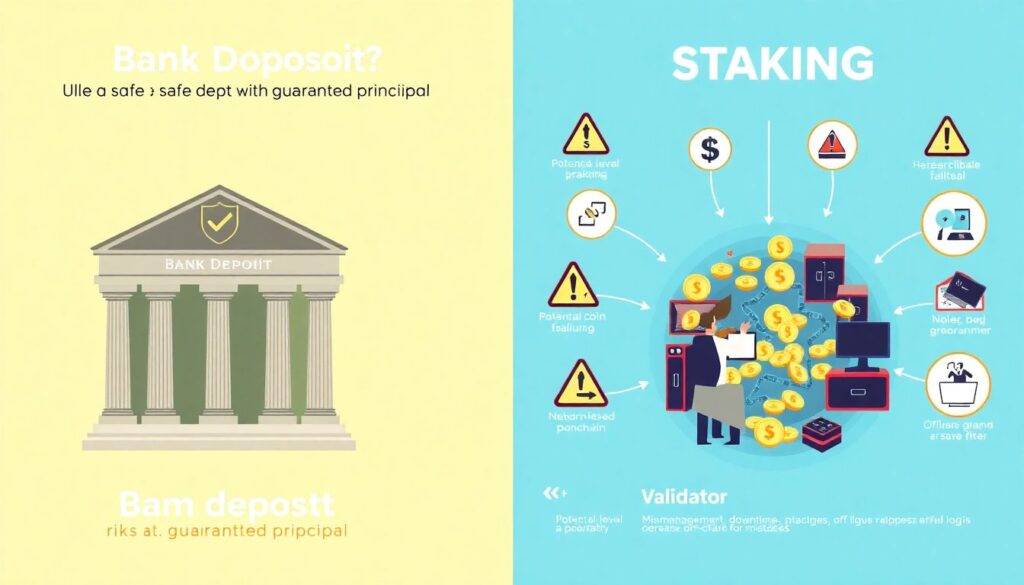
A frequent myth is that staking equals a bank deposit with guaranteed principal. In reality, staking carries several layers of risk. Network-level risks include potential slashing or protocol failure if there is a major bug in the consensus logic. Validator risk includes mismanagement, downtime, or malicious behavior that leads to slashing. Smart contract risk arises if you use liquid staking tokens or third-party services. And of course, there is price risk: the asset itself can fall significantly in value, wiping out years of staking rewards in a single market cycle.
What makes staking comparatively safer than yield farming is not the complete absence of risk, but the narrower set of moving parts and usually lower leverage. As long as you choose reputable validators or platforms and understand lockup terms, your main decisions revolve around asset selection and time horizon. Still, calling it “risk-free yield” is misleading and often used for marketing rather than honest analysis.
—
2. “Yield Farming Always Pays More, So It’s Automatically Better”
It’s easy to open a dashboard, see triple-digit APRs on exotic farms, and conclude that yield farming automatically beats staking. However, comparing defi staking vs yield farming returns only by headline numbers ignores the risk side of the equation. High APR is often a sign of newly launched incentives where token emissions are front-loaded and unsustainable. Once speculation cools, rewards can collapse, and the governance tokens you’ve been farming may lose most of their value.
Moreover, yield farming strategies often expose you to correlation risk: you might be providing liquidity in pairs where both assets are strongly tied to the same sector. If that sector suffers, both sides of your LP position can fall together, turning even high nominal rewards into a net loss. So while yield farming can indeed outperform simple staking in certain phases of the market, it’s more accurate to see it as higher-risk, higher-maintenance, and often shorter-term in nature. The decision is less about “which pays more” and more about “which risk profile matches my skills and tolerance.”
—
3. “You Must Choose Either Staking or Yield Farming, Not Both”
Newcomers often think they have to pick a camp: either become a “staker” or a “yield farmer.” In reality, both approaches can complement each other inside a single portfolio. For instance, a cautious setup might involve staking your core long-term holdings on secure networks while allocating a small experimental slice to yield farming opportunities. This way, the staking side provides a relatively stable base of returns, while the farming side lets you learn protocols and possibly capture higher upside without putting your entire stack at risk.
In fact, many advanced strategies already blur the line between the two. Liquid staking tokens (like staked ETH derivatives) can themselves be used as collateral in DeFi, turning your staking rewards into the base layer for yield farming. Conversely, some farming strategies essentially wrap underlying staking positions, sharing extra rewards from token emissions without changing the secured nature of the core asset. Thinking in binary terms limits your options; thinking in terms of layers and risk buckets usually leads to more resilient positioning.
—
Comparing the Two Paths: Which Trail Should You Take First?
When you evaluate yield farming vs staking as possible starting points, it helps to move beyond marketing claims and look at real trade-offs. Both tools can be part of a rational strategy, but they serve different purposes and demand different levels of involvement. Below is a practical way to think through the decision without getting lost in acronyms and buzzwords.
1. Time and attention
If you want something close to “set it and check it monthly,” simple staking usually fits better. You mainly monitor network updates and validator performance. Yield farming, on the other hand, rewards those willing to track new incentives, adjust positions, and understand when a farm has become unprofitable or too risky to stay in. If your schedule is tight, constantly rebalancing farms will feel like a chore rather than an opportunity.
2. Risk tolerance and learning curve
Staking is generally easier to understand conceptually: you support the network, you earn rewards. The main skills involve choosing reputable platforms and not panicking during volatility. Yield farming requires you to grasp liquidity pools, impermanent loss, token emissions, and sometimes leverage. The payoff is flexibility and potentially higher returns, but the price of misunderstanding can be steep. Consider where you stand in terms of technical comfort before betting big on farming.
3. Asset preference and market view
If you’re already convinced about the long-term prospects of a PoS asset, staking it might be the more natural first move. Your thesis is about the success of the chain itself; yield is a secondary benefit. If instead you enjoy analyzing tokenomics, governance, and cross-protocol incentives, then exploring a curated set of farming strategies on established platforms may align better with your style. In both cases, keep in mind that every extra layer of complexity should have a clear justification in terms of expected reward versus additional risk.
—
Putting It All Together

For most beginners, starting with simple staking is the more sensible “first trail.” It lets you understand how blockchain rewards work, feel comfortable with on-chain transactions, and see your balance grow without drowning in complexity. Once you have that foundation, you can experiment with modest yield farming positions, treating them as optional upgrades rather than mandatory moves. This gradual approach also makes it easier to compare staking and yield farming returns in practice instead of relying solely on advertised APRs.
As you gain experience, the question stops being “Which is better: yield farming or staking?” and turns into “What mix of both fits my goals, skills, and nerves?” If you keep that framing in mind, the choice between these trails becomes less about hype and more about building a resilient, well-thought-out crypto income strategy that you can actually manage over the long run.