
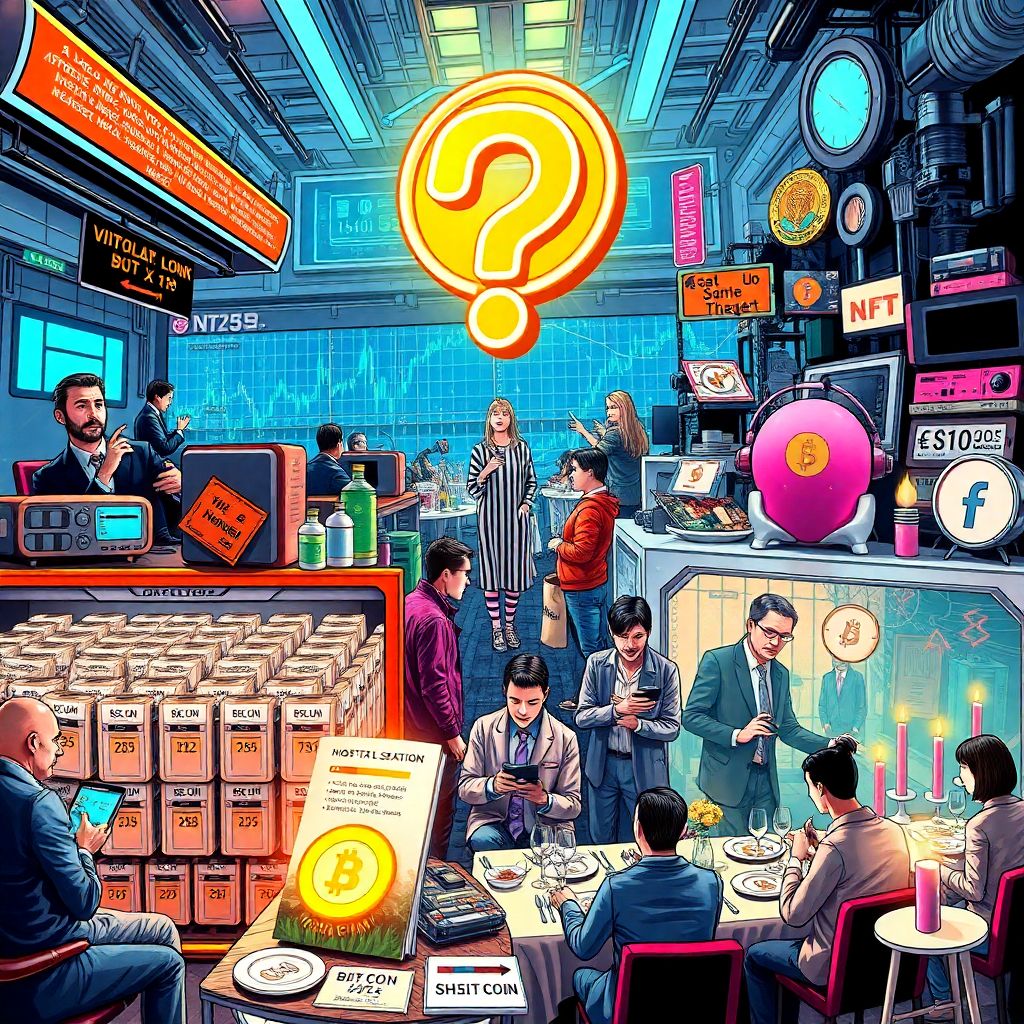
13 WTF Moments of the Year: 2025 Crypto Edition
================================================
The rise of cryptocurrency has always felt like an alternate timeline: a financial system bootstrapped from forum posts, memes, and math, driven by a white paper from an anonymous creator who might be one of the wealthiest people alive—or might not even be human, if you believe some corners of the internet.
What began as a cypherpunk experiment is now a bizarre cultural melting pot: finance bros and anarchists, progressive activists and far‑right extremists, Balkan dissidents and West African startup founders, all transacting on the same blockchains. Against that backdrop, it’s almost logical that 2025 became one of the strangest years in crypto history.
From literal feces-backed tokens to cops trapping a Bitcoin ATM like it was a runaway horse, here are 13 absolutely unhinged crypto moments that defined 2025.
—
1. Literal “Shit Coins” Stop Being a Joke
For over a decade, “shitcoin” was just an insult for low‑effort tokens. In 2025, someone took it literally.
A group of performance artists and self-described “on‑chain absurdists” launched a collection of tokens allegedly “backed” by… human waste. Holders could, in theory, redeem tokens for vacuum‑sealed samples stored in a climate‑controlled warehouse. The team published a detailed “manure management paper,” complete with charts about methane emissions, decomposition timelines, and “bio‑backed intrinsic value.”
What began as satire warped into a micro‑economy. Traders piled in, speculating on “deflationary flush events” and “scarcity of premium compost tiers.” The price mooned after a popular influencer filmed themselves attempting to redeem a token at a high‑end gallery, only to be politely told that “health regulations prevent in‑person handover.”
Regulators were baffled. Is it a commodity? A biohazard? Art? A security? For a few surreal weeks, one of the fastest‑rising assets on certain decentralized exchanges was, in every meaningful sense, a shit coin.
—
2. The Multi‑Course Token Dinner
In 2025, “dine and stake” became a thing.
A Michelin‑starred restaurant in a major European capital announced a one‑night‑only “on‑chain tasting menu.” Each course was tied to a token. Your appetizer? Minted as an NFT receipt. Your main course? Unlocked by signing a transaction at the table with a hardware wallet. Dessert? Airdropped later as a “sweetener” to your wallet if you left a good on‑chain tip.
Guests paid a hefty fee upfront in crypto and were seated at long communal tables equipped with tablet-like signing stations. Sommeliers doubled as wallet support staff, calmly explaining gas fees between wine pairings. At one point, service ground to a halt because a popular meme token spiked in price mid‑meal, and half the room tried to rebalance their portfolios between the second and third course.
The strangest twist: the restaurant tokenized future reservations. Diners who flipped their reservation NFTs for a profit ended up making more money trading their table slots than the restaurant did from serving food. Fine dining officially met yield farming—and nobody was sure who was the main course.
—
3. A Token for Your Twerks
If there was any doubt that literally anything can be financialized, 2025 erased it with a “move‑to‑earn” spin‑off: twerk‑to‑earn.
A short‑form video platform rolled out a pilot program where users could tokenize their dance clips. The most absurd sub‑genre: twerk videos that generated a proprietary reward token based on “engagement intensity” measured by an AI motion‑tracking model.
Creators were promised a new path to monetization: the more you moved, the more you earned. Users could tip with governance tokens that allegedly gave them the right to vote on “platform culture decisions,” though in practice most votes were about which dance challenges to boost.
Within weeks, Telegram groups sprung up offering “optimized twerk strategies” and analytics dashboards for tracking your “shake‑to‑stake” ROI. Predictably, the token crashed after a brief euphoria, leaving latecomers holding bags full of illiquid dance‑coin.
Still, the experiment made one thing very clear: if there’s human behavior, someone will try to bolt a token model on top of it.
—
4. Chill House, Not So Chill
A trendy “crypto wellness house” opened in 2025, promising to fuse meditation, breathwork, and blockchain. Members paid monthly dues in a native token that supposedly accrued yield from “curated DeFi strategies.” In exchange, they got access to sound baths, co‑working space, and occasional “alpha circles.”
The problem arose when members realized the treasury was being actively traded in highly leveraged positions. During a sharp market drawdown, the token cratered, and the project’s treasurer was caught on a leaked recording saying, “It’s fine, people are here for the vibes, not the APR.”
They were not fine. The supposedly serene community space turned into a scene of panicked laptop huddles as members tried to withdraw what was left of the stash. Guided meditations were interrupted by people refreshing price charts. One yoga session descended into a shouting match over who had voted for the last “aggressive growth” proposal.
In the end, the community held a restorative circle to decide the future of the DAO—then immediately launched a rival “on‑chain mindfulness co‑op” with stricter risk rules. Namaste, but with governance.
—
5. The “Jack Off 500”
2025 proved that anything involving numbers, competition, and attention can become a leaderboard—and therefore, a tokenized event.
Enter the “Jack Off 500,” a bizarre NFT “race” themed loosely around classic motorsport aesthetics but centered on an absurd premise: participants bought jokey driver NFTs, then “raced” by completing on‑chain challenges with names and branding hovering right on the edge of platform guidelines.
The project leaned hard into over‑the‑top innuendo: pit crews, lubrication sponsorships, “photo finishes” rendered in pixel art. Every completed challenge nudged your driver up a global ranking, with the top 500 earning access to a special token airdrop and limited‑edition collectibles.
Despite (or because of) the juvenile humor, serious money appeared. Some traders aggregated positions in top drivers, building pseudo‑funds around who was likely to “finish strong.” There were rumors of bots auto‑completing challenges at high speed, sparking a debate over whether “manual effort” should be required for eligibility.
Critics called it peak degeneracy; defenders insisted it was merely “honest about what web3 really is: a game with money and memes.” Either way, everyone agreed the name would forever haunt pitch decks from anyone involved.
—
6. Dumpster Diving for Dollars
In an era of lost hard drives and forgotten seed phrases, one of 2025’s strangest scenes involved people literally climbing into dumpsters.
After a long‑dormant wallet containing an enormous stash of early‑era tokens suddenly showed signs of life, on‑chain sleuths traced it to an address they believed belonged to a defunct hardware wallet manufacturer. Rumors circulated that unclaimed or returned devices might still store access to fortunes.
Cue the scavenger hunt: groups began raiding e‑waste facilities and old office parks, hoping to unearth discarded wallets. One viral video showed a group celebrating around a cracked Ledger they found under a broken printer, only to discover it stored nothing but a few meme tokens and a failed ICO coin from 2018.
The gold rush sparked debates about data privacy, property rights, and the ethics of rummaging through corporate trash to find forgotten keys. It also highlighted one of crypto’s most stubborn realities: value can be locked away forever if the keys vanish, turning landfills into speculative “digital gold mines.”
—
7. Getting Buzz and Influencing People
Influencer culture and crypto have long been intertwined, but 2025 brought a new level of absurdity when a micro‑cap token partnered with a household‑name energy drink brand for a cross‑promotion stunt.
The premise: buy a can, scan a QR code, mint a “Buzz Pass NFT,” and earn small token rewards for posting content featuring both the drink and the coin. The campaign promised “real‑world utility” and “gamified brand engagement,” and for a week, social feeds were a blur of people chugging neon liquid while shilling charts.
Things went sideways when someone discovered the token’s smart contract allowed the team to mint more supply at will, despite marketing materials claiming it was capped and “mathematically scarce.” A wave of angry holders spammed the brand’s customer support lines, demanding both refunds and legal action.
The brand quietly pulled the campaign. But the stunt left a lingering question: where exactly is the line between “web3 growth hack” and garden‑variety pump‑and‑dump hidden behind lifestyle marketing?
—
8. You Too Can Create a Treasury
DAOs in 2025 continued to prove that if you can put a multisig around it, someone will call it a treasury.
A viral no‑code tool emerged that let anyone spin up a “mini‑treasury” in minutes. With a few clicks, users could deploy a smart contract, issue a governance token, and start soliciting contributions for whatever cause they dreamed up: local skate parks, indie films, “global vibes,” or “the preservation of extremely specific internet memes.”
The tool’s creators marketed it as “Kickstarter on‑chain, but supercharged,” and adoption exploded. Some treasuries funded genuine grassroots projects—community gardens, mutual aid initiatives, open‑source tools. Others collected money with vague promises like “change the world with art and frequency.”
Predictably, grifters arrived. Treasury after treasury raised funds, went quiet, then posted a final message about “unexpected personal circumstances” or “shifting roadmaps.” On the flip side, a few tiny, almost joke‑like treasuries ended up deploying capital so effectively that they were studied by serious governance researchers as examples of “emergent coordination.”
The year’s lesson: it has never been easier to create a pot of shared money—and never more important to ask who holds the keys.
—
9. Lone Star Cops Lasso a Bitcoin ATM
Some law enforcement officers spent 2025 getting unnervingly creative with how they treated crypto hardware.
In one widely shared incident in a southern U.S. state, police attempted to seize a Bitcoin ATM suspected of being tied to an unlicensed money‑transmitting operation. Rather than follow a straightforward procedure, they literally roped it.
Witnesses filmed officers looping a lasso around the top of the heavy machine, then anchoring the rope to a pickup truck and dragging the ATM out of a gas station kiosk, scratching the floor and showering the parking lot with cables and broken plastic.
The clip went viral not just because it was slapstick, but because it encapsulated the gap between old‑school enforcement tactics and new‑age financial infrastructure. Crypto advocates pointed out that the hardware was just an interface; without proper handling of the associated keys, the “seizure” might have been purely theatrical.
Still, for a few days, the internet was united in one opinion: whatever the right way to deal with illicit Bitcoin ATMs is, it probably doesn’t involve rodeo techniques.
—
10. “Melania Bolognia” and the Celebrity Token Circus
Tokenized celebrity moments are nothing new, but 2025 managed to take it to a more farcical place.
A high‑profile political spouse—already notorious for dipping toes into NFTs—became the unwilling center of a meme token storm when a clip of them mispronouncing an Italian dish went viral. Within hours, a “Bolognia” token launched, claiming to “honor the fusion of luxury, confusion, and slightly overcooked pasta.”
The token’s branding riffed ruthlessly on the clip, remixing the audio into dance tracks and GIFs. Devs promised a donation to “food literacy initiatives,” though on‑chain analysis later suggested only a tiny fraction of funds ever left the project’s wallet.
When asked by reporters, the public figure’s spokesperson dismissed it as “internet nonsense,” which only pushed traders to speculate harder. For a brief period, Bolognia outperformed several mid‑cap DeFi projects by market cap—until, as with most meme plays, liquidity dried up and the price sank back to near zero.
One day you’re mispronouncing lunch; the next, you’re the accidental face of a short‑lived micro‑economy.
—
11. BOOM, Headshot: Gaming Meets High‑Stakes Finance
The dream of play‑to‑earn refused to die in 2025, and occasionally it resurfaced in ways that made everyone question their life choices.
A competitive first‑person shooter rolled out an experimental mode where every in‑game kill triggered a tiny on‑chain transfer. Headshots paid a premium, objective captures earned bonuses, and post‑match rewards were distributed automatically through smart contracts.
For a brief, chaotic moment, “BOOM, headshot” meant your wallet actually pinged.
Streamers flocked to the mode, flexing earnings dashboards alongside kill feeds. But so did cheaters, bots, and exploit hunters. Someone figured out how to script coordinated AFK lobbies where participants took turns farming low‑resistance kills for hours, draining the reward pool.
The devs scrambled to introduce anti‑cheat measures and skill‑based caps, but by then, the experiment had highlighted the core tension: the more you financialize gameplay, the more it attracts people who see a balance sheet, not a game.
Still, for those few weeks, being “cracked at shooters” translated directly into on‑chain income—and many players are already lobbying for a cleaner second attempt.
—
12. Dogwifhat… but Not wif Sphere
No memecoin captured mainstream imagination in late 2024 like dogwifhat, and by 2025 its influence had seeped into physical reality in the most questionable ways.
A startup announced a project to build a literal “Dog With Hat Sphere”—a domed venue inspired by the famous Vegas sphere, entirely wrapped in LED panels displaying looping dog-with-pink-hat animations. The plan: fund construction through a token sale, grant holders discounted tickets to future concerts, and share revenue from advertising on the exterior display.
Hype was intense. A slick teaser showed a glowing orb in the middle of a desert, topped by a giant neon hat. Tokens sold out in minutes.
Then the land deal fell apart. Local authorities balked at the proposed structure, questioning everything from light pollution to structural safety. It turned out the team had “assumed positive regulatory outcomes” and pushed the token launch ahead of any binding permits.
Investors were left with “Sphere tokens” for a venue that existed only in pitch decks and renders. The project rebranded itself as a “virtual experience platform,” but the whole debacle underscored a hard truth: blockchains don’t magically solve the difficulty of pouring concrete or navigating zoning laws.
—
13. “Yu Gotta Be Kidding”: The AI Dev That Wasn’t
The final WTF moment of 2025 blurred the line between human incompetence and machine hallucination.
A hyped infrastructure project claimed that its core smart contracts had been “autonomously co‑authored” by a custom AI assistant nicknamed “Yu,” trained on decades of financial data and security audits. The pitch: faster development, fewer bugs, and “machine‑verified economic safety.”
Investors loved it. The token launch was oversubscribed. Then independent auditors dug in.
They found that “Yu” had in fact copied large chunks of code from open‑source repositories with only minimal changes—sometimes leaving in comments referencing entirely different projects. Worse, one critical function contained a subtle arithmetic error that made it possible to drain the protocol under specific conditions.
When confronted, the team tried to blame the AI, claiming “Yu” had “generalized incorrectly.” The AI vendor fired back, noting that humans had final sign‑off and deployed the contracts. Social media had a field day with variations of “Yu gotta be kidding me” memes.
Funds were eventually patched and users compensated, but the saga left the industry with a sobering takeaway: slapping an AI label on sloppy engineering doesn’t turn it into innovation—if anything, it makes the inevitable failure more theatrical.
—
What 2025’s Crypto Chaos Really Tells Us
Taken individually, each of these stories feels like a one‑off stunt. Put together, they sketch a picture of an industry still stuck between two realities: a serious attempt to rebuild the world’s financial plumbing, and an anything‑goes carnival of speculation, art projects, and social experiments.
Several themes stand out:
– Everything is getting financialized. From dinners to dance moves to treasuries for hyper‑niche causes, 2025 showed that any human activity is a candidate for tokenization—whether or not it makes sense.
– The real and digital worlds keep colliding. Bitcoin ATMs dragged by trucks, proposed crypto spheres in the desert, garbage dumps treated like treasure vaults: the moment crypto touches physical infrastructure, the absurdity ramps up.
– Memes remain a core organizing force. Shit coins, Bolognia, dogwifhat spheres—attention and humor still drive capital flows in ways traditional finance can barely comprehend.
– Tools empower both real communities and opportunists. The same treasury builders and DAO frameworks that funded gardens and art projects also enabled soft‑rug treasuries and vague “change the world” grifts.
– Tech buzzwords don’t replace responsibility. Whether it’s “AI‑authored contracts” or “wellness yield strategies,” the old basics—risk management, audits, legal compliance—still decide who gets wrecked.
—
How to Survive the Next Round of WTF
If 2025 proved anything, it’s that the next year will be just as strange—if not stranger. A few practical lessons emerged for anyone navigating this landscape:
1. Look past the meme. Jokes are fun, but where does the money actually go? Who can mint more tokens? What’s locked, what’s liquid, and what’s just vibes?
2. Follow the keys, not the branding. Whether it’s a wellness DAO or a celebrity token, always ask: who controls the treasury? How many people can move funds, and under what conditions?
3. Assume physical projects are twice as hard. Any token promising to build a real‑world venue, hardware network, or giant glowing orb has to pass not just code audits, but mundane hurdles like permits and construction delays.
4. Treat AI claims with skepticism. “AI‑powered” doesn’t guarantee safe or original code. If anything, it demands even more scrutiny.
5. Remember that fun and risk can coexist. Some of the year’s most outrageous experiments were also genuinely creative. You don’t have to avoid them entirely—but size your exposure like you would to any expensive night out: only spend what you’re prepared to never see again.
—
The Bizarre Future Is the Point
Crypto’s story has never been clean or dignified. It emerged from anonymous forums, attracted misfits and visionaries in equal measure, and grew up in public with all the awkwardness of a teenager livestreaming their entire life.
The 13 WTF moments of 2025 aren’t glitches in the system—they’re features of a technology that lowers the cost of coordination, speculation, and experimentation to nearly zero. When you make it that easy for anyone, anywhere, to spin up a new economy, you’re going to get both breathtaking innovation and breathtaking stupidity.
As new users, institutions, and regulators pile in, there will be more memecoins, more performance art tokens, more AI‑assisted disasters, and more communities genuinely trying to build something meaningful on the same rails.
The challenge for the next wave of participants isn’t to avoid the weirdness. It’s to recognize it for what it is: a side effect of an open financial sandbox—and then decide, eyes open, which games are worth playing.