
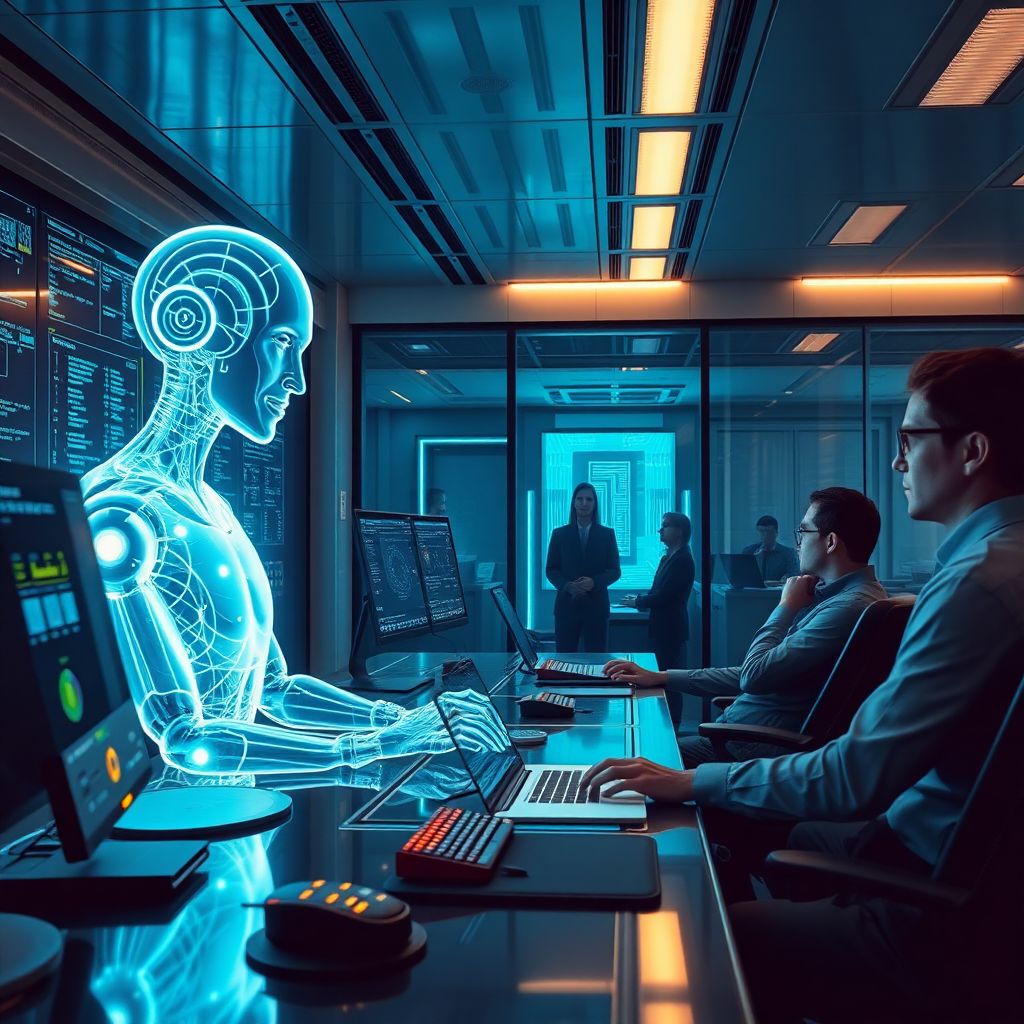
AI is no longer just another tool in the developer’s toolkit-it is rapidly becoming the primary author of its own evolution. According to a new report from Anthropic titled “When AI Builds Itself,” modern models like Claude are already playing a central role in designing, coding, and testing the next generation of AI systems. In some areas, human engineers are less the builders and more the project managers deciding what to build in the first place.
Anthropic’s researchers argue that this marks the beginning of a profound shift in how software-and especially AI software-is created. Instead of developers manually writing the vast majority of code, large language models now handle most of the routine implementation, experimentation, and even some of the architectural thinking. People increasingly intervene at higher levels: choosing goals, setting constraints, reviewing safety, and making judgment calls about trade-offs.
One of the headline claims from the report is striking: Claude now writes over 80% of the code that actually gets merged into Anthropic’s own codebase. That doesn’t mean humans are out of the loop; engineers still review, test, and integrate that code. But the heavy lifting of drafting functions, refactoring modules, and wiring up experiments is largely delegated to the model itself. The company says that since early 2024, this division of labor has increased effective code output by about a factor of eight.
Before Anthropic rolled out its specialized coding capabilities internally, engineers reportedly spent a huge portion of their time on boilerplate tasks: generating similar scripts for experiments, wiring together evaluation pipelines, or tweaking configuration parameters. Once Claude Code arrived in research preview, that pattern flipped. Members of the team began sketching high-level instructions and design requirements, feeding them to the model, and using the extra time to think about research direction and safety implications rather than syntax and plumbing.
The report frames this as the early stage of what’s often been called recursive self‑improvement: AI systems that participate in designing their own successors. In Anthropic’s view, we are not yet at a point where AI autonomously invents entirely new paradigms and deploys them without human supervision. But we are clearly past the point where AI is just a passive tool. It is now an active collaborator in the research and development loop-running complex experiments, summarizing results, proposing follow‑up directions, and generating the code to make those ideas real.
Interestingly, Anthropic suggests that the primary bottleneck to faster AI progress is no longer computational power or even the sophistication of current models, but humans themselves. People are slower at reading long experiment logs, slower at reviewing thousands of lines of generated code, and more cautious in approving new experiments that might have unknown side effects. In other words, the rate of advancement is limited by human attention, oversight capacity, and risk appetite rather than the raw capability of the AI.
This does not mean human involvement is a nuisance to be eliminated. Anthropic emphasizes that human judgment remains central-especially when it comes to questions of safety, ethics, and societal impact. The report argues that as AI takes on more of the day‑to‑day engineering workload, people must move upward in abstraction: focusing on defining which problems are worth solving, what constraints must be respected, and how to measure whether a system’s behavior is acceptable in the real world.
The workflow Anthropic describes is already familiar to many AI‑assisted teams. An engineer starts with a specification: “We need an evaluation harness to compare model A and model B on a new benchmark,” or “We want to test how a change in the training objective affects honesty and helpfulness.” Claude drafts the code for the evaluation framework, proposes candidate metrics, and even generates simulated edge cases. The human then validates assumptions, tweaks the design, and decides which experiments are safe and meaningful enough to run at scale.
Over time, this pattern could make AI development look more like directing a research organization than writing software line by line. An individual researcher equipped with powerful coding models can run the sort of large‑scale experiment campaigns that used to require a whole team. Anthropic claims that this has already shifted the internal culture: instead of asking “Can we build this?” people are asking “Should we build this now?” and “Is this a good use of our limited human review bandwidth?”
The possibility of recursive self‑improvement raises obvious concerns. If AI systems help design successors that are more capable than themselves, what prevents a runaway process where each generation rapidly surpasses the last with diminishing human control? Anthropic’s report acknowledges this risk but argues that current practice remains strongly human‑in‑the‑loop. Models do not have autonomous access to deployment pipelines; they cannot unilaterally push their own changes into production or provision vast new computing resources without explicit approvals and guardrails.
Still, the line is moving. As tools improve, more of the AI development pipeline can be automated: data preprocessing, hyperparameter search, architecture search, evaluation design, and red‑teaming can all be at least partially delegated to models. What remains distinctively human is the setting of goals and the interpretation of consequences. Deciding whether a performance gain justifies increased risk, or whether a model’s new capability is socially acceptable, is not something we can safely outsource.
Another subtle shift highlighted by the report is cognitive: working with AI that can outpace you in code generation forces engineers to redefine what it means to be “good” at their jobs. Expertise becomes less about memorizing APIs or writing flawless code under time pressure, and more about formulating clear specifications, spotting hidden failure modes, and designing robust safety checks. Anthropic suggests that teams who adapt to this mindset can unlock far more value from AI tools than those who treat them as mere autocomplete.
There are also implications for the speed of AI progress as a whole. If the primary constraint is human oversight, then scaling AI development may depend more on training and empowering responsible reviewers than on acquiring more GPUs. Organizations might invest in specialized “AI safety leads” or “AI experiment directors” whose job is to monitor not just what the models are doing, but why those projects are being pursued, who might be affected, and which red lines must not be crossed.
In practical terms, this shift will likely change how products are built outside frontier labs too. Startups and enterprises can already use code‑capable models to stand up prototypes in days instead of weeks. As tools become more integrated-linking coding assistance, automated testing, monitoring, and documentation-the marginal cost of trying a new idea falls dramatically. The limiting factor becomes the number of humans who can thoughtfully evaluate those ideas, ensure they comply with regulations and company values, and steer the roadmap.
Anthropic’s framing also has a psychological dimension. If engineers internalize the idea that “AI is doing most of the work,” they may be tempted to trust its output more than they should. The report implicitly warns against this complacency by centering human decision‑making as the core resource. Even if Claude writes nearly all the code, a flawed specification or an overlooked edge case can still cause real‑world harm. The presence of a powerful assistant makes human discernment more important, not less.
Looking ahead, the company envisions a future in which AI systems act as full‑fledged research collaborators: independently proposing novel avenues of inquiry, constructing experiment suites, and even drafting papers or technical reports summarizing what they’ve learned. In this world, humans become curators of research directions and guardians of norms rather than primary implementers. The challenge is to design these collaborations so that they amplify human values instead of diluting or bypassing them.
Anthropic’s report ultimately paints a dual‑edged picture. On one hand, AI‑assisted AI development promises unprecedented acceleration in innovation, making it possible to explore vast design spaces and refine systems much faster than any human‑only team could. On the other hand, this acceleration amplifies the consequences of poor choices, weak oversight, or misaligned incentives. If humans are now the main bottleneck, then raising the quality of human judgment is just as important as making the models more capable.
For policymakers, investors, and technologists, the takeaway is clear: the question is no longer whether AI will help build AI-it already does. The real questions are who sets the objectives, who holds the brakes, and how we structure the feedback loops between human values and machine‑driven optimization. The future of AI may be written mostly by code that AI itself generated, but the responsibility for what that future looks like still rests squarely with people.
Комментарии