
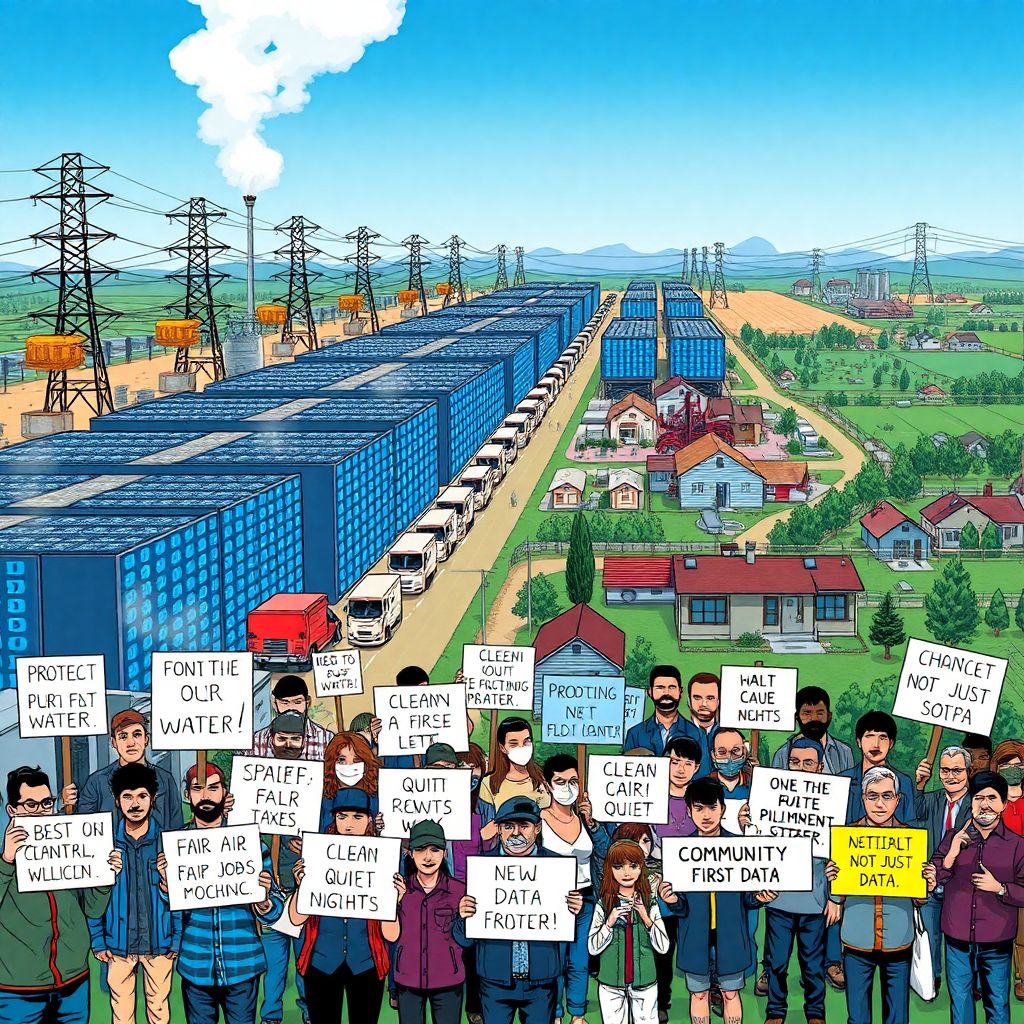
Experts: Local Backlash Against Data Centers Threatens to Choke AI Infrastructure Boom
AI-focused data centers are spreading at breakneck speed across the United States, but the buildout that underpins today’s artificial intelligence boom is running into a powerful obstacle: mounting pushback from the communities expected to host these facilities.
A new report from the nonprofit think tank Brookings warns that conflicts over energy consumption, water use, tax breaks, and environmental impacts are increasingly delaying, shrinking, or killing proposed data center projects. Unless those tensions are addressed through enforceable agreements with local residents and governments, the authors argue, public opposition could become a serious brake on AI infrastructure growth.
According to the report, AI data centers now sit at the heart of the modern digital economy. They provide the compute and storage capacity that makes large language models, image generators, and other AI tools possible. Yet the very scale that makes these facilities so powerful—massive power draws, intensive cooling systems, and sprawling footprints—also makes them among the most contentious forms of new development.
“Data centers are both controversial and critical to the artificial intelligence technologies undergirding the digital economy,” the authors write. Without a robust pipeline of new facilities, they warn, the AI revolution could slow to a crawl, and many anticipated benefits—from productivity gains to new services for consumers and businesses—could fail to materialize or remain concentrated in only a few regions.
Why communities are pushing back
Local resistance is fueled by a cluster of concerns that tend to surface as soon as a large data center proposal is announced. One of the biggest flashpoints is electricity use. AI-ready data centers can require hundreds of megawatts of power, straining aging grids, driving up infrastructure costs, and raising fears that local customers may ultimately foot the bill through higher rates or more frequent outages.
Water usage is another growing point of contention. Many large facilities rely on evaporative cooling, consuming enormous quantities of water each year—an especially sensitive issue in regions already grappling with drought, competing agricultural needs, or long-term climate pressures. Residents worry that AI infrastructure could lock in high water demand for decades.
Tax abatements and other incentives have become equally controversial. To attract operators, state and local governments often offer generous packages that can include property tax relief, sales tax exemptions on equipment, or subsidized infrastructure upgrades. Critics question whether these deals actually pay off for local budgets, especially if facilities create relatively few permanent jobs once construction ends.
Environmental impact rounds out the list of common complaints. Even where operators pledge to purchase renewable energy credits or invest in green power, communities remain skeptical about local air quality, noise pollution from cooling equipment, increased truck traffic, and the carbon footprint of building and operating vast, energy-hungry campuses.
Binding community benefit agreements as a pressure valve
Brookings researchers argue that these tensions will not simply fade as AI becomes more mainstream. Instead, they recommend a clear, structured response: legally binding community benefit agreements (CBAs) between data center developers and host jurisdictions.
Unlike informal promises or aspirational sustainability pledges, CBAs spell out concrete obligations that developers must meet—often including specific investments in local infrastructure, job training, environmental mitigation, and ongoing monitoring. Because they are typically enforceable contracts, CBAs can give residents and local governments leverage they lack under standard permitting processes.
In the context of AI data centers, such agreements could require developers to fund upgrades to local power lines, support new renewable generation, or contribute to grid modernization efforts. They might also set caps or mitigation strategies for water consumption, establish air and noise standards, or include financing for conservation and recycling systems.
Crucially, the report emphasizes that well-designed CBAs should share the economic upside of AI infrastructure more directly with the communities bearing its risks. That can include commitments to hire local workers, invest in local schools and technical training, support small businesses in the supply chain, or provide direct fiscal contributions that compensate for tax breaks granted up front.
How backlash could slow AI’s momentum
Without such mechanisms, experts fear a growing wave of “not in my backyard” sentiment could collide with the industry’s ambitious expansion timelines. AI companies and cloud providers are racing to add capacity, driven by surging demand for model training and inference. Yet the more high-profile and resource-intensive these projects become, the more visible and politically sensitive they are at the local level.
Delays in permitting, prolonged zoning disputes, lawsuits over environmental or water impacts, and community-led political campaigns can all add months or years to project timelines. In some cases, opposition can be strong enough to push companies to quietly withdraw or relocate elsewhere, at significant cost.
If this becomes a widespread pattern, the net effect could be a bottleneck in the physical infrastructure that underlies AI. Even with abundant capital and technical know-how, the report warns, the sector cannot sidestep the reality that every new facility has to be accepted—or at least tolerated—by specific communities with specific concerns.
That slowdown would not just affect headline-grabbing AI labs. Enterprises, startups, universities, and public agencies increasingly rely on cloud and AI services hosted in these facilities. A constrained buildout could mean higher prices for compute, limited capacity in key regions, or slower rollout of advanced AI applications in areas like healthcare, logistics, and scientific research.
The energy question: decarbonization vs. demand shock
One of the thorniest dimensions of this debate is the intersection of AI and climate policy. On one hand, operators often portray modern data centers as relatively efficient, especially compared to legacy on-premise server rooms. They point to power usage effectiveness metrics and pledges to match consumption with renewable energy purchases.
On the other hand, AI workloads—especially training large models—can be vastly more energy-intensive than traditional cloud computing. As more businesses embed AI into everyday processes, the cumulative demand on the grid could grow much faster than previously expected.
Brookings analysts suggest that managing this energy shock responsibly will be central to easing community fears. That may mean tying new AI data center approvals to concrete commitments on clean energy procurement, participation in grid flexibility programs, or investments in local generation and storage.
Some regions are already experimenting with co-locating data centers near renewable projects or nuclear plants to minimize both emissions and strain on local distribution networks. But the report underscores that without transparent, enforceable frameworks, promises about green power risk being seen as marketing rather than meaningful protection for local residents.
Water, land, and quality of life
Beyond energy, the physical footprint of AI infrastructure is becoming a more prominent political issue. Large campuses require significant land, often near existing transmission lines or substations, which can overlap with agricultural areas, open space, or residential growth corridors.
Brookings highlights that communities want more than broad assurances about “minimal impact.” They increasingly expect independent assessments, clear data on projected water use and noise levels, and detailed plans for mitigating any harm.
Community benefit agreements can encode hard limits on water withdrawals, encourage the use of air-cooled systems where feasible, or require investments in local water recycling. They can also cover landscaping, traffic management, and design standards to reduce visual and noise intrusion, making data centers less disruptive neighbors over the long term.
These quality-of-life measures, while less often discussed in national debates about AI, can make or break local support. Residents may be willing to accept an abstract role in the AI economy, but not at the cost of constant truck flows, nighttime noise, or pressure on already stressed local aquifers.
Sharing the gains from the AI era
Another theme running through the Brookings analysis is fairness: who actually benefits from hosting AI infrastructure? In many deals, the biggest winners are global tech companies and distant shareholders, while local residents see relatively modest job creation once construction ends.
To counter that perception, the report argues, data center projects must be linked more deliberately to durable local value. That can mean targeted workforce development programs in partnership with technical colleges, apprenticeships in electrical and mechanical trades, and pathways for residents to move into higher-paying operations and maintenance roles.
Beyond employment, CBAs can channel a portion of project value into long-term community priorities—such as broadband expansion, public transit, environmental restoration, or educational programs. When residents can point to visible, lasting improvements that stem directly from AI infrastructure, opposition may soften, and the political calculus for local officials becomes less fraught.
Policy and planning: getting ahead of the curve
The Brookings report suggests that leaving these issues to ad hoc negotiations on a project-by-project basis is increasingly risky. Instead, it calls for more proactive planning at regional and state levels, including:
– Designating appropriate zones for high-density data center development, with clear rules and expectations.
– Integrating projected AI-related power and water demands into long-term infrastructure planning.
– Establishing standard frameworks or model CBAs that local governments can adapt, reducing the negotiation burden and leveling the playing field.
– Coordinating policies so that neighboring jurisdictions do not simply compete to offer ever-larger incentives with fewer protections.
Such systematic approaches, the authors contend, can reduce uncertainty for both communities and investors. Companies gain clearer visibility into where and how they can build, while residents see that their concerns are embedded in policy rather than treated as last-minute obstacles.
The stakes for AI’s future trajectory
The fundamental tension described in the report is straightforward: AI’s promise depends on scaling up an infrastructure model that many communities increasingly view with suspicion. If that tension is mishandled, it could harden into political and regulatory roadblocks that slow or redirect the entire trajectory of AI development.
If, however, local concerns are taken seriously and addressed through binding commitments, the AI sector could secure a more durable “social license” to expand. That would not eliminate all conflict—large industrial projects rarely escape controversy—but it could transform opposition from an existential threat into a manageable part of doing business.
Brookings concludes that the era of easy data center approvals is ending. As AI pushes demand to new heights, the industry and policymakers must evolve their approach from transactional, incentive-heavy deals toward more balanced, transparent, and enforceable partnerships with host communities.
In that sense, the emerging backlash is not simply a hurdle for AI, but a test of whether one of the defining technologies of this decade can grow in a way that is seen as legitimate, accountable, and broadly beneficial—rather than just powerful and profitable.