
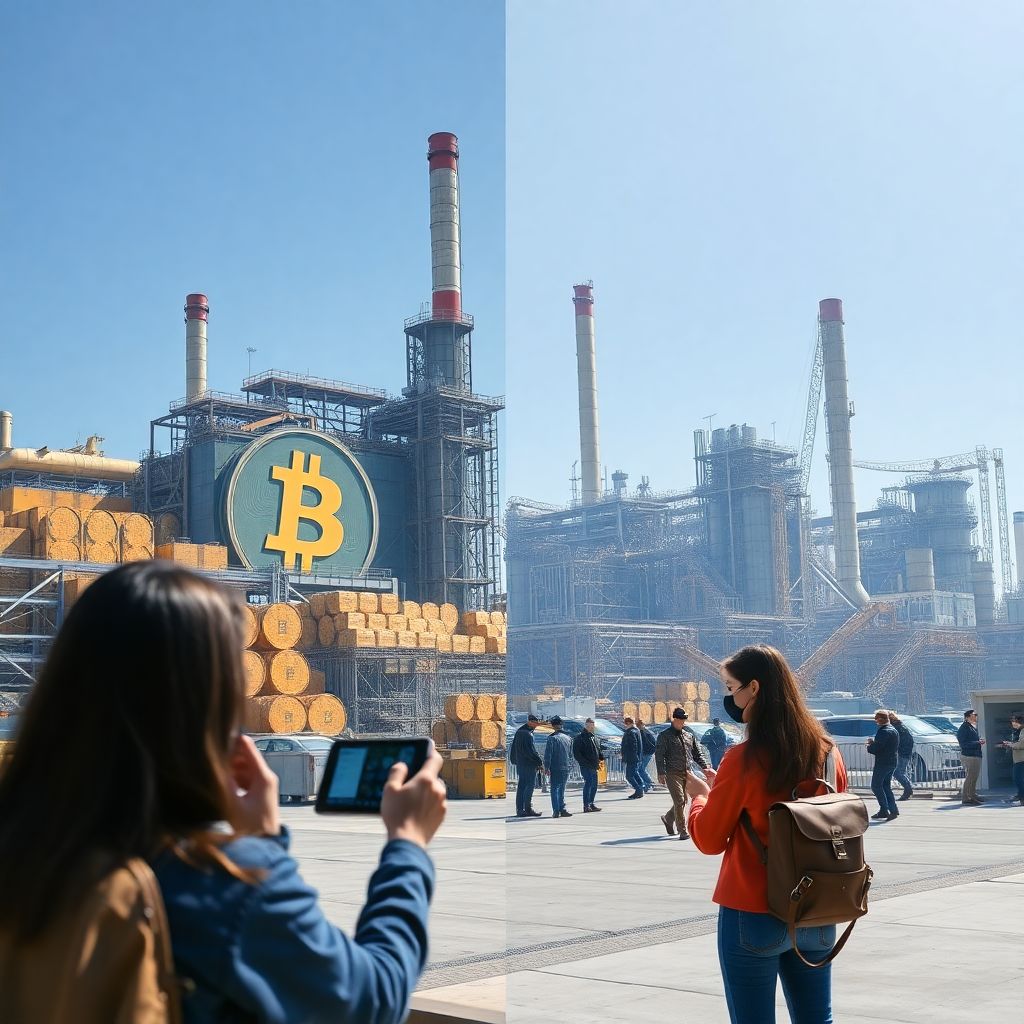
AI drifts toward personal devices as Bitcoin mining goes big‑industry
The technological trajectories of Bitcoin and artificial intelligence are starting to diverge in a striking way: as Bitcoin mining consolidates into large, industrial operations, AI is showing early signs of moving back toward smaller, personal devices.
Alex Thorn, head of research at Galaxy Research, notes that Bitcoin’s infrastructure has almost completely reversed from its origins. What once could be mined on a laptop or a home-built rig is now dominated by sprawling data centers filled with specialized ASIC machines. By contrast, AI-currently concentrated in heavily fortified, hyperscale data centers-may be at the beginning of a decentralization cycle of its own.
From garage rigs to industrial Bitcoin mines
When Bitcoin first launched, participation in the network was radically open. Anyone with a CPU, then later a GPU, could compete to secure the blockchain and earn block rewards. That amateur-friendly phase gradually disappeared as professional miners deployed purpose-built hardware and optimized for scale.
Today, effective Bitcoin mining generally demands vast warehouses in locations with cheap, reliable electricity, sophisticated cooling systems, and professional-grade operations. The barrier to entry for an individual consumer has risen dramatically: hardware is expensive, energy costs are volatile, and competition is fierce. Mining has become an industrial commodity business where margins are thin and scale is everything.
AI may be heading in the opposite direction
AI started out almost inverted: powerful models were born in elite research labs and locked inside enormous cloud data centers, controlled by a small set of well-capitalized corporations. Training and running state-of-the-art models has required vast amounts of data, specialized chips, and access to proprietary infrastructure.
Thorn argues that this pattern may now be shifting. As open-source models rapidly improve and large models run into practical constraints around memory and high-quality training data, a new front has opened: making models smaller, cheaper to run, and more efficient on everyday hardware.
“If local models keep getting smaller, cheaper, and more efficient, AI may become increasingly personal and on-device,” he observes. Instead of sending every query to a distant server, users could run capable models directly on their phones, laptops, or smart home devices.
Edge AI is set for explosive growth
Market research backs this thesis. Analysts at Grand View Research forecast that the global “Edge AI” market-systems that execute AI workloads directly on local devices rather than remote clouds-could reach about $119 billion by 2033. That’s a dramatic leap from an estimated $25 billion in 2025.
This growth is driven by two reinforcing trends:
1. An explosion in connected devices: everything from smartwatches and industrial sensors to autonomous vehicles and household appliances now generates and consumes data.
2. A push for real-time processing: many applications cannot tolerate the latency of bouncing data back and forth to a distant server. They need instant inference, close to where the data is created.
Instead of forwarding raw information to centralized clouds, edge devices can analyze it locally, making split-second decisions and only sending summaries-or nothing at all-upstream.
Privacy and localized intelligence at the network edge
Edge AI is not just about speed. It is also a response to intensifying concerns over data privacy, security, and regulatory compliance.
According to GVR’s analysis, companies across industries are increasingly prioritizing “localized intelligence at the network edge.” This means pushing more computation into factories, hospitals, vehicles, and consumer electronics so that sensitive information never has to traverse the public internet or reside in a third-party cloud.
For businesses, this approach offers several benefits:
– Reduced exposure of private data
– Lower dependence on single cloud providers
– Improved reliability in environments with patchy connectivity
– Compliance with strict data localization laws
In effect, firms can automate and optimize operations without constantly exporting their most sensitive datasets to a centralized hub.
Bitcoin mining scatters geographically, but centralizes operationally
While it is becoming harder for individuals to participate meaningfully in Bitcoin mining, the physical locations of large-scale facilities are diversifying. A recent report from crypto exchange KuCoin highlights that, although ownership of specialized mining hardware is consolidating into fewer hands, the rigs themselves are popping up in more parts of the world.
High electricity prices in many regions of the United States have made Bitcoin mining uneconomical for some operators. In extreme cases, the cost of power required to produce a single Bitcoin has been estimated to surpass $100,000, far above the market price.
This squeeze is pushing miners to scout for cheaper energy globally. Countries such as Ethiopia and Paraguay have emerged as attractive destinations, especially where hydroelectric resources are abundant and underutilized. By relocating to areas with surplus renewable power, miners can reduce costs while tapping energy that might otherwise go to waste.
Decentralization through geography, not through households
This global shift has an important implication for Bitcoin’s security model. Even though mining is dominated by professional outfits rather than hobbyists, the network can still maintain resilience if its hash power is spread across multiple jurisdictions, legal regimes, and power grids.
KuCoin’s analysis emphasizes that a broad geographic distribution of mining facilities “enhances the security of the network by making it less vulnerable to any single country’s political or environmental shocks.” If one region faces regulatory crackdowns, energy crises, or natural disasters, the global network can continue functioning because other regions still supply hash power.
The decentralization of Bitcoin, therefore, is less about millions of home miners and more about preventing any single government or grid operator from becoming a critical point of failure.
Two different meanings of “decentralized”
These parallel developments expose a subtle but crucial distinction. Bitcoin’s decentralization is primarily about who controls network consensus and where the infrastructure is located. AI’s potential decentralization is about where computation occurs and who controls their own data and models.
In Bitcoin:
– Mining centralizes into industrial operators, but
– Those operators are incentivized to spread across multiple countries to minimize regulatory and energy risk.
In AI:
– Model development may remain partially concentrated among large labs, but
– The deployment and usage of those models could increasingly happen on end-user devices.
The result is a world where Bitcoin becomes professionally run yet globally dispersed, while AI becomes personally accessible yet potentially built from a narrower set of core technologies.
Why on-device AI matters for everyday users
A move toward personal, on-device AI would be more than just a technical detail. For individuals, it could reshape how they interact with technology in several ways:
– Greater privacy: Conversations, documents, biometric readings, and behavioral data could be processed without leaving the device, limiting exposure to third parties.
– Offline capabilities: AI tools would continue functioning in low-connectivity environments-airplanes, remote areas, or countries with restricted internet access.
– Tailored assistants: Models could be continually fine-tuned on a user’s own habits, preferences, and history without sending raw data to a central server.
– Lower recurring costs: Running inference locally can reduce dependence on metered cloud APIs, potentially lowering long-term expenses for both consumers and businesses.
This is not guaranteed, of course. Centralized providers still have strong incentives to keep users tethered to cloud-based services. But the economics and capabilities of edge hardware are rapidly improving.
Constraints pushing AI toward the edge
The same factors that once favored hyperscale data centers are now creating an opening for more distributed AI. Large language models have already vacuumed up much of the high-quality text available on the open web. Further scaling requires ever-more exotic datasets and increasingly expensive compute clusters.
At the same time, chipmakers are squeezing more performance per watt into consumer hardware: smartphones, laptops, and even microcontrollers are now capable of running surprisingly advanced models. As open-source communities refine architectures and quantization techniques, it becomes feasible to run capable AI systems within the constraints of edge devices.
In a sense, AI is running into the walls of centralized scale while discovering new dimensions of efficiency at the edge.
Economic incentives in Bitcoin favor bigness
Bitcoin, in contrast, has economic rules that strongly reward scale. Larger miners can:
– Negotiate better electricity rates
– Invest in custom cooling and infrastructure
– Secure favorable hardware pricing from manufacturers
– Smooth out income volatility across large fleets of machines
These advantages accumulate, making it difficult for small miners to compete long-term. The protocol’s fixed block reward and difficulty adjustment do not inherently favor small participants; they simply reward whoever can deliver the most hash power at the lowest cost.
As block subsidies decline over time and transaction fees become relatively more important, miners may be further driven to seek scale and efficiency. That dynamic reinforces industrialization even as it may expand geographically.
Convergence: when edge AI meets Bitcoin’s energy hunt
An intriguing possibility lies at the intersection of these two trends. As miners chase cheap power-especially intermittent or stranded renewable energy-there is growing interest in pairing Bitcoin mining with other compute-intensive workloads, including AI.
Future facilities might dynamically allocate power and hardware between training or running AI models and hashing for Bitcoin, depending on market conditions. During times of low Bitcoin revenue, more resources could be shifted to AI services; when network fees spike or prices rise, mining might take priority.
At the same time, edge AI devices could interact directly with Bitcoin and other cryptocurrencies, making micropayments, verifying transactions, or coordinating machine-to-machine commerce without human intervention. In such a scenario, on-device AI becomes not only a tool for users but also an economic agent connected to decentralized networks.
A world of industrial Bitcoin and personal AI
Taken together, the current evidence suggests a counterintuitive future: Bitcoin, once a pastime for hobbyists, matures into a terrain dominated by industrial players scattered across the globe. AI, which began as a highly centralized pursuit of a few tech giants, may gradually seep into every pocket, car, and factory floor as a localized, everyday utility.
Decentralization, in other words, is not a single trajectory but a set of evolving patterns shaped by incentives, regulation, and technology. While Bitcoin’s security rests on large actors competing across borders, AI’s next wave may hinge on empowering individuals and organizations to own and run their intelligence locally.
Whether this shift ultimately redistributes power or simply reshuffles it will depend on how open the underlying tools remain, how regulators respond, and whether users demand control over their data and devices. For now, one thing is clear: as Bitcoin mining grows more industrial, AI is quietly preparing to come home.