
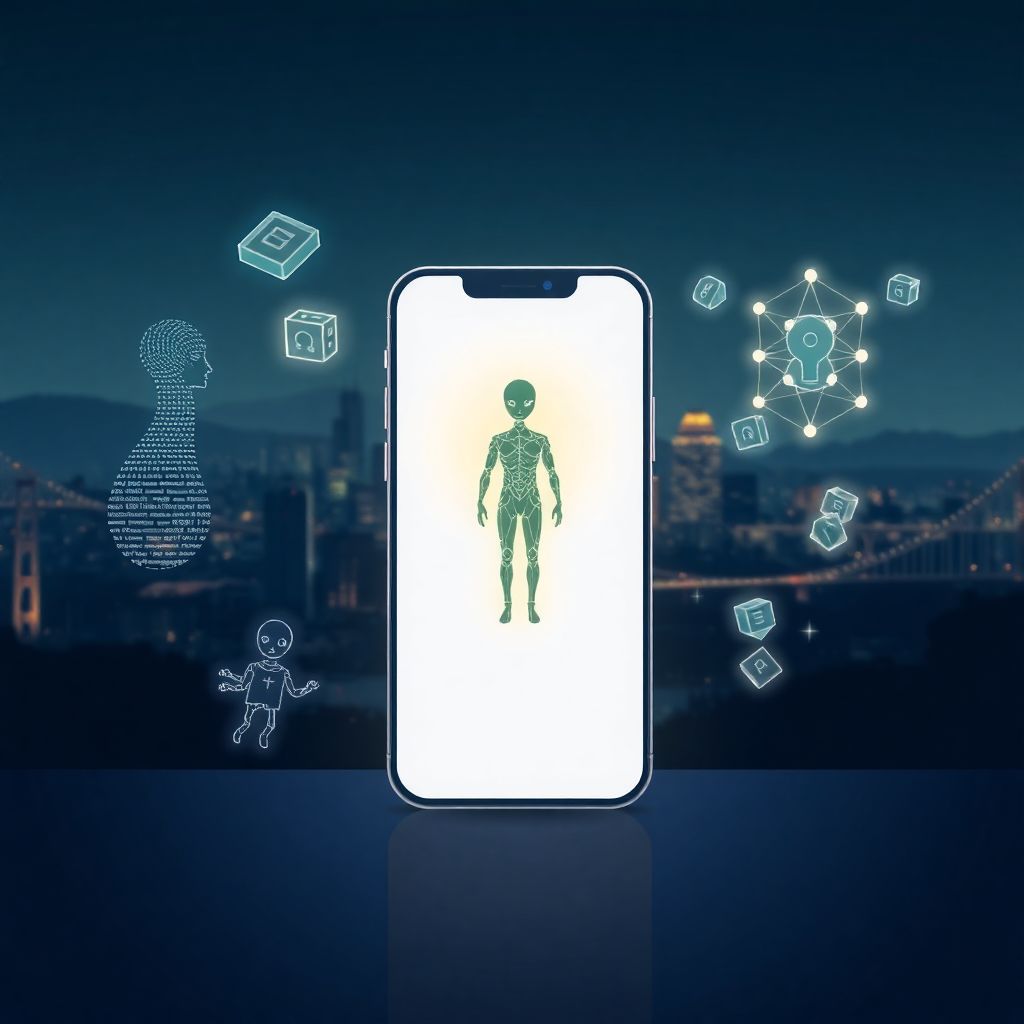
Humanity-Verification App ‘Alien’ Targets Bot Problem With Privacy-First Digital Identity
A new startup called Alien claims it has found a way for people to prove they’re human online without handing over sensitive personal data. The company’s identity system, now live on iOS and Android, uses cryptography to confirm what it calls “unique humanity” at a time when AI-powered bots are increasingly indistinguishable from real users.
Headquartered in San Francisco, Alien says its app verifies a user’s identity without storing raw biometric information or requesting government-issued documents. Instead of sending a face scan to a remote server, Alien processes it locally in secure hardware enclaves on the user’s device. The system relies on multi-party computation so that no single party ever has full access to the underlying biometric data.
According to the team, the facial image captured during onboarding is deleted immediately after processing. What remains is not a photo or a fingerprint-style template, but an anonymized, hash-like vector representing the fact that a unique person has been verified. This vector is then committed on-chain, creating a permanent, privacy-preserving proof that an account corresponds to a real, singular human being.
“We started with a simple question: what does it mean to be a human in the age of AI?” Alien CEO Kirill Avery said. As generative models become capable of writing emails, passing Turing tests, and operating thousands of automated accounts in parallel, the line between person and program is blurring. Alien is attempting to draw that line again—without replicating the pervasive surveillance and data collection that already define much of the internet.
How Alien’s “Unique Humanity” Check Works
Alien’s core idea is not to verify *who* you are, but to prove that you are a *one-of-one* human: a single, unique individual who has not previously registered with the system. During onboarding, the app performs a brief facial scan. That scan is processed within the secure enclave, a hardware-isolated environment designed to prevent other apps or even the operating system from reading the raw data.
Through multi-party computation techniques, different pieces of the computation and resulting data are split so that no single operator can reconstruct the complete biometric profile. The system then generates a vector—a numerical representation of key features—that is heavily transformed and anonymized.
Only this obfuscated vector, not the original scan, is committed on-chain. That on-chain record effectively says:
– A unique human has been verified once.
– That same unique vector cannot be registered again without being flagged as a duplicate.
– No publicly visible record reveals the person’s face, identity, or government data.
The claim is that if someone tries to create a second account using the same face, the system will detect it as already registered, while still preserving privacy.
A Privacy-First Alternative to Legacy Identity Models
Traditional online identity checks revolve around collecting and storing everything: full names, addresses, passports, driver’s licenses, or direct biometric templates. These databases are lucrative targets for hackers and are often repurposed for tracking, profiling, or cross-platform advertising.
Alien positions itself in opposition to that model. By not collecting government IDs, the startup avoids tying real-world identities to on-chain addresses. By avoiding retention of raw biometrics, it seeks to reduce the catastrophic downside if its systems are ever compromised. What lives on-chain is not meant to be reverse-engineerable into a face or name, only into a ‘yes’ or ‘no’ about whether a given human has already been verified.
This approach is especially relevant in the crypto and Web3 ecosystem, where pseudonymity is valued but Sybil attacks—one entity running many accounts—are a persistent risk. A mechanism for proving “one person, one identifier” without sacrificing anonymity is a long-sought piece of infrastructure.
Why Humanity Verification Matters in the Age of AI
The timing of Alien’s launch speaks to a broader shift in the internet’s trust model. Social feeds, comment sections, marketplaces, and governance platforms now face waves of AI-driven bots capable of:
– Generating realistic comments and reviews in seconds.
– Scaling spam and phishing across millions of accounts.
– Steering public discourse, polls, or votes with synthetic personas.
If every account can sound human, text-based CAPTCHAs and simple puzzles no longer suffice. What platforms increasingly need is a robust guarantee that each account maps to a single real human—not a bot farm—and that one human cannot trivially spin up hundreds of “unique” identities.
Alien’s system is an attempt to supply that guarantee without forcing people to sacrifice their privacy or attach their legal identity to every interaction. In theory, third-party apps could integrate Alien’s verification as a plug-in: “Log in with proof of humanity” rather than “Log in with your passport.”
On-Chain Identity Without Doxxing
Putting the anonymized vector on-chain is a key design choice. It makes the proof of uniqueness auditable and portable across applications without relying on a central database owned solely by Alien. Smart contracts or decentralized apps could query whether a given wallet corresponds to a verified unique human without ever learning who that human is.
Crucially, being on-chain also means the record is difficult to tamper with. Once a unique-human vector is registered, it can’t simply be erased or overwritten by a malicious operator. That immutability is part of how Alien tries to prevent multiple registrations or retroactive manipulation of the system’s history.
At the same time, the company says it deliberately avoids recording personally identifiable information on-chain. The balance it aims for is:
– Strong enough uniqueness guarantees to meaningfully deter Sybil attacks.
– Weak enough linkage to real-world identity that users remain pseudonymous.
Potential Use Cases Across the Digital Economy
If Alien’s approach proves robust, its “unique humanity” credential could show up in many contexts:
1. Social Media and Forums
Platforms could require humanity verification for certain actions—posting, voting, or creating new groups—while allowing unverified browsing. This might cut down on bot-driven harassment, astroturfing, and fake engagement without forcing every user to reveal their name or ID.
2. Crypto Governance and DAOs
Decentralized organizations often struggle with vote-buying or whales controlling multiple wallets. A proof that each address represents a distinct person could enable “one person, one vote” mechanisms or quadratic voting models that are resistant to Sybil attacks.
3. Airdrops and Rewards
Projects distributing tokens frequently battle farmed addresses and fake accounts. Requiring a humanity proof could help ensure a more equitable distribution to real participants, while limiting data exposure.
4. Marketplaces and Review Systems
E-commerce or service platforms might boost rankings from verified humans, making it harder for fake review farms to dominate ratings. Sellers and buyers could maintain pseudonyms but still prove they’re real individuals.
5. Messaging and Anti-Spam Filters
Email-like systems, messaging apps, or on-chain communication tools could prioritize or exclusively accept messages from verified humans, drastically reducing automated spam.
The Trade-Offs and Open Questions
While the Alien model is explicitly privacy-first, it raises a number of questions that will determine its real-world impact:
– Who Controls the Infrastructure?
Even if biometrics never leave the enclave in raw form, users must still trust Alien’s implementation. Independent security audits, open specifications, or partially open-source components may be needed to build confidence.
– False Positives and False Negatives
How often does the system mistakenly flag two different people as the same “unique human”? And how often does it fail to detect that the same person is trying to register twice? These error rates will shape how usable the system is at scale.
– Inclusivity and Accessibility
Biometric-style systems can mis-perform across demographics, lighting conditions, or for people with certain disabilities. To fulfill its promise, Alien will need to ensure that “humanity verification” works fairly across diverse populations and devices.
– Regulatory and Ethical Boundaries
Operating in jurisdictions with strict data protection laws requires clear proof that no personal biometric data is retained or misused. Ethical guidelines will also matter: for example, whether governments or corporations could pressure Alien to de-anonymize or selectively block certain groups of users.
Competing Visions of Digital Identity
Alien enters a landscape where multiple approaches to digital identity and humanity verification are already being tested. Some projects lean heavily on government-issued IDs; others use heavy biometric hardware; still others try social-graph attestations or reputation systems. Each comes with its own privacy, usability, and centralization trade-offs.
Alien’s main differentiator is its insistence on three principles at once:
1. Proof that you are a single real human.
2. No persistent storage of raw biometrics or government IDs.
3. On-chain, portable attestations that other apps can consume.
Whether that balance holds in practice will depend on technical rigor and ecosystem adoption. If the cryptography is sound but no one integrates it, the system stays theoretical. If many platforms adopt it but security assumptions fail, the consequences could be serious for both trust and privacy.
What This Means for Everyday Users
For the average user, the details of secure enclaves and multi-party computation may feel abstract. What matters practically is:
– You can prove you’re a real human without uploading your passport or permanently storing your face data.
– You gain a reusable, pseudonymous credential that you can carry between different apps and services.
– You potentially gain access to spaces—governance systems, communities, marketplaces—structured around “real people only,” where bot noise is minimized.
If Alien and similar systems succeed, the internet may gradually shift from a world where any account can be a bot to one where high-value interactions are gated by strong, privacy-respecting proofs of humanity.
The Future of “Being Human” Online
As AI continues to advance, the concept of “being human” will take on a more technical meaning. It will be something that must be proven cryptographically, not just assumed from the fact that someone typed a sentence or clicked a button. Alien’s attempt to solve this problem without replicating surveillance-era identity models hints at what a new layer of digital infrastructure could look like.
Instead of forcing users to choose between anonymity and authenticity, systems like Alien aim to make both possible at once: anonymous to other people, but verifiably human to the network. Whether this experiment becomes a backbone of tomorrow’s internet or remains a niche tool will depend on its security, accessibility, and the trust it can earn in a world already wary of identity technology.