
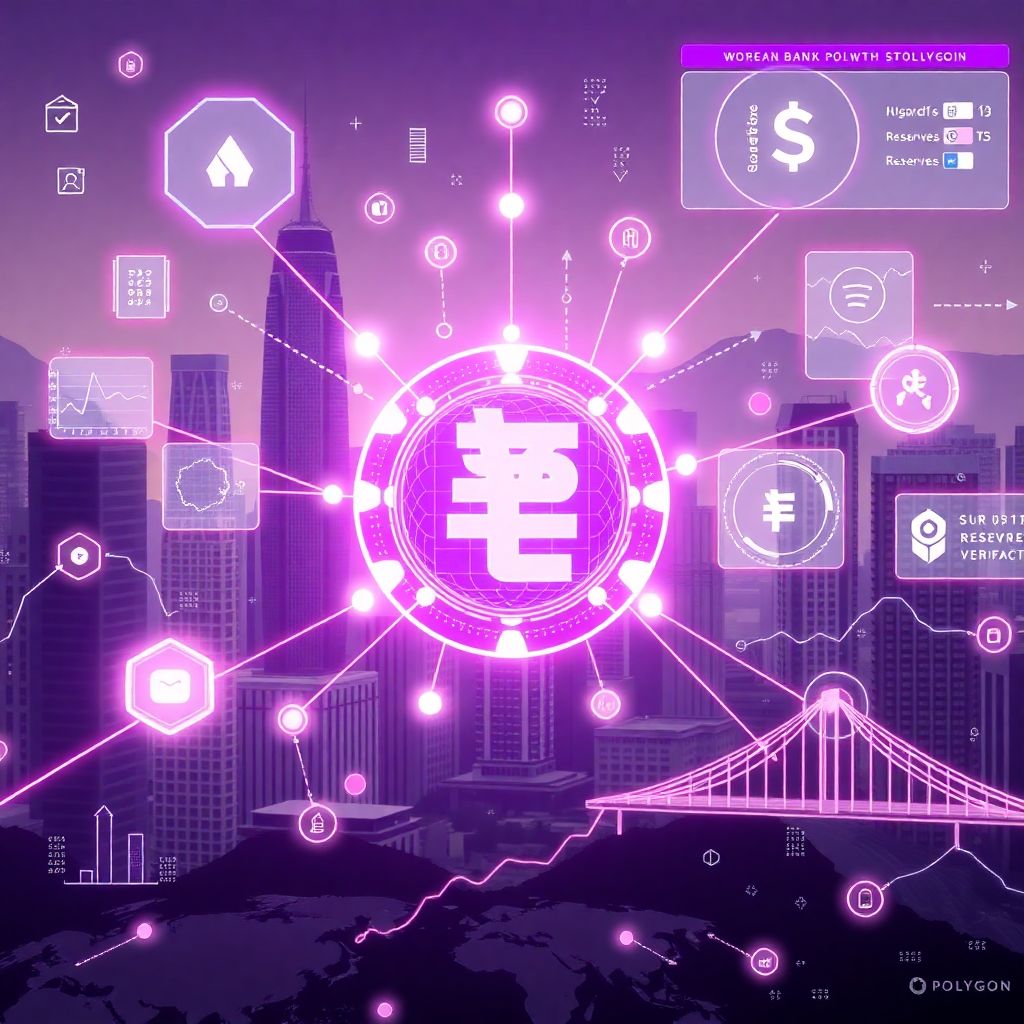
BDACS launches KRW1, a KRW-backed stablecoin, on Polygon with real-time reserve verification
BDACS has deployed its Korean won–pegged stablecoin KRW1 on the Polygon network, expanding the asset’s reach beyond its original infrastructure and positioning it for broader use in payments, remittances, and institutional finance. The rollout follows a proof-of-concept phase that tested the entire cycle from fiat deposits in Korean won to on-chain settlement, demonstrating stable performance and near real-time execution.
According to BDACS, KRW1 on Polygon is designed as a foundational layer for digital payments and enterprise-grade financial operations rather than a purely speculative asset. Polygon’s high throughput and low-cost environment are expected to support frequent microtransactions, recurring payment flows, and large-scale settlement processes without the friction associated with legacy rails or more expensive blockchain networks.
A key differentiator of KRW1 is its collateralization model. BDACS states that every unit of KRW1 in circulation is fully backed by Korean won reserves held at domestic commercial institutions, including Woori Bank. This reserve backing is not only maintained but continuously verified through a direct API integration with Woori Bank, providing what the company describes as real-time proof-of-reserves. Instead of depending on delayed attestations or periodic audits, KRW1’s architecture enables on-demand confirmation that the corresponding fiat collateral exists and is properly matched to the circulating supply.
This transparency mechanism is central to BDACS’s positioning within an increasingly regulated digital asset landscape. Industry analysts suggest that the ability to deliver real-time, bank-linked reserve verification may put KRW1 ahead of regulatory requirements that are now emerging in South Korea and across Asia-Pacific. For institutional participants, this model reduces counterparty and opacity risk, potentially making KRW1 more acceptable for treasury operations, corporate payments, and regulated financial products.
Polygon, for its part, has spent the past several years cementing its position as an infrastructure provider for digital payments, tokenization, and institutional-grade stablecoins. The network already counts among its partners large global payment and fintech companies such as Stripe, Circle, and Mastercard, and it has been involved in wallet infrastructure, exchange integrations, and multi-rail payment experiments. Executives at Polygon point to the KRW1 deployment as another building block in their digital payments framework, highlighting the network’s tooling, developer ecosystem, and integration capabilities as reasons why regulated stablecoins are increasingly choosing Polygon as a home.
KRW1’s arrival on Polygon aligns with BDACS’s multi-chain expansion strategy. Rather than confining KRW1 to a single blockchain, BDACS aims to distribute the stablecoin across several networks to improve liquidity, enhance accessibility, and allow users to choose the infrastructure that best fits their needs. Industry observers note that this approach is becoming standard for serious stablecoin issuers, as multi-chain availability can reduce fragmentation and allow smoother capital flows across various DeFi protocols and payment platforms.
The Polygon deployment may also accelerate KRW1’s visibility in global markets. As more businesses and institutions experiment with Web3-based financial infrastructure, a fiat-stable asset tied to a major Asian currency can fill an important gap in cross-border flows. Analysts point out that while USD-pegged stablecoins dominate current volumes, demand for local-currency stablecoins is growing, particularly for trade settlement, localized payroll, and hedging against exchange-rate volatility.
From a use-case perspective, KRW1 is well positioned for cross-border remittances. Migrant workers sending money to South Korea, or Korean residents sending funds abroad, often face high fees and multi-day settlement times using conventional routes. With KRW1 on a high-throughput, low-fee chain like Polygon, remittance providers can build corridors that settle nearly instantly, with transparent FX conversion and verifiable reserves backing the digital won. For end users, this can translate into lower fees, faster access to funds, and greater predictability.
Public-sector and social impact programs are another potential area of growth. Researchers highlight that KRW1’s real-time verification system could enable government agencies or NGOs to execute targeted disbursements—such as emergency aid, subsidies, or relief funds—directly to citizens’ wallets. The speed and traceability of on-chain transfers would allow authorities to confirm that funds were distributed correctly and on time, while the reserve-linked design may help satisfy stringent oversight and audit requirements.
Corporate finance teams are also likely candidates to adopt KRW1 for day-to-day operations. International payroll, cross-border vendor payments, and intercompany transfers can be optimized by using a KRW-pegged stablecoin that operates around the clock, without banking cut-off times or holidays. Polygon’s infrastructure allows batching, automation, and integration with existing ERP and treasury systems through APIs and middleware, helping enterprises bridge traditional finance with token-based settlement.
Polygon’s technical characteristics support these ambitions at scale. The network is designed to handle large transaction volumes with low finality times and minimal gas costs relative to many legacy chains. Industry representatives argue that such performance is essential if stablecoins are to move beyond speculative trading and into mainstream transactional roles. As KRW1 expands, this scalability may become a competitive edge, especially when compared with networks that suffer from congestion, higher fees, or slower settlement during peak usage.
The launch of KRW1 on Polygon could also reshape the regional stablecoin landscape. Asia-Pacific is quickly emerging as a focal point for digital currency experimentation, with multiple jurisdictions exploring stablecoins, tokenized deposits, and central bank digital currencies. Analysts believe that a robust, bank-linked KRW stablecoin running on a modern, interoperable chain may encourage other issuers and networks to improve their own transparency, settlement efficiency, and regulatory alignment, or risk losing users to more advanced alternatives.
In parallel, the deployment intersects with a broader trend towards tokenization and inter-institutional payment pilots. Polygon has been involved in various experiments around tokenized assets and cross-bank settlement, and KRW1 slots naturally into this narrative as a stable-value instrument suitable for on-chain collateral, liquidity provisioning, and programmable money flows. As regulated entities look for compliant, fiat-anchored tokens to support these pilots, KRW1 can serve as a Korean won component within multi-currency tokenized environments.
From a regulatory standpoint, BDACS’s transparency-first strategy may prove to be more than a differentiator—it could become a requirement. South Korean authorities are moving toward comprehensive digital asset frameworks that emphasize consumer protection, reserve quality, and disclosure standards for stablecoins. By tying KRW1’s supply directly to verifiable reserves in commercial banks and making that verification accessible in real time, BDACS is positioned to fulfill both current expectations and anticipated future rules, which is particularly important for institutional adoption.
There is also an emerging narrative about the role of non-USD stablecoins in rebalancing global digital finance. While dollar-based tokens dominate liquidity pools and exchange pairs, they also expose users to US monetary policy and potential regulatory shocks. A stable, transparent KRW token offers diversification for traders, liquidity providers, and businesses with exposure to Korea’s economy. In combination with Polygon’s interoperability features, KRW1 could become part of multi-currency payment routes and FX smart contracts, where automated swaps between USD, KRW, and other fiat-pegged tokens occur on-chain.
Technically inclined builders may find new opportunities around KRW1 as a programmable asset. By integrating KRW1 into smart contracts on Polygon, developers can construct subscription payments, escrow arrangements, milestone-based funding, and B2B settlement applications denominated in KRW rather than volatile cryptocurrencies. The low cost of execution on Polygon helps make these use cases viable for smaller transactions, not just large corporate deals.
For retail users, KRW1 on Polygon may gradually become a familiar tool for everyday digital money management, especially as wallet interfaces improve and custodial solutions evolve. Consumers could hold KRW1 as a stable store of value within Web3 applications, pay for services in KRW without conversion to foreign stablecoins, or move funds between exchanges and DeFi protocols without exiting to traditional banking rails each time. As regulatory clarity increases, integration with card rails and merchant ecosystems could further blur the line between on-chain KRW and conventional bank balances.
Stepping back, the KRW1–Polygon partnership illustrates how the stablecoin sector is maturing. Rather than focusing solely on market capitalization and trading volume, leading issuers and networks are emphasizing transparency, regulatory compliance, and real-world utility. BDACS’s use of bank-linked proof-of-reserves, combined with Polygon’s institutional partnerships and payment-centric roadmap, points toward a future where stablecoins function as core financial infrastructure rather than speculative instruments.
As multi-chain strategies gain traction and Asia-Pacific jurisdictions refine their approaches to digital assets, KRW1 on Polygon may influence how other currencies and issuers design their own products. If the model of fully collateralized, real-time verified reserves on high-performance networks proves successful, it could set a benchmark for what regulators, institutions, and end users expect from next-generation stablecoins worldwide.