
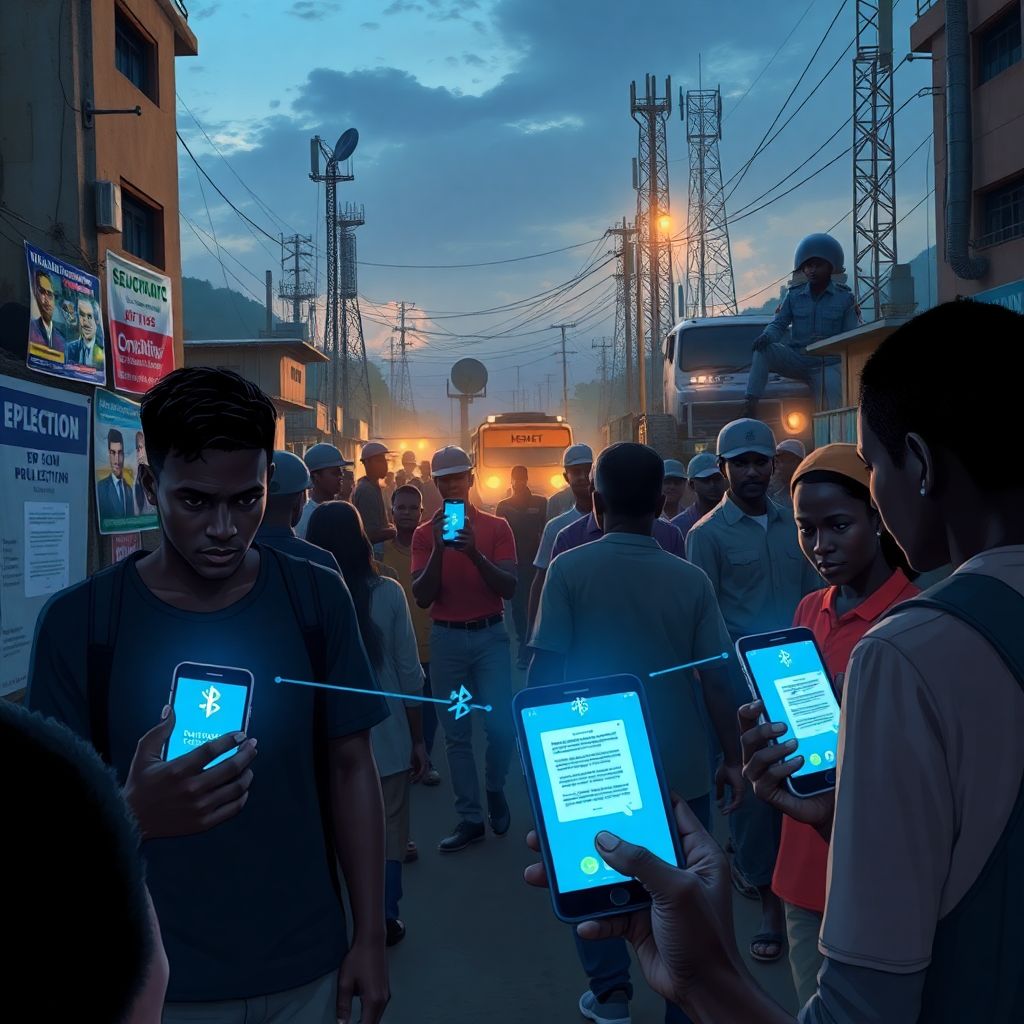
Jack Dorsey’s offline messaging app Bitchat is seeing an explosive rise in interest and usage across Uganda, as citizens and opposition figures brace for what they fear could be yet another pre-election internet blackout ahead of the 2026 polls.
Over just a few days, search activity related to the app has jumped sharply. Google Trends data shows that queries for “Bitchat” in Uganda have skyrocketed, with associated terms such as “bitchat apk,” “bitchat mesh,” “what is bitchat,” and “how to use bitchat” all flagged as breakout searches. In Google’s terminology, this indicates that the search volume for these phrases has surged dramatically in a short time frame, from a very low base to a notable peak.
Bitchat positions itself as a censorship-resistant, decentralized messaging tool that works without traditional internet connectivity. Instead of routing messages through remote servers, the app uses Bluetooth-based mesh networking between nearby smartphones. Each device in the mesh acts as a node that can receive, store, and forward encrypted messages to others within range, gradually propagating communication across a local area even when mobile data and Wi-Fi are unavailable.
A core feature of Bitchat is its minimal requirement for user identity. People do not need to register with a phone number, SIM card, or email address. Messages are stored locally on users’ phones, not in a centralized database. This architecture is designed to reduce dependence on telecom infrastructure, limit the ability of governments to intercept or block traffic, and make it harder to link real-world identities to specific accounts or conversations.
This model has already attracted users in other politically tense environments. Over recent months, the app has gained traction in places such as Nepal, Madagascar, and Indonesia, where demonstrators and activists have reportedly relied on Bitchat to communicate during protests, avoid government monitoring, and stay connected when authorities restricted internet access or throttled social media platforms. For those facing shutdowns and heavy surveillance, Bitchat is increasingly perceived as a practical workaround rather than a niche experiment.
In Uganda, the app’s visibility rose sharply after Robert Kyagulanyi, better known as Bobi Wine, publicly encouraged citizens to install it. Wine, a prominent opposition leader and musician-turned-politician, has framed Bitchat as a critical safeguard against what he alleges are recurring tactics by the ruling government to restrict communication during election periods.
“As we all know, the regime is plotting an internet shutdown in the coming days, like they have done in all previous elections,” Wine wrote in a post on X dated Dec. 30. He accused authorities of cutting off access “in order to block communication and ensure that citizens do not organise, verify their election results and demand for accountability over the massive election theft.”
Wine is challenging the long-standing rule of President Yoweri Museveni, who has been in power for decades. During Uganda’s 2016 and 2021 elections, the government ordered a comprehensive shutdown of internet services for five days starting on the eve of voting. Social media sites were blocked, mobile data was cut off, and digital communication across the country was severely disrupted, drawing international criticism and fueling accusations of electoral manipulation.
Reports from December 2025 suggest that the pattern could repeat. According to those accounts, the Electoral Commission and security agencies in Uganda have held internal discussions about imposing another temporary internet shutdown. Officials have framed such measures as necessary to combat misinformation, hate speech, and sectarian content circulating on social media. Critics, however, view these justifications as a pretext for tighter information control.
Wine disputes the official narrative, arguing that the true objective is to impede the opposition’s ability to monitor the vote. He has specifically highlighted the importance of Declaration of Results Forms (DR Forms), which record the tally of votes at each polling station and are used to verify official results. By cutting off internet access, he claims, authorities make it harder for polling agents and observers to quickly transmit images or copies of these forms to centralized teams that can compare them against the announced totals.
“You will be able to send pictures of DR Forms and share any other critical information to specific or other users,” Wine told supporters as he encouraged them to download and learn to use Bitchat ahead of time. In his framing, the app is not merely a chat tool but a key instrument for parallel vote tabulation and grassroots oversight of the electoral process.
Usage metrics seem to support the perception of a nationwide rush to adopt the technology. Data from Chrome-Stats indicates that Bitchat downloads have spiked in the past week, with more than 32,000 new installations recorded. Within a single 24-hour window, the app reportedly added 4,252 downloads, underscoring how rapidly it is spreading as talk of potential shutdowns intensifies.
For many Ugandans, the appeal of Bitchat lies in its ability to function in environments where connectivity is unreliable or deliberately suppressed. Traditional messaging apps like WhatsApp, Signal, or Telegram depend on access to the internet and to centralized servers. When a government orders telecom providers to block data services, these platforms often become unusable overnight. Mesh-based applications, by contrast, allow communication to hop directly from phone to phone, bypassing the need for a working cellular or broadband network.
Technically, this approach has limits: Bluetooth range is relatively short, and the network’s effectiveness depends heavily on how many people are using the app in a given area. However, in densely populated urban centers, crowds at rallies, or clusters of polling stations, a sufficiently large number of Bitchat users can create a dense enough mesh for messages and images to move across neighborhoods even without the internet.
The anonymity of Bitchat is also a key selling point in a politically charged climate. Because the app does not require a SIM card or personal credentials, it offers a layer of protection for activists who fear being targeted for their online activity. This can make it harder for authorities to link a specific device or user account to political content or coordination, especially in contexts where SIM registration is tightly controlled and connected to national ID systems.
At the same time, the rise of such tools raises broader questions about the future of digital communication in authoritarian or semi-authoritarian environments. Mesh messaging apps challenge the assumption that shutting down the internet is an effective way to silence dissent or prevent information from spreading. When citizens can continue to share photos, videos, and updates offline, shutdowns may become less of an absolute barrier and more of a partial obstacle.
However, the same characteristics that make Bitchat attractive to activists—encryption, anonymity, and decentralization—also prompt concerns among some policymakers and security agencies. Encrypted peer-to-peer platforms can be misused for criminal activity, disinformation campaigns, or incitement to violence, and authorities often point to these risks when justifying broader surveillance or shutdown powers. Balancing the legitimate need for public safety with the right to private, secure communication remains one of the most contentious debates in digital governance.
Uganda’s situation fits into a larger global pattern in which governments, especially during sensitive political moments, have resorted to internet restrictions. Over the past decade, complete shutdowns, targeted blocks of social media, and throttling of network speeds have been documented in multiple regions. Each time, citizens and civil society groups have scrambled to adopt alternative technologies, from virtual private networks to satellite messaging and now Bluetooth mesh apps like Bitchat.
For opposition movements and human rights advocates, the adoption of such tools is part of a broader strategy to maintain transparency and accountability around elections. Rapidly sharing images of polling station results, coordinating observers, and documenting potential abuses all rely on the ability to communicate in real time or near real time. Tools like Bitchat help preserve those capabilities even when authorities attempt to constrain the digital space.
The surge in Ugandan interest in Bitchat also illustrates how quickly tech solutions can spread when amplified by influential local voices. While the app’s association with Jack Dorsey, a well-known figure in the tech world, may attract global attention, its takeoff on the ground appears driven primarily by immediate, practical concerns: fear of being cut off from information, frustration with past shutdowns, and the desire to safeguard the integrity of the upcoming vote.
Looking ahead to the 2026 election, several scenarios are possible. If the government proceeds with an internet shutdown, the adoption of offline tools like Bitchat could enable a parallel information ecosystem, making it harder to completely isolate communities from one another. If, under domestic or international pressure, authorities refrain from a full blackout, the mere possibility of robust offline communication might still reshape their calculations around digital control.
For everyday Ugandans, the sudden prominence of Bitchat is a reminder that elections are no longer fought only at the ballot box or in the streets; they are also contested in the invisible layers of digital infrastructure. The choice of which apps to install, how to share information, and how to organize securely has become central to how citizens participate in political life.
Whether Bitchat will remain a central tool in Uganda after the 2026 polls, or whether its usage will decline once the immediate threat of a shutdown passes, is still unclear. But its rapid rise in the country underscores a deeper trend: in environments where power is contested and information is tightly managed, decentralized technologies are increasingly stepping in to keep people connected when traditional channels go dark.