
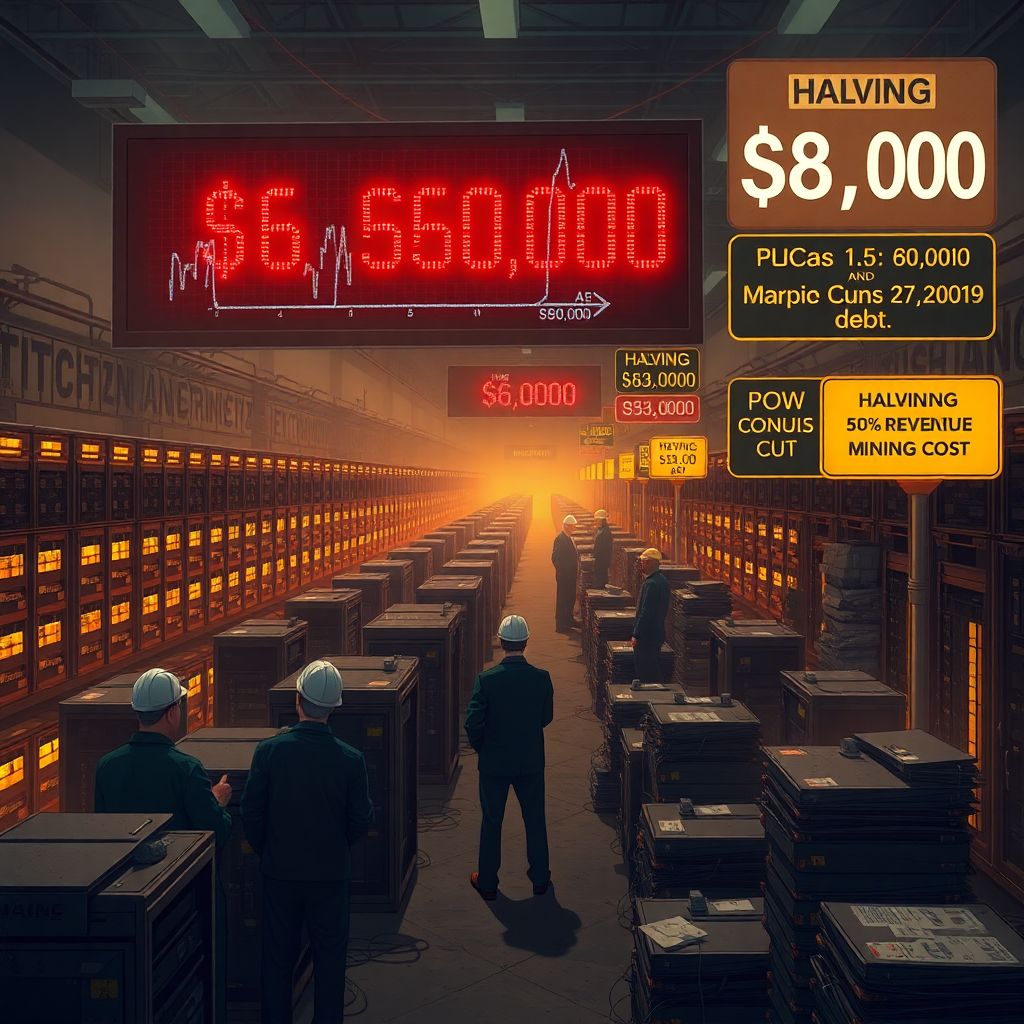
Bitcoin miners are edging toward a breaking point as the price of BTC slides, compressing profit margins just months after the latest halving event.
After a sharp sell-off, Bitcoin has dropped about 50% from its October peak and recently traded below $63,000—dangerously close to what it costs some industrial miners to produce a single coin. That proximity between market price and production cost is raising alarms about a potential wave of miner stress, consolidation, or outright capitulation if prices fall further or stay depressed for long.
A widely shared chart from on-chain analytics platform Checkonchain has added fuel to the discussion. It tracks Bitcoin’s “difficulty regression price,” a metric derived from a statistical relationship between Bitcoin’s market price and its mining difficulty over time. At the moment referenced, that regression value hovered around $86,000—far above the actual spot price of Bitcoin. Many observers interpreted this as evidence that miners are already operating deep in the red.
However, this interpretation oversimplifies how mining economics work. As Julio Moreno, head of research at CryptoQuant, has pointed out, the difficulty regression line is an indirect proxy, not a direct measurement of real-world operating costs. It does not explicitly incorporate variables like regional electricity prices, hardware purchase and depreciation, cooling, labor, maintenance, or financing obligations. Instead, it uses historical data to infer a “fair value” band based on how price and difficulty have moved together in the past.
In reality, the break-even cost of mining Bitcoin varies widely from one operation to another. Some miners in regions with ultra-cheap energy, such as those using hydroelectric surplus or flared natural gas, can still generate BTC at significantly lower costs than large public companies paying commercial power rates. Others, especially firms that expanded aggressively during the bull market, are saddled with expensive machines, high-interest debt, and energy contracts that leave them exposed when revenue shrinks.
Even so, the direction of travel is clear: the margin of safety has shrunk dramatically. The most recent halving cut the block subsidy from 6.25 BTC to 3.125 BTC per block, instantly slashing miners’ revenue in coins by 50%. For that reduction to be sustainable, either the Bitcoin price must rise substantially, transaction fee income must grow, or miners must become dramatically more efficient. When the halving is followed, instead, by a steep price drop, many miners find themselves squeezed from both sides.
Publicly traded mining companies are especially vulnerable because they typically carry higher fixed costs and are under constant scrutiny from shareholders and creditors. Their average cash cost to mine one BTC often clusters in a relatively narrow band—close enough to current prices that an extended downturn can push them into negative margins. When that happens, mining each additional coin actually loses money on a cash basis, not even counting hardware depreciation.
This is where the risk of a “miner crisis” begins to look real. If Bitcoin’s price dips significantly below the effective production cost of a critical mass of miners, several cascading effects can follow:
First, the industry usually enters a phase of rapid cost-cutting. Miners shut down older, less efficient ASICs, reduce operating hours in higher-cost facilities, and renegotiate power contracts where possible. Some firms delay capital expenditures, halt expansion plans, or sell surplus equipment at a discount. The objective is simple: survive until conditions improve.
Second, balance sheets come under stress. Companies that relied heavily on debt to finance infrastructure during the bull run may struggle to service those obligations when cash flow weakens. They may be forced to sell parts of their Bitcoin treasury at unfavorable prices, raise dilutive equity capital, or divest data centers and other assets. In extreme cases, bankruptcy or forced mergers become the only option.
Third, the Bitcoin network itself responds mechanically. As unprofitable miners power down, total network hash rate—the combined computing power securing the chain—declines. Over time, this triggers Bitcoin’s built-in difficulty adjustment, which reduces the complexity of the cryptographic puzzles miners must solve. That, in turn, lowers the cost of mining for those who remain, partially restoring profitability.
This feedback loop is why some analysts argue that miner capitulation, while painful for individual companies, is ultimately healthy for the network. Inefficient miners are flushed out, the hash rate stabilizes at a lower but still secure level, and those with the lowest costs gain a larger share of future rewards. Historically, severe miner stress has often coincided with late-stage bear markets, followed by periods of renewed strength.
Yet this theoretical resilience does not eliminate the short-term risks. A rapid and deep drop in hash rate can raise concerns about network security or centralization, especially if a small number of large players control a disproportionate share of the remaining computing power. It can also create volatility around difficulty adjustments, with swings in block times and transaction confirmation speed.
For investors in mining stocks, the situation is even more delicate. Mining equities tend to behave as leveraged plays on Bitcoin itself: when BTC rallies, their profits can surge, and when BTC falls, their margins compress far more aggressively than the underlying asset’s price. A 50% drawdown in Bitcoin from its recent peak, combined with a halved block reward, is precisely the kind of stress test that exposes which business models were built for durability and which relied on perpetual bull-market conditions.
Some miners have tried to hedge this cycle risk through diversification. Strategies include building out high-performance computing and AI hosting services alongside traditional Bitcoin mining, securing long-term fixed-rate power contracts, or co-locating in regions with abundant renewable energy. Others employ sophisticated financial hedges—using derivatives to lock in a minimum BTC price for a portion of their production or to manage power price volatility. These approaches can soften the blow of a price crash, but they rarely eliminate it altogether.
Another critical variable is transaction fee revenue. In theory, as block subsidies decline with each halving, fees should gradually become a more important component of miner income. Periods of intense demand—such as during network congestion or speculative mania in new token standards—have indeed produced short-lived spikes in fees that sometimes rival or exceed the block reward. However, fee income has historically been volatile and unpredictable, making it a risky pillar for miners to rely on as a consistent buffer.
For long-term Bitcoin holders, miner distress can be interpreted in two opposing ways. On one hand, a wave of forced selling from miners needing to cover operating expenses could add downward pressure to the market in the short run. On the other hand, every such stress episode that the network survives reinforces the narrative that Bitcoin’s economic design is robust enough to endure booms and busts without central intervention.
If prices continue to hover near production cost, the mining industry is likely to undergo significant consolidation. Larger, better-capitalized firms with access to cheap energy may acquire struggling competitors, scooping up their infrastructure at a discount. Smaller independent miners could be pushed out or absorbed, reducing the diversity of players but potentially increasing average operational efficiency. This consolidation trend has appeared in previous cycles and may accelerate if the current downturn persists.
Looking ahead, several scenarios are possible. If Bitcoin manages to rebound sharply from current levels, many of today’s worries will fade, and miners who endured the lean period could emerge stronger, with a larger share of the network and improved cost structures. If, however, BTC drifts lower or grinds sideways for an extended period, the industry may face a protracted shakeout, punctuated by bankruptcies, distressed asset sales, and ongoing hash rate volatility.
From a strategic standpoint, miners that survive this phase will likely be those that treat Bitcoin’s cyclicality as a core assumption, not an exception. That means building business models that can withstand long stretches of marginal profitability, maintaining prudent leverage, and preparing for each halving as a known and predictable shock rather than a surprise. In that sense, the current environment is a stark reminder that mining is not just a technology arms race—it is a capital-intensive, commodity-like business where cost discipline often matters more than headline hash rate.
In the meantime, the line between “healthy adjustment” and “full-blown crisis” will depend on how deep and how long the price stays near or below miners’ effective production costs. The network will adapt as it always has, but for many operators on the ground, the coming months could determine whether they remain in the game at all.