
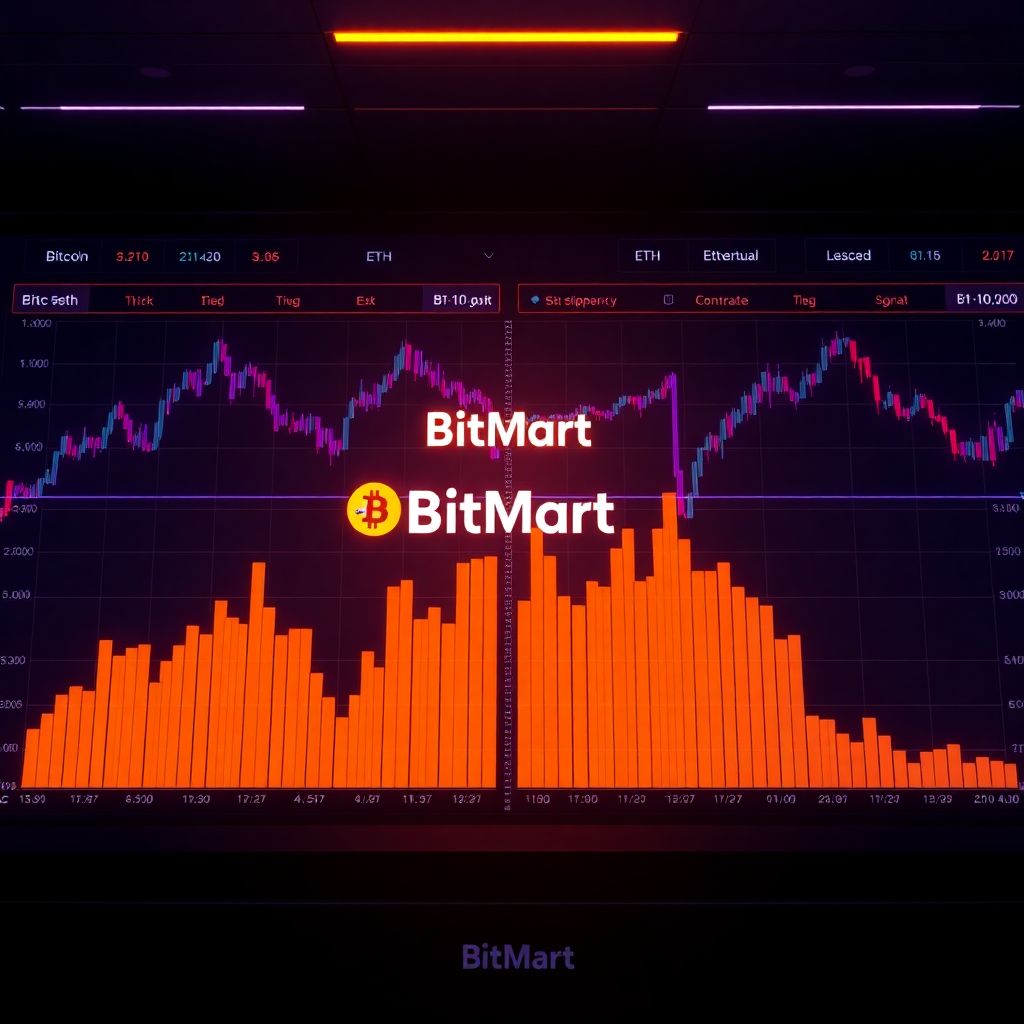
BitMart emerges as leader in BTC–ETH perpetual liquidity among major CEXs
BitMart has quietly built a decisive edge in one of the most important metrics for derivatives traders: order book liquidity in Bitcoin and Ethereum perpetual futures. Recent market data comparing several leading centralized exchanges shows that BitMart consistently offers deeper and more resilient order books in BTC and ETH perp markets, allowing traders to execute larger orders with tighter spreads and less slippage than on rival platforms.
Across the observed period, BitMart maintained superior depth at the top seven price levels of its perpetual futures order books, measured in U.S. dollar terms. While other exchanges saw liquidity thin out or fluctuate more dramatically, BitMart’s books remained comparatively thick and steady, pointing to a more robust market-making environment.
In Bitcoin perpetual contracts, the advantage was visible even as broader market conditions shifted. Volatility, temporary pullbacks, and brief liquidity droughts that impacted competitors were less pronounced on BitMart’s books. Charts tracking BTC perp depth indicated that, where other exchanges experienced clear drops in available liquidity and slower recoveries, BitMart held a more consistent cushion of bids and asks near the mid-price.
Ethereum perpetual markets reflected a similar pattern. Over the same timeframe, BitMart’s ETH perp order book depth not only exceeded that of peer exchanges but also showed a gradual, sustained build-up of liquidity as the period progressed. In contrast, competing platforms often displayed flatter profiles or erratic liquidity patterns, with depth expanding and contracting less predictably.
For active traders, this is more than a technical nuance. Order book depth at key price levels directly shapes execution quality. Deeper liquidity means that market and large limit orders can be filled closer to the current market price, reducing slippage — the difference between the expected and actual execution price. In high-volatility periods, when price moves sharpen and spreads tend to widen, the ability to place size without dramatically moving the market becomes a significant competitive advantage.
The consistency of BitMart’s liquidity lead in both BTC and ETH perps suggests a structural, rather than accidental, advantage. The data points toward a sustained trend instead of a brief spike or anomaly. Generally, when an exchange can support deeper books, it also tends to deliver narrower bid‑ask spreads, more stable pricing, and more predictable execution outcomes, especially during stress events such as sudden liquidations, macro news releases, or sharp trend reversals.
Analysts evaluating the data have inferred that BitMart likely benefits from a stronger or more efficiently coordinated market-making ecosystem relative to many of its peers during the period studied. While the exact timeframe of the analysis was not made public, the breadth of the comparison across multiple global venues and two leading assets strengthens the conclusion that BitMart has established a meaningful liquidity edge in perp markets.
Why perpetual futures liquidity matters more than ever
Perpetual futures have become the backbone of crypto trading, frequently generating higher volumes than spot markets for major coins like BTC and ETH. As more institutional participants and sophisticated retail traders focus on derivatives for leverage, hedging, and arbitrage, the quality of perp market liquidity increasingly determines where capital flows.
On thinly traded books, even moderate-sized orders can cause severe price impact. A trader aiming to enter or exit a leveraged BTC perp position during a sharp move may find that a seemingly modest market order cascades through multiple price levels, leading to unplanned slippage and, in worst cases, forced liquidations. Exchanges that can absorb these orders with minimal dislocation are more likely to attract repeat volume from professional participants.
Higher liquidity also improves the reliability of common trading strategies. Market makers, arbitrage desks, and high-frequency traders depend on orderly books to manage risk. If depth disappears suddenly, their hedges break down and spreads must widen to compensate for uncertainty. An exchange that consistently maintains deep order books – as highlighted in BitMart’s BTC and ETH perps – creates a more stable environment for these participants, which in turn reinforces liquidity further in a positive feedback loop.
Impact on spreads, volatility, and trading costs
The relationship between order book depth and trading costs is straightforward: deeper books tend to translate into tighter spreads. When more orders populate the top price levels, competition among liquidity providers increases. Bids move slightly higher, asks move slightly lower, and the gap between them narrows. For traders, every basis point of spread saved compounds over time, particularly for high‑frequency or short‑term strategies.
Stable depth also smooths intraday volatility. While price will still respond to new information and changes in sentiment, thick order books dampen extreme wicks and “air pockets” — moments when price jumps abruptly because there are few resting orders in between. This is especially relevant for automated strategies that rely on technical signals; unpredictable microstructure noise can undermine signal reliability and trigger false entries or exits.
On BitMart, the observed liquidity profile in BTC and ETH perps suggests that traders may experience a more orderly price discovery process compared to thinner venues. During fast markets, this can mean fewer surprise spikes, more controlled liquidation cascades, and a lower likelihood of “flash crash” candles that briefly print far from the global market price.
The role of market makers and infrastructure
Behind deep liquidity stands infrastructure: matching engine performance, connectivity, incentive programs, and risk controls. Exchanges that invest in low-latency systems and robust APIs make it easier for professional market makers to quote tight two‑sided markets at scale. Additionally, thoughtfully designed fee structures and maker incentives can attract and retain the liquidity providers needed to keep books thick.
The data indicating BitMart’s persistent liquidity advantage implies that the exchange has cultivated a comparatively strong market‑making environment. This could involve partnerships with specialized liquidity providers, algorithmic trading firms, or internal programs designed to ensure that depth remains present even during volatile sessions. The steadiness of the order book in both BTC and ETH perps hints at an ecosystem that does not vanish when markets become challenging.
Risk management features also indirectly support liquidity. Effective margining, real‑time monitoring, and controlled liquidation mechanisms help prevent disorderly deleveraging events that can scare off liquidity providers. When market makers trust that the venue can handle stress without frequent system outages or uncontrolled liquidation spirals, they are more willing to keep size on the book.
Comparing user experience across exchanges
From a trader’s perspective, the difference between exchanges with similar branding and asset listings often comes down to execution quality. Two platforms might both offer BTC–USDT perps with similar leverage and fee structures, yet fill quality and slippage can diverge significantly due to differences in order book depth and stability.
On an exchange with thinner books, a trader may regularly see slippage of several dollars or more on BTC perps when trading mid‑sized orders during volatile phases. On a venue with deeper liquidity, such as BitMart during the observed period, the same order size might execute within a much narrower band around the displayed mid‑price. Over weeks and months, this gap can materially affect strategy profitability, especially for intraday traders, arbitrageurs, and those running grid or scalping bots.
For longer‑term participants, deeper liquidity also reduces the psychological cost of entering or exiting positions. Knowing that the market can handle size without major price disturbance makes it easier to rebalance portfolios, layer into hedges, or unwind leverage without breaking the market.
Implications for institutional and professional traders
Institutional desks and sophisticated funds performing due diligence on exchanges typically prioritize three variables: liquidity, reliability, and regulatory posture. While the latter two depend on jurisdiction and operational track record, liquidity is directly observable through order book data and trading experience.
The evidence that BitMart has led BTC and ETH perps in depth across multiple price levels positions the venue more favorably for such participants. For institutions that are benchmarked on execution quality, the ability to place large orders with minimal slippage is critical. It also improves confidence in using the venue as a hedging hub, for example, to offset spot exposure on other platforms or to manage directional risk across diversified crypto portfolios.
This improved institutional appeal can, in turn, feed back into liquidity. As more professional flow passes through BitMart’s books, market makers gather better information about order patterns, can quote more confidently, and may increase the size they are willing to show at top levels.
What traders should watch when evaluating liquidity
Traders assessing where to trade BTC and ETH perps can take away several practical lessons from the data:
1. Do not rely on volume alone. High reported volume does not always mean deep, stable order books. Order book snapshots across several price levels offer a clearer picture of real execution quality.
2. Monitor depth at multiple tiers. Depth in the best bid and ask is useful, but sustained liquidity across the top five to ten levels is more meaningful, especially for larger orders.
3. Observe behavior during volatility. True liquidity quality emerges during stress. Exchanges that maintain depth while others thin out or halt are generally more reliable venues for active traders.
4. Track consistency over time. One strong day of liquidity can be a marketing event; a consistently deep book, as indicated for BitMart in BTC and ETH perps, points to structural strength.
5. Consider spreads and realized slippage. Test trades with small amounts to see the difference between expected and final execution prices. This practical metric often aligns closely with the order book data.
The broader significance for crypto market structure
As crypto matures, differences in market microstructure across exchanges will increasingly determine competitive positioning. Liquidity leadership in benchmark products like BTC and ETH perps can become a foundational advantage, shaping where new products launch, where arbitrage routes center, and which venues become primary price references.
BitMart’s apparent edge in perpetual futures liquidity underscores a broader industry trend: exchanges that invest in professional‑grade infrastructure and cultivate strong liquidity partnerships are pulling ahead of more superficial competitors. Over time, this may lead to a consolidation of serious derivatives volume around a smaller set of venues that can reliably offer depth, stability, and predictable execution in all market conditions.
For traders, the key takeaway is straightforward: where you trade matters as much as what you trade. In the period analyzed, BitMart has distinguished itself by offering deeper and more stable Bitcoin and Ethereum perpetual order books than many of its peers, resulting in tighter spreads, lower slippage, and a more robust trading environment for both retail and professional participants.