
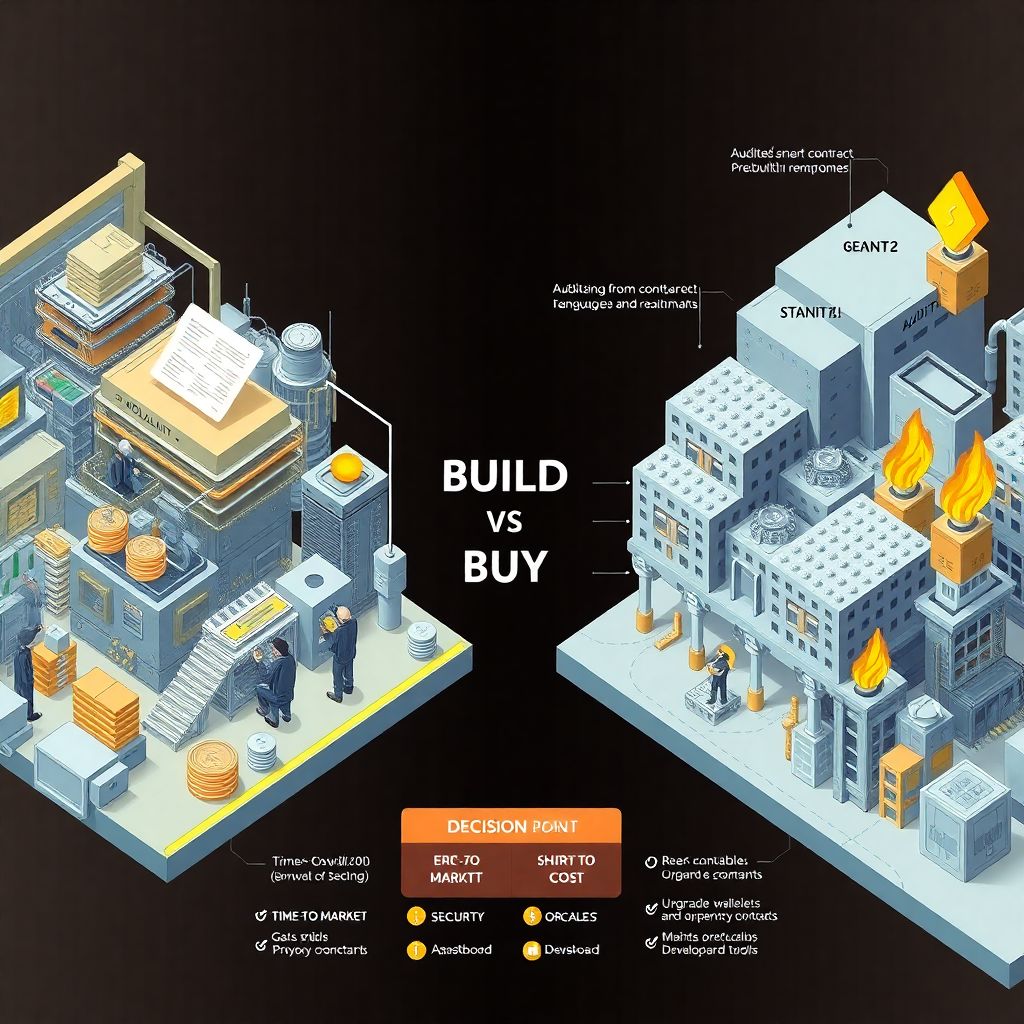
The build vs buy decision: how modern blockchain teams ship 10x faster
——————————————————————–
Web3 development has entered a very different phase. Spinning up a blockchain product no longer automatically means months of Solidity work, a bench of highly paid specialists, and a six‑figure budget before you even see a testnet deployment. Increasingly, teams are assembling production‑grade systems from prebuilt components and audited codebases, cutting DeFi build costs by up to 90% and shrinking timelines from quarters to weeks—or even days.
Why the economics of blockchain development flipped
Half a decade ago, the default path for any serious web3 project was full custom development. Founders would:
– Hire or contract a team of Solidity engineers
– Design every smart contract from the ground up
– Iterate through long audit cycles
– Spend months integrating wallets, oracles, and frontends
Only after burning through significant runway would mainnet deployment become realistic.
That model still makes sense for projects pushing the boundaries of protocol design: new consensus mechanisms, novel AMM curves, unconventional derivatives, or untested governance systems. But most blockchain products are not reinventing finance from first principles.
For the majority—token launches, staking dashboards, launchpads, DEX forks, NFT collections, basic lending markets—much of the logic has already been standardized, battle‑tested, and commoditized. Writing those components from scratch is less a technical necessity and more a misallocation of scarce capital and time.
The hard numbers: custom code vs production‑ready templates
The cost differential between building and buying is stark.
– Senior Solidity developers regularly bill in the range of 150–300 USD per hour
– A full‑featured DeFi application commonly requires 100,000–300,000 USD in engineering effort
– Security audits start at around 10,000 USD for simple contracts and scale beyond 100,000 USD for complex protocols or large codebases
These figures also assume clean execution—no major refactors, no vulnerability discoveries mid‑audit, no multi‑week delays waiting for security firms’ availability.
By contrast, acquiring production‑ready smart contracts or complete project templates from specialized marketplaces compresses both time and cost dramatically. Teams replace months of custom build and QA with days of configuration, integration, and brand‑specific customization, while reusing patterns that have already been exercised in production.
Reports from teams using this approach point to cost reductions on the order of 80–90% for standard product types, with time‑to‑market shrinking from several months to a few sprints.
The rise of blockchain code marketplaces
Software marketplaces are a familiar pattern in traditional development. WordPress themes migrated from scattered zip files and personal blogs to structured template platforms. Mobile developers turned to app UI kits, template projects, and backend boilerplates instead of greenfield builds.
Blockchain is following the same trajectory.
Dedicated web3 code marketplaces have emerged as curated hubs where founders and developers can purchase complete, configurable project source code rather than reinventing existing solutions. A representative example is platforms that bundle:
– Marketplaces of production‑ready smart contracts
– Complete dApp templates (frontend + backend + contracts)
– Integrated documentation, deployment scripts, and configuration guides
– Catalogs of developer tools—RPC providers, indexing services, testing frameworks, security toolchains
One such platform lists dozens of developer tools grouped into categories, covering everything from node providers and SDKs to static analysis and formal verification utilities.
The value proposition is not just having code in one place. It is about curation and readiness for production.
Why marketplaces beat raw open‑source for production use
Open‑source repositories are invaluable for learning and experimentation, but they introduce serious uncertainty for production systems:
– Code quality varies dramatically
– Projects may be unmaintained or abandoned
– Test coverage is inconsistent or undocumented
– Security review status is unclear or nonexistent
– Licensing terms are often misunderstood or incompatible with commercial use
Commercial and curated marketplaces attempt to bridge that gap. Listings typically ship with:
– Clear documentation and setup instructions
– Explicit deployment playbooks for multiple networks
– Dependency and versioning information
– License terms that clarify modification rights and commercial usage
– Sometimes, references to past deployments or demonstrable usage patterns
A contract that simply compiles is not equivalent to a contract suitable for handling real funds on mainnet. The discipline required to cross that gap—security hardening, edge case handling, gas optimization, upgrade paths—is part of the reason marketplace products can legitimately command significant prices even when superficially similar logic exists in public repositories.
What “production‑ready” actually means in blockchain
In traditional software, “production‑ready” often refers to stability and performance under load. In blockchain, the bar is higher because mistakes are irreversible and assets are at stake.
Truly production‑ready smart contracts and dApps usually share several characteristics:
1. Security baked into the architecture, not added later
– Protection against core classes of vulnerabilities: reentrancy, integer overflow/underflow, access control failures, frontrunning exploits, and others
– Use of established patterns: ownable roles, pausability, withdrawal patterns, and restricted administrative functions
– Emergency controls: pause switches, circuit breakers, and fail‑safes to mitigate discovered issues without fully redeploying the system
– Awareness of known issues: there are dozens of documented vulnerability categories specific to smart contracts, and robust codebases are designed explicitly with these in mind
2. Gas efficiency and cost awareness
Every wasted storage write or poorly designed loop becomes a direct tax on users. Mature implementations:
– Minimize state mutations
– Choose data structures that balance readability and gas costs
– Batch related actions where appropriate
– Avoid expensive on‑chain computations when they can be delegated off‑chain
3. Upgrade and migration strategies
Requirements evolve and bugs are inevitable. Production setups typically:
– Use proxy contracts or modularized architectures to allow safe upgrades
– Separate core logic from data storage
– Provide migration paths for users and liquidity in case of major changes
4. Integration points beyond the contract itself
Modern blockchain products are rarely “just contracts.” Production templates often include:
– Wallet connection infrastructure (e.g., integration with major browser and mobile wallets)
– Oracle hooks for price feeds or external data
– Event design that ensures frontends, indexers, and analytics tools can track system state efficiently
5. Operational and developer documentation
Beyond code comments, production‑ready packages usually include:
– Network‑specific deployment scripts
– Configuration reference (parameters, environment variables, chain IDs, etc.)
– Verification instructions for public explorers
– Runbooks for routine operations and maintenance
This is the unglamorous engineering work that distinguishes a hackathon project from a system entrusted with millions in total value locked.
The hybrid model: where build vs buy gets interesting
Framing the decision as “build everything” versus “buy everything” misses how high‑performing blockchain teams actually operate. The most efficient organizations treat it as a portfolio allocation problem.
They intentionally:
– Buy or reuse components that are standardized, commoditized, or well understood:
– ERC‑20 or ERC‑721 token contracts
– Staking, vesting, and reward distribution modules
– Basic AMM DEX implementations
– NFT marketplace primitives
– Launchpad and presale logic
– Build the parts that constitute their unique edge:
– Novel economic mechanisms or incentive schemes
– New governance experiments
– Proprietary algorithms or trading logic
– Innovative cross‑chain routing or liquidity management
Consider a DeFi team designing a new yield strategy platform. Their differentiator might be in how strategies are composed, risk‑managed, and dynamically adjusted—not in how deposits are tracked or how a basic staking pool works. By starting with prebuilt, audited components for deposits, rewards, and token issuance, they reserve engineering capacity for the mechanics that matter competitively.
The developer tools layer: glue between components
Buying reusable code does not eliminate the need for robust tooling; it changes where effort is invested.
Modern web3 development environments typically sit on a stack of:
– Node and RPC providers for reliable chain access
– Development frameworks and testing suites
– Security analysis and static checking tools
– Indexing and subgraph systems to expose data to applications
– Monitoring and alerting layers for production operations
Curated marketplaces that also reference or organize these tools can dramatically flatten the learning curve for new teams. Instead of spending weeks discovering what the ecosystem already uses, projects can start from a recommended baseline and customize as they grow.
For senior teams, the benefit is different: they can standardize on a known good stack and plug in purchased templates, shortening integration paths and limiting the number of unknowns in their architecture.
Security: the constant constraint
Amid all this acceleration, one thing does not change: security remains the non‑negotiable core of blockchain development.
Prebuilt contracts and templates can improve security when they:
– Are based on patterns that have already survived substantial on‑chain usage
– Incorporate known best practices from security researchers
– Have been through independent review or repeated audits in similar configurations
But buying code does not remove the need for due diligence. Teams still need to:
– Review and understand the purchased codebase
– Run their own tests and simulations
– Apply targeted audits for custom integrations or new logic
– Maintain secure deployment and key management practices
The worst outcome is blind trust in any code—open‑source or commercial—without verification. The best outcome is a combination of mature templates plus a rigorous review process tailored to the final assembled system.
How different stakeholders are affected
The build vs buy shift impacts everyone around a project differently:
Founders and product owners
– Faster iteration from idea to MVP and then to mainnet
– Lower upfront capital requirements, enabling more experiments
– Ability to validate market demand before over‑investing in custom development
Developers and technical leads
– Less time spent reinventing common modules
– More time available for architecture, optimization, and innovation
– Responsibility shifts from “write everything” to “evaluate, integrate, and extend”
Investors and treasuries
– Reduced burn during early stages
– Better capital efficiency: dollars go further toward user‑facing value
– Improved risk profile when standard, battle‑tested components are used correctly
End users
– Faster availability of new products and features
– More consistent UX across dApps using similar underlying components
– Potentially lower fees due to gas‑optimized templates and fewer critical bugs
When you should still build everything from scratch
Despite the advantages of marketplaces, there are clear scenarios where building remains the better choice:
– You are designing a fundamentally new protocol or category with no established pattern
– You need a unique security model or compliance posture that off‑the‑shelf code cannot satisfy
– Your differentiation lies precisely in the low‑level mechanics of how transactions are processed or how value is routed
– You require cryptographic primitives or privacy features that existing templates do not yet support
In these cases, templates can still inform your architecture or test strategies, but the core logic rightly remains bespoke.
Practical framework for your build vs buy decision
Teams can formalize their decision process with a few questions for each component:
1. Is this component core to our competitive advantage?
If no, strongly consider buying or reusing.
2. Are there proven, audited implementations of this pattern?
If yes, weigh the risk of rolling your own against the benefits of reuse.
3. How much will we actually customize this module?
Heavy customization of a purchased template may erode time and cost savings.
4. What is the long‑term maintenance burden?
Owning the full stack means owning all future upgrades, patches, and refactors.
5. What are the security implications of each option?
Compare the risk profiles of new custom code vs mature, widely used templates.
By methodically evaluating these dimensions, teams can assemble a hybrid architecture that maximizes speed without undermining safety or uniqueness.
Where this trajectory is heading
As web3 matures, the baseline expectation for any new blockchain product will continue to rise. Users will assume:
– Robust, audited core contracts
– Clean wallet integrations
– Reasonable gas usage
– Clear documentation and predictable behavior
Meeting that baseline through bespoke development alone will increasingly look like an avoidable luxury. Just as web2 teams no longer build their own web servers, databases, and UI frameworks from scratch, web3 teams are moving toward a world where only truly novel logic is hand‑crafted.
The rest will be composed—carefully, securely, and strategically—from a growing ecosystem of production‑ready building blocks.
—
Disclosure: This content is provided for educational purposes only and does not constitute investment advice.