
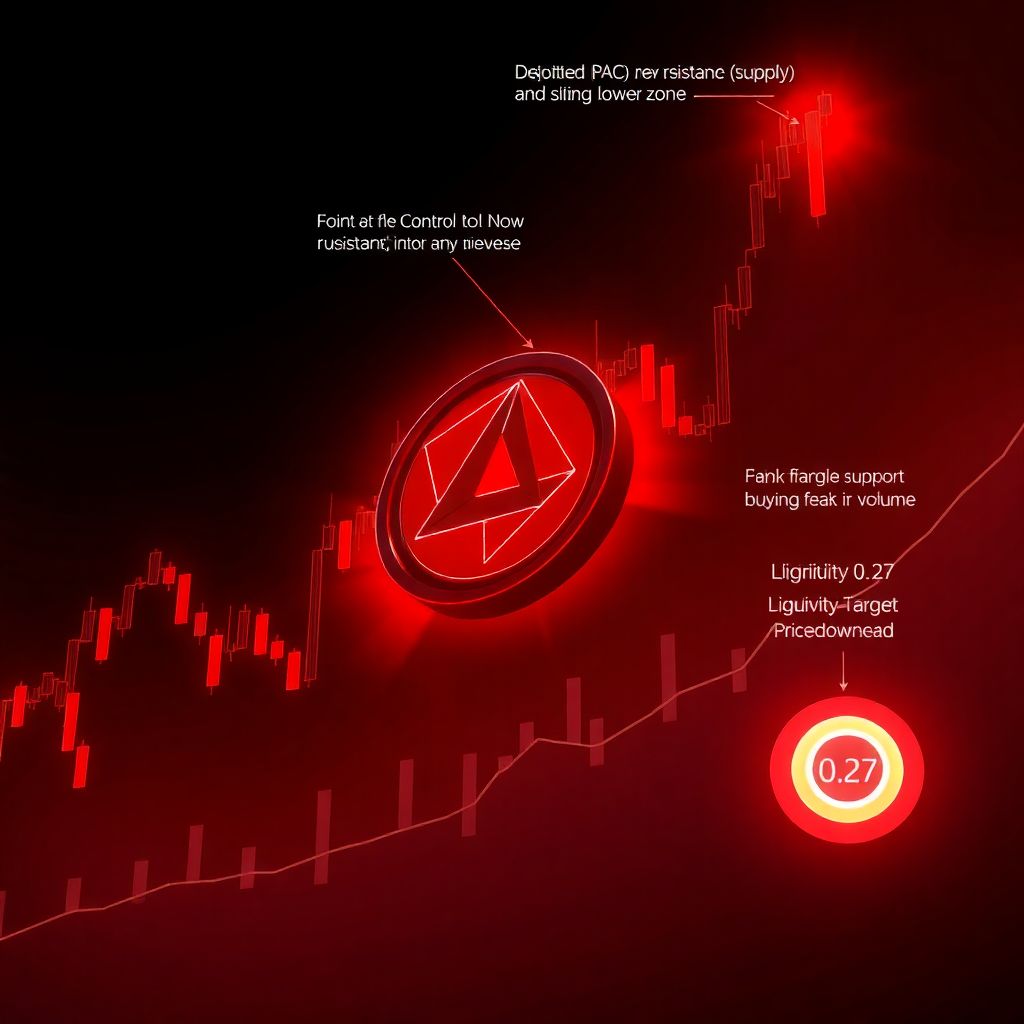
Cardano price remains under sustained selling pressure, with market structure clearly pointing to the possibility of further downside in the near term. Despite occasional pauses and minor relief rallies, bears continue to dictate direction, while buyers fail to show the strength needed to reverse the broader trend.
Persistent bearish structure dominates ADA
From a structural standpoint, Cardano (ADA) is firmly locked in a classic bearish trend: price action is defined by a sequence of lower highs and lower lows. Each attempt to push higher has been quickly absorbed by sellers, turning what could have been the start of a recovery into nothing more than short-lived corrective bounces.
In this environment, upward moves are better interpreted as countertrend rallies within a broader downtrend rather than the beginning of a sustainable bullish phase. Until ADA can convincingly break this pattern, the prevailing assumption remains that rallies are opportunities for sellers to re-enter the market rather than a sign of accumulation by strong hands.
Rejection at key resistance confirms supply zone
One of the clearest technical signals reinforcing the bearish outlook was Cardano’s reaction around the high-time-frame resistance at 0.48 dollars. After losing this level to the downside, price attempted a classic back-test – a move often used by traders to gauge whether a breakdown is genuine or a false move.
The result was decisive: ADA failed to reclaim 0.48 and was firmly rejected, confirming this zone as a strong area of supply. This rejection effectively validated the breakdown and added further weight to the ongoing downtrend, as former support has now flipped into resistance.
Point of Control lost, momentum shifts to lower value
Following the rejection near 0.48, Cardano briefly stabilized around the Point of Control (POC) of the recent trading range – the price area where the highest volume of trading had previously taken place. The POC typically acts as a battleground where control flips between buyers and sellers.
However, ADA has since lost acceptance above this key level. Instead of building value and holding near the POC, price slipped below it, signaling a transition from a balanced, range-bound state toward a new, lower-value area. With the POC now functioning as resistance rather than support, the path has been cleared for a further rotation to the downside.
Weak demand at the Value Area Low raises red flags
After rejecting from resistance and failing at the POC, Cardano rotated down toward the Value Area Low (VAL) of the broader range – an area where, under more constructive conditions, buyers often step in with conviction. The VAL is frequently seen as a potential bounce zone, where price can spring back toward the range’s midpoint.
This time, however, the response has been notably underwhelming. Attempts to rally from the VAL have lacked strength, with no meaningful increase in volume and no impulsive follow-through. Such a tepid reaction is a warning sign: it suggests that demand is thin and that buyers may not be prepared to absorb continued selling pressure.
In healthier markets, the VAL often produces sharp, energetic recoveries as bargain hunters and late buyers step in. The absence of that kind of reaction in ADA strengthens the case that this support area is vulnerable and may give way if selling continues.
Candles still signal clear seller dominance
Price-action analysis reinforces the bearish picture. Recent candles show that any push higher is quickly sold into, leaving long upper wicks and closing the session closer to the lows. This pattern indicates that sellers remain active and willing to offload positions as soon as price attempts to rise.
As long as ADA keeps printing lower highs beneath former support and now-established resistance levels, the bearish structure remains intact. The market currently shows no evidence of aggressive accumulation, no series of higher lows, and no decisive engulfing moves in favor of the bulls.
Liquidity targets lie lower, with 0.27 as a key magnet
Beyond immediate support zones, liquidity dynamics also lean toward further downside. Below the current trading levels, there is relatively little strong structural support until the swing low near 0.27 dollars – the lower boundary of the larger range that has defined Cardano’s price for some time.
Markets often gravitate toward such obvious lows to clear out resting liquidity, trigger stop-loss orders, and test the depth of demand. If intermediate support areas continue to attract weak or non-existent buying interest, it becomes increasingly likely that ADA will seek out this lower liquidity pool around 0.27.
Crucially, a move toward 0.27 would not necessarily imply capitulation or a breakdown of Cardano’s long-term viability. Within the context of the existing trend and range, it would be a continuation of the current market structure, allowing price to probe deeper into demand zones before any more durable rebalancing or trend reversal can take shape.
What traders should watch in the short term
In the immediate term, the key reference points remain the POC above and the swing low near 0.27 below:
– As long as ADA trades below the Point of Control and fails to build value above it, bearish pressure is likely to persist.
– If the Value Area Low continues to produce only shallow, low-volume bounces, the odds favor a full rotation down toward the 0.27 region.
– A sharp drop toward 0.27 accompanied by a spike in volume and a strong intraday reversal could be the first sign of real demand stepping in, but such a scenario has not yet materialized.
Short-term traders who favor trend-following approaches will generally treat failed rallies into resistance and the POC as potential opportunities to align with the prevailing downtrend, while carefully managing risk in case of a sudden squeeze higher.
Conditions needed for a bullish shift
For a credible bullish scenario to emerge, Cardano would need to invalidate the current bearish structure on multiple fronts:
1. Reclaim and hold above resistance levels
Price would need to climb back above the former support zones that now act as resistance and sustain acceptance there, not just briefly wick above. That includes retaking and defending the Point of Control as a support base rather than a ceiling.
2. Break the pattern of lower highs
A series of higher lows and higher highs on at least the mid‑time‑frame charts would be required to suggest that buyers are finally gaining traction.
3. Show strong volume on upward moves
Any genuine trend reversal is typically accompanied by increased buying volume, signaling that new capital is entering the market rather than simply short covering.
4. Defend reclaimed levels on pullbacks
Once reclaimed, key levels must be retested successfully from above. Strong bounces on such retests would confirm that market participants are willing to defend those prices.
Until such criteria are met, upward movements are more likely to be interpreted as bear-market rallies rather than the start of a new bullish phase.
Implications for different types of market participants
– Short-term traders may continue to favor momentum and range strategies, selling into resistance and taking profits near support. Given the prevailing downtrend, strict risk management is essential, as abrupt volatility spikes are common when markets approach major liquidity areas like 0.27.
– Swing traders might wait for either a clearer breakdown toward 0.27 followed by a strong reaction, or for evidence that ADA is starting to build a base above the POC. Entering too early in a weakening support zone can lead to multiple failed attempts before the market finally stabilizes.
– Longer-term holders are likely more focused on the broader structure and macro trend. For them, a test of deeper support zones may represent a potential accumulation opportunity, but only if they accept that price could remain under pressure or range-bound for an extended period.
Risk management in a bearish environment
In a market where the path of least resistance is still lower, risk management takes precedence over aggressive positioning:
– Position sizes are often kept smaller than usual due to elevated uncertainty and downside momentum.
– Clear invalidation levels – such as a decisive reclaim of the POC for shorts or a loss of key support for longs – help define when a trade thesis is no longer valid.
– Use of staggered entries and exits can help mitigate the impact of sudden volatility spikes common near important support or resistance levels.
Without a strong, high‑volume bounce from the Value Area Low, the risk remains that ADA will slowly grind lower or accelerate toward previous swing lows as sellers continue to dominate.
Outlook: downside remains the path of least resistance
Until proven otherwise by price action, Cardano’s technical picture remains skewed to the downside. Failure at 0.48, loss of the Point of Control, weak reaction at the Value Area Low, and persistent lower highs all line up to signal that sellers still control the trend.
Any talk of a sustained bullish recovery will require a clear structural shift: reclaiming lost levels, reasserting demand with strong volume, and breaking the pattern of declining highs. Until those signals appear on the chart, the most probable scenario in the immediate term is continued weakness, with a potential extension of the move toward the 0.27 swing low.