
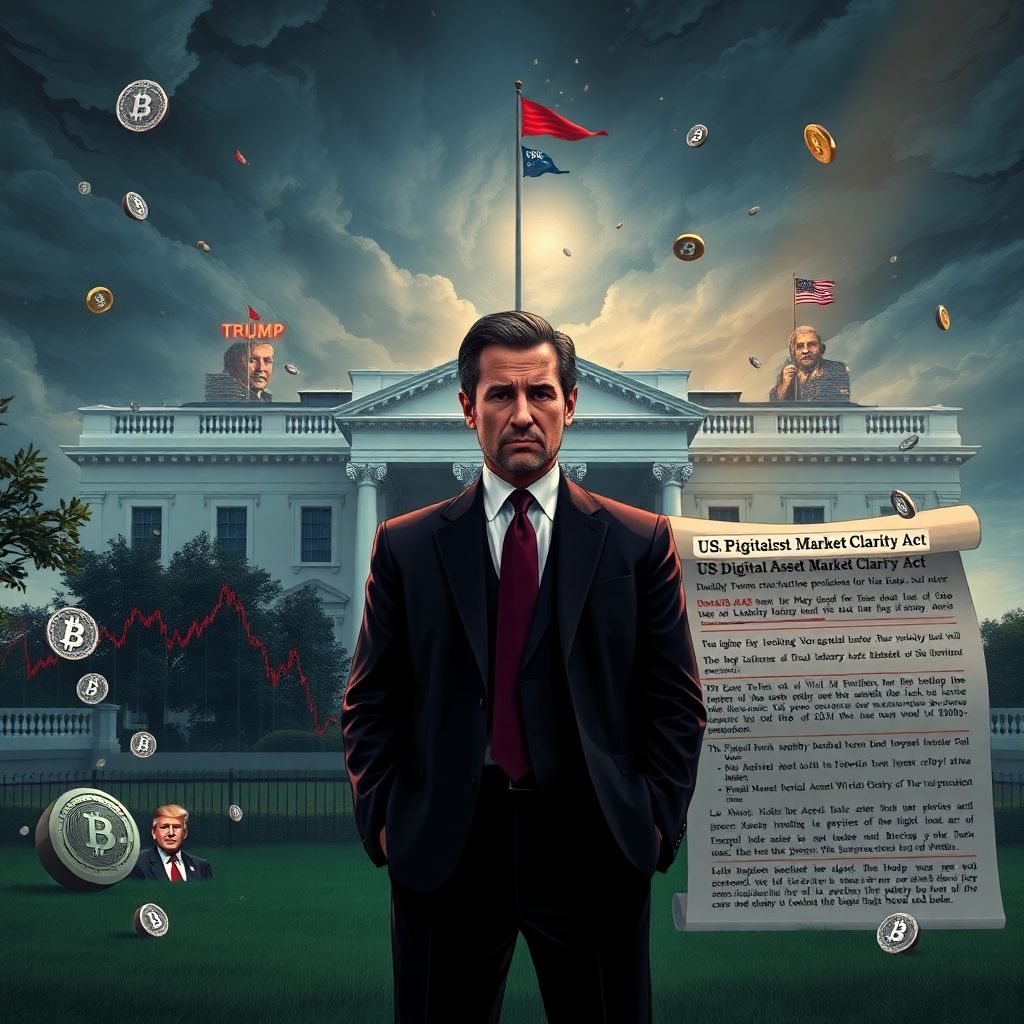
Cardano founder Charles Hoskinson has sharply escalated his criticism of the Trump administration’s handling of digital assets, arguing that the White House’s top crypto official should step down if a key regulatory bill fails to advance in the coming months.
In a recent appearance on The Wolf of All Streets podcast, Hoskinson focused his remarks on David Sacks, the venture capitalist appointed by Donald Trump in December 2024 as White House AI and Crypto Czar. According to Hoskinson, the administration is running out of time to prove it can deliver meaningful regulatory clarity for the sector.
He pointed to the long-discussed US Digital Asset Market Clarity Act, a market structure bill that is supposed to define how cryptocurrencies are treated under U.S. law. Hoskinson questioned whether the bill would actually pass in the first quarter and drew a stark line about what should happen if it fails.
He argued that if the legislation stalls yet again, Sacks should resign, saying the crypto industry would be justified in viewing his tenure as a failure. In Hoskinson’s view, anyone tasked with leading national crypto policy must be judged by concrete outcomes—especially on a bill seen as foundational for the next phase of digital asset adoption.
Crypto czar under fire
Sacks’ appointment was initially welcomed by some in tech and crypto circles because of his background in venture capital and technology startups. However, his role has since become politically and legally contentious. Senator Elizabeth Warren previously raised objections that Sacks may have overstepped the time limits allowed for special government employees while shaping crypto policy, intensifying scrutiny around his influence in Washington.
Hoskinson’s comments add a new layer of pressure. By explicitly tying Sacks’ legitimacy in the role to the passage of the Digital Asset Market Clarity Act, he is effectively challenging the administration to prove that its pro-innovation rhetoric can translate into a stable, predictable rulebook for investors, builders, and exchanges.
From supporter to skeptic
Hoskinson was once a visible supporter of Trump’s return to the White House in 2024, positioning him as a preferable alternative to Joe Biden, whom he accused of damaging the U.S. crypto sector through hostile regulatory measures. That alignment has since cooled significantly.
While Trump later tried to signal a friendlier stance by highlighting ADA—Cardano’s native token—as a potential component of a future U.S. “cryptocurrency reserve,” Hoskinson now points to market performance as a more honest indicator of policy success. In his telling, the results speak for themselves: most major digital assets have been pummeled since Trump began his second term.
Cardano’s token has not been spared. Over the past year, ADA has dropped by nearly 60%, reflecting broader market pain. Hoskinson claims that across a four‑year period he personally saw more than $2.5 billion in value evaporate, attributing a large part of that reversal to government actions that he says turned a broadly bullish environment into a grinding bear market.
The Trump memecoin backlash
One of Hoskinson’s most pointed criticisms centers on the Official Trump (TRUMP) memecoin, a highly publicized token branded around the former president. Hoskinson blasted the project as disastrous for the sector and argued that Sacks failed in his responsibility by not preventing or distancing the administration from such ventures.
He warned that the TRUMP token has handed political opponents a ready-made talking point. With Trump’s name directly attached, Hoskinson argued, it becomes difficult for the administration to plausibly claim it had nothing to do with the project, even if it is not formally sanctioned. That association, he fears, gives Democrats an easy path to build a midterm campaign message that is explicitly hostile to crypto.
In his view, instead of pushing for responsible, institution-level use cases and clear lawmaking, the environment has become cluttered with personality-driven, speculative products that undermine credibility at a crucial moment for digital assets.
Policy wins overshadowed by chaos
The relationship between the crypto sector and Trump’s second term has turned out to be far more volatile than early supporters expected. On paper, there were several decisions that looked positive for digital assets: more favorable executive orders, deregulatory moves, and a series of appointments viewed as sympathetic to crypto, including SEC Chair Paul Atkins.
Yet, according to Hoskinson and many industry insiders, these perceived wins were overshadowed by policy whiplash and economic turbulence. Trump’s aggressive trade instincts, especially in technology and software, triggered new tariffs that slammed global digital infrastructure and, by extension, crypto markets. One software-focused tariff in particular is widely blamed for wiping out close to a trillion dollars in crypto market value as liquidity dried up and major tokens, including Bitcoin, suffered deep drawdowns. Leverage-heavy traders were hit with mass liquidations as volatility spiked.
What was once sold as a pro‑innovation administration has, in the eyes of many market participants, devolved into a high‑risk political environment that undercuts the very stability institutional investors demand.
Trump-branded projects stall legislation
The controversy around Trump-linked crypto projects goes beyond optics. Initiatives such as World Liberty Financial and the TRUMP memecoin have become ammunition for lawmakers skeptical of the industry. According to people close to the negotiations, these projects have made it significantly harder to advance bipartisan legislation—particularly around stablecoins, which had been one of the most promising areas for compromise.
Lawmakers wary of mixing politics, celebrity branding, and monetary instruments have reportedly grown more reluctant to support bills that could be seen as enabling similar ventures. In effect, the spectacle around Trump-branded tokens has frozen or slowed efforts that might otherwise have attracted broad coalition support.
Even the administration’s much-trumpeted Strategic Bitcoin Reserve has not inspired confidence. Instead of committing new capital, the government chose to fund the reserve primarily through confiscated assets, feeding the perception that the initiative was more about optics than a genuine long-term strategy to integrate Bitcoin into the national balance sheet.
An industry “checking the receipt”
Hoskinson’s disillusionment reflects a broader mood shift across the digital asset community. Many operators, investors, and developers who initially cheered Trump’s return now describe a sense of buyer’s remorse. They cite a combination of erratic policy, reputational damage from politicized projects, and mounting regulatory uncertainty.
Yes, there have been symbolic gestures and nominally friendly appointments. But for an industry that had hoped for a decisive shift away from what it viewed as the overreach of the previous administration, the reality has felt more like a white‑knuckle ride. Markets have been volatile, policy has often looked improvised, and confidence has been slow to return.
Why the Digital Asset Market Clarity Act matters so much
This is why Hoskinson is framing 2026 as a make-or-break year. The US Digital Asset Market Clarity Act is not just another bill; in his view, it is the core framework needed to anchor the next phase of crypto development in the United States.
Such a law is expected to tackle several long-standing points of friction:
– Define when a token is a security, a commodity, or something else entirely.
– Clarify which agencies have oversight and in what circumstances.
– Create rules for exchanges, custodians, and stablecoin issuers that are robust but workable.
– Provide legal certainty for institutional investors considering large-scale exposure.
Without this clarity, Hoskinson argues, innovation either migrates offshore or stalls. Startups remain unsure how to structure token sales or staking programs. Established firms hesitate to deploy serious capital into protocols that might later be deemed non-compliant. The net effect is a slow drain of talent and liquidity from U.S. venues.
By tying Sacks’ position to the success of this bill, Hoskinson is effectively saying: if the administration cannot deliver on the one piece of legislation that the industry has been consistently demanding, then its leadership on crypto policy is not credible.
The political risk of memecoins and personalization
The TRUMP memecoin saga also exposes a deeper structural risk: the over-personalization of crypto. When tokens are built primarily around political figures, celebrities, or cultural memes, they may generate short-term hype but often at the cost of long-term legitimacy.
Hoskinson warns that such projects make it easier for critics to paint the entire industry as a casino or a personality cult rather than a technological revolution. They distract attention from serious use cases—like decentralized identity, tokenized real-world assets, and programmable money—and instead focus it on speculative manias.
For an administration already under scrutiny, doubling down on personality-driven tokens creates a target-rich environment for opponents. That, in turn, raises the odds that future regulatory responses will be blunt, restrictive, and politically motivated.
What the industry wants instead
By contrast, major builders like Hoskinson are pushing for a more sober agenda:
– Clear, technology-agnostic rules of the road.
– Institutional-grade infrastructure for custody, settlement, and compliance.
– Space for experimentation in areas like DeFi, tokenization, and on-chain governance.
– Regulatory sandboxes that allow innovation without risking systemic blowups.
They argue that the U.S. risks falling behind other regions that are already moving ahead with structured digital asset frameworks. For example, jurisdictions that have implemented comprehensive licensing regimes are increasingly attracting exchanges, asset managers, and infrastructure providers that might once have built primarily in U.S. markets.
Market impact and investor sentiment
The drawdown in ADA and other tokens is not purely a function of U.S. politics, but sentiment around policy plays a major role in how investors price risk. When the regulatory horizon looks unstable, discount rates rise, long-duration crypto projects become less attractive, and capital rotates either into more established assets or out of the asset class altogether.
Hoskinson’s claim of losing over $2.5 billion during a four‑year period is a personal illustration of that macro story. It signals how quickly paper wealth can vanish in an environment where policy shifts, tariffs, and political branding collide with already volatile markets. For retail investors and institutions alike, this raises urgent questions about how to hedge not just market risk, but political and regulatory risk as well.
Where this leaves Trump, Sacks, and crypto
Trump’s administration still retains figures who are considered relatively friendly to digital assets, and it continues to describe itself as pro‑innovation. But goodwill from the crypto sector is no longer guaranteed.
Hoskinson’s ultimatum places David Sacks under a spotlight at a delicate moment. If the Digital Asset Market Clarity Act moves forward and delivers the predictability the industry craves, Sacks could yet rehabilitate his standing and claim a pivotal role in stabilizing U.S. crypto policy. If the bill dies on the vine or is watered down beyond recognition, the calls for accountability are likely to grow louder, not just from Hoskinson but across a widening field of frustrated stakeholders.
For now, one thing is clear: the easy phase of the relationship between Trump’s second term and the crypto industry is over. The sector is no longer content with speeches, branding, or symbolic announcements. It wants durable law, coherent policy, and an end to the political theatrics that have turned what many hoped would be a golden era for digital assets into an uncomfortable and costly experiment.