
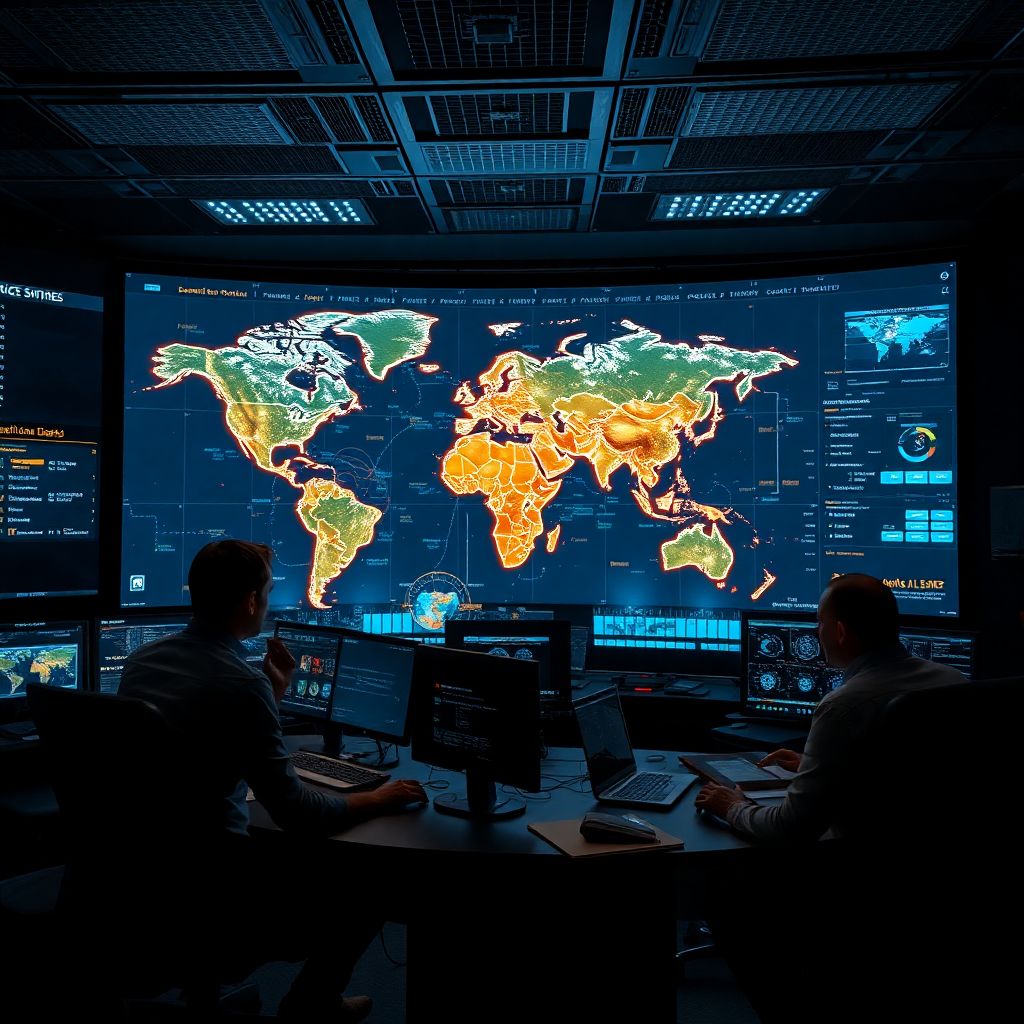
CIA to Roll Out AI “Co‑Workers” to Track Spies and Anticipate Hostile Moves
The Central Intelligence Agency is preparing to embed advanced artificial intelligence directly into its core analytic systems, creating what senior officials describe as AI “co‑workers” for intelligence officers. According to Deputy Director Michael Ellis, these tools are expected to become standard across the agency within the next two years and will be used to help identify foreign spies, flag suspicious behavior, and forecast potentially hostile actions from rival states.
Ellis outlined the vision for this new AI layer at a recent national security event in Washington, emphasizing that the technology will function as a tightly controlled, classified version of generative AI. Instead of replacing human analysts, it will serve as a digital assistant that automates repetitive tasks and accelerates the processing of vast tranches of classified and open‑source data.
“Within the next couple of years, we will have AI co‑workers built into all of the agency’s analytic platforms – a kind of classified version of generative AI that will help our analysts with basic tasks,” Ellis said. In practice, that means the systems could draft initial versions of intelligence assessments, highlight anomalies in data streams, and surface hidden connections within global communications, financial flows, and movement patterns.
These AI aides are expected to be particularly valuable in pattern recognition, one of the most time‑consuming aspects of modern intelligence work. They could, for example, correlate travel data, financial transactions, intercepted communications, and social signals to flag an individual who might be operating as a clandestine asset. They may also help model how foreign governments or military organizations are likely to respond to specific geopolitical triggers, giving U.S. decision‑makers more time to prepare.
Ellis, however, was explicit that the CIA has no intention of handing life‑and‑death decisions to algorithms. He stressed that human officers will retain authority over all “key decisions,” from targeting and operations to high‑level strategic assessments. In other words, the machines will sort, summarize, and suggest – but humans will still decide.
The move comes at a moment when the relationship between U.S. national security agencies and major commercial AI developers is under visible strain. A high‑profile partnership between federal departments and Anthropic, the company behind the Claude AI models, has deteriorated amid disputes over how far the government could push the system into surveillance support, battlefield applications, and autonomous decision‑making.
Concerns over using Claude for surveillance operations and potential integration into autonomous weapon systems prompted President Donald Trump in March to order federal agencies to halt the use of Anthropic’s technology. In response, the Department of Defense formally categorized Anthropic as a supply chain risk – a designation that can severely restrict how its products are procured and deployed. The company is now challenging that label in court.
Ellis did not directly name Anthropic in his remarks, but he implicitly addressed the broader tension between national security requirements and the commercial priorities of big tech firms. “We cannot allow the whims of a single company to constrain our capabilities,” he said, signaling that the CIA intends to reduce its dependence on any one external provider and instead build or tightly control the AI tools it uses.
This drive for autonomy marks a strategic shift. Rather than simply adapting off‑the‑shelf commercial models, the agency is moving toward a model in which its most sensitive AI systems are developed or customized within a secure, classified “walled garden.” Such an approach would let the CIA incorporate proprietary data, protect sources and methods, and adjust model behavior without relying on external entities that may be subject to public pressure, shareholder concerns, or foreign influence.
The agency’s interest in advanced digital tools is not limited to text and pattern recognition. Ellis has previously highlighted blockchain analysis as a critical piece of the CIA’s evolving toolkit. In remarks earlier this year, he revealed that the agency actively tracks blockchain data to support counterintelligence missions, treating cryptocurrency and digital assets as a key battleground in the wider technological rivalry with China.
By following blockchain transactions, intelligence officers can map networks of wallets, identify suspicious clustering of funds, and potentially trace illicit finance that supports espionage, sanctions evasion, or covert influence campaigns. For intelligence agencies, the pseudonymous nature of many crypto systems is simultaneously an obstacle and an opportunity: hard to penetrate at first glance, but rich with data once proper analytical tools are in place.
Ellis framed the overall technological push as a response to the narrowing gap between the United States and China in critical emerging technologies. “Five to ten years ago, China was nowhere near America, in terms of technological innovation. That’s just not true today,” he warned. In his view, AI, quantum computing, and advanced cryptography are now contested domains rather than areas of unquestioned U.S. dominance.
Against this backdrop, the CIA’s AI co‑worker initiative is less a futuristic experiment and more a defensive necessity. If Beijing and other rivals are harnessing AI to sift through data, optimize espionage operations, and anticipate U.S. moves, Washington cannot afford to remain reliant on older, largely manual analytic workflows. The competitive logic is straightforward: whoever makes better, faster sense of information will have the advantage in crisis and in covert contests.
The rise of AI inside intelligence agencies raises significant ethical and operational questions. Even if humans remain in charge of final decisions, the recommendations generated by AI systems can subtly shape what analysts see, which hypotheses they consider, and how they prioritize threats. Biases in training data, blind spots in model design, or vulnerabilities in the underlying infrastructure could all lead to distorted outputs.
To mitigate those risks, the CIA will need robust safeguards: rigorous testing and “red‑teaming” of AI systems, strong access controls, detailed audit logs showing how models arrived at particular conclusions, and training programs that teach analysts to treat AI as a tool rather than an oracle. The agency will also have to grapple with the possibility that adversaries could attempt to poison data sources or feed deceptive signals into the very streams the models rely on.
Another concern is overdependence. If officers become accustomed to AI drafting their reports and surfacing all relevant data, they may gradually lose certain analytic skills – much as overreliance on navigation apps can erode basic map‑reading ability. Intelligence leaders will need to strike a balance between embracing efficiency and preserving the critical thinking and skepticism that are central to sound intelligence work.
There is also the question of how these classified AI systems will interface with the broader government and allied partners. If the CIA’s tools begin generating predictive assessments about foreign behavior, those products may influence military planning, diplomatic initiatives, and economic policy. Clear standards around confidence levels, caveats, and model limitations will be essential to avoid overinterpreting machine‑generated forecasts as certainty.
On the operational side, AI “co‑workers” could reshape the day‑to‑day work of thousands of analysts. Routine tasks such as summarizing raw reports, translating foreign‑language material, or checking consistency across multiple intelligence streams could be largely automated. That, in turn, may free specialists to focus on deeper strategic questions, scenario planning, and evaluating how multiple, seemingly unrelated developments connect at the global level.
In fields like counterintelligence, where missing a single piece of the puzzle can have catastrophic consequences, AI may become a crucial safety net. Models trained on decades of espionage cases could flag subtle behavioral or financial patterns that historically preceded betrayal, enabling earlier detection of insider threats or penetrations by hostile services. Used carefully, such systems could reduce the risk that a key warning sign is buried in the noise.
The blockchain focus indicates that financial intelligence will remain a central pillar of this AI‑driven transformation. As more value moves into tokenized assets and decentralized platforms, the line between “traditional” financial surveillance and crypto analysis will blur. Intelligence agencies will likely deploy AI not only to monitor illicit finance, but also to understand macro‑level flows that reveal how rivals are funding technology programs, influence campaigns, or proxy groups.
Longer term, the CIA’s decision to internalize AI development rather than lean heavily on external providers will shape the broader AI ecosystem in national security. Government‑built or government‑directed models might prioritize explainability, auditability, and robustness over raw performance benchmarks that dominate commercial competition. They may also require more stringent controls against unauthorized replication or exfiltration, given their exposure to sensitive training data.
At the same time, distancing from private vendors is not without cost. The most advanced AI systems are expensive and compute‑intensive to develop, and commercial leaders move quickly. The CIA will have to find ways to absorb cutting‑edge techniques – from new model architectures to advances in homomorphic encryption and post‑quantum security – without compromising its independence or security posture.
The contest with China adds urgency to solving that puzzle. Chinese entities, both state and private, are investing heavily in AI, surveillance technologies, and digital finance infrastructure. If they succeed in fusing those capabilities into a coherent intelligence apparatus, they could gain asymmetric insight into global movements of people, capital, and information. The CIA’s AI co‑worker project is, in part, an attempt to prevent that scenario from unfolding unopposed.
What emerges from this effort over the next several years will likely redefine what it means to be an intelligence analyst. Instead of combing through documents line by line, future officers may spend their days interrogating models, validating outputs, and designing better questions for their AI partners. The human role will shift from being the primary processor of information to being the chief editor, skeptic, and strategist guiding how machines are used.
For now, the CIA’s message is that AI is coming not as a replacement, but as a colleague – albeit one that never sleeps, never tires, and can ingest more raw data in an hour than a human team could handle in a year. Whether this new partnership between human judgment and machine pattern recognition will strengthen American security without eroding core values will depend on how carefully it is built and how vigilantly it is overseen.