
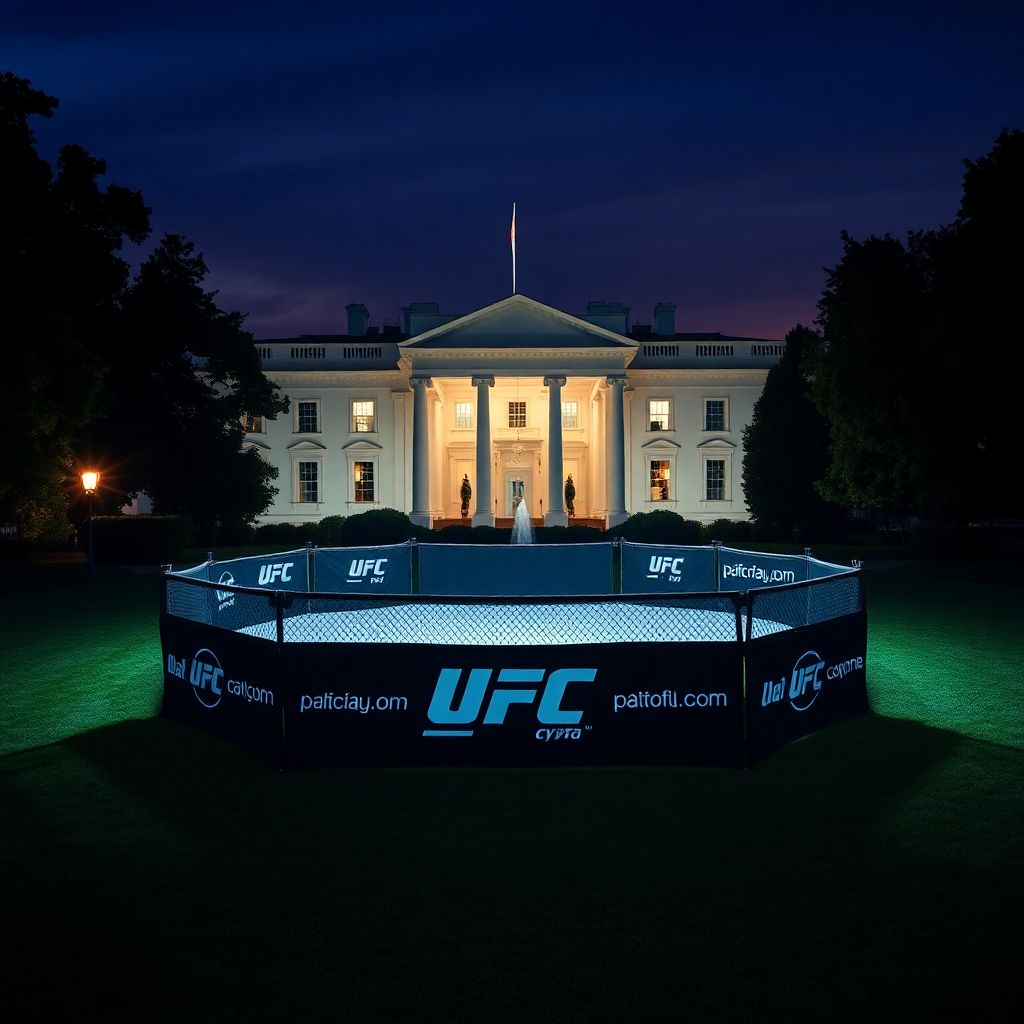
How Crypto Companies Are Set to Dominate the Octagon at Trump’s White House UFC Event
Crypto brands are about to receive an unusually prominent showcase this Sunday, when President Donald Trump hosts a UFC event on the White House South Lawn. Beyond the politics and spectacle, the Octagon itself is turning into a billboard for digital asset companies, amplifying the industry’s visibility at one of the most symbolically important locations in the United States.
As with other UFC fight cards, the canvas and pads of the cage are being blanketed with sponsor logos. But this time, photos shared from the setup show a striking concentration of crypto firms: VeChain, Polymarket, and Stake are among the most visible brands printed on the Octagon floor and banners. For an industry that has historically struggled to break into mainstream consciousness, this is premium, television-ready real estate.
The crypto-heavy branding arrives several years after the UFC signed a landmark sponsorship deal with Crypto.com, which remains a co-presenting partner of Sunday’s show. That agreement, once emblematic of the bull-market euphoria surrounding digital assets, now serves as the foundation for an even broader wave of crypto exposure within the promotion. While Crypto.com’s branding is already familiar to UFC fans, the presence of additional blockchain projects and platforms around the Octagon underscores how deeply intertwined combat sports and crypto marketing have become.
What makes this particular event stand out is not just the brands involved, but where the fights are happening. Staging a UFC card on the White House lawn is an unprecedented convergence of politics, sports entertainment, and financial technology. Trump’s outspokenly pro-crypto stance has been a defining economic message of his recent campaign trail appearances, and those views are now, indirectly, being projected from one of the most recognizable backdrops in the world.
Trump has repeatedly positioned himself as an ally of the crypto sector, criticizing what he calls regulatory overreach and signaling support for friendlier treatment of digital assets. Hosting a UFC event drenched in crypto sponsorship doesn’t change policy on its own, but it sends a powerful visual message: the emerging digital finance ecosystem is being welcomed into the heart of political power, at least symbolically. Corporate logos that were once relegated to niche exchanges and industry conferences are now poised to appear in broadcast shots framed against the White House itself.
For the companies involved, the value of this exposure is difficult to overstate. UFC broadcasts reach millions of viewers around the world, many of whom may barely be familiar with cryptocurrencies beyond Bitcoin. Seeing VeChain, for instance, might prompt viewers to look up its enterprise-focused blockchain solutions, while Polymarket’s brand placement could draw attention to the growing popularity of prediction markets as a way to gauge public sentiment and probabilities around current events. Stake, a major crypto casino and betting platform, gains a natural audience among sports fans already accustomed to wagering and fantasy leagues.
The demographic overlap is a core reason crypto firms continue to funnel marketing budgets into fight sports. UFC’s viewership skews younger, male, and globally distributed-precisely the profile that tends to be receptive to speculative assets, new financial technologies, and online platforms. These fans are used to rapid innovation, app-based experiences, and cross-border digital products, making them prime candidates to become active crypto users or traders after initial brand impressions formed during high-energy fight nights.
At the same time, the symbolism of crypto branding in such a politically charged setting invites scrutiny. Critics argue that allowing speculative financial platforms to dominate the visual environment at a White House event blurs the line between public office and private commercial interest. Supporters counter that the presence of crypto firms reflects the reality of a fast-growing sector that is increasingly integrated into global markets, and that showcasing it alongside a mainstream sports property is simply acknowledging economic trends.
The relationship between UFC and the crypto sector is not without risk. The collapse of several prominent crypto companies over the past few years has made regulators and consumers more cautious. Sponsorship arrangements in sports have occasionally aged poorly when partners ran into legal or financial trouble. This has pushed some organizations to vet crypto firms more thoroughly, looking at licensing, regulatory compliance, and capital backing before allowing their logos onto the canvas. The companies spotlighted on Sunday will be under heightened public and media scrutiny simply because of where they are appearing.
Still, for crypto brands willing to take on that visibility, the upside is significant. The White House UFC event effectively operates as an international infomercial, blending entertainment with soft political messaging and corporate promotion. Every slow-motion replay of a knockout, every clinch against the cage, and every post-fight interview shot in the Octagon has the potential to keep those logos on screen for prolonged periods. That repetition can convert vague name recognition into curiosity, search traffic, and ultimately user acquisition.
There is also a broader narrative advantage. By attaching themselves to an event backed by a sitting or recent president, crypto companies gain a veneer of legitimacy that might otherwise take years to build through traditional advertising alone. To many observers, this looks like a visual endorsement: even if no formal policy changes are being announced, viewers may infer that these companies-and by extension the asset class they represent-are being accepted within the highest levels of political and cultural life.
From the perspective of the UFC, leaning deeper into crypto sponsorship is a logical extension of its global ambitions. Digital assets, cross-border payments, and tokenized loyalty programs fit neatly into the promotion’s strategy of building a worldwide fanbase unconstrained by national boundaries. Crypto companies, in turn, benefit from being tied to a sport that has a gritty, high-stakes aura-an image that resonates with the risk-taking ethos often associated with early crypto adopters and traders.
This convergence might also signal where sports marketing is headed. As traditional industries like banking and automotive maintain a strong presence in sponsorship deals, they are increasingly sharing space with fintech and crypto challengers that move faster, take bolder brand risks, and are willing to experiment with unconventional venues. A fight card staged on the South Lawn, with blockchain logos pressed into the mat, is a clear example of how far that experimentation can go.
In the longer term, events like this could influence public sentiment around regulation and adoption. When everyday viewers repeatedly encounter crypto brands in seemingly “official” settings-whether in a presidential arena, at major league stadiums, or during globally televised tournaments-the idea that digital assets are fringe or temporary begins to fade. Even skeptics may concede that, at minimum, the sector has become too visible and too embedded in mainstream culture to ignore.
Whether this exposure translates into concrete policy outcomes remains to be seen. What is already clear is that Sunday’s White House UFC event will function as a high-impact marketing platform for a cluster of crypto firms eager to cement their place in the public imagination. On a night when fighters battle for dominance inside the cage, the logos encircling them will be waging a parallel contest-for attention, trust, and a lasting foothold in the next phase of the global financial system.