
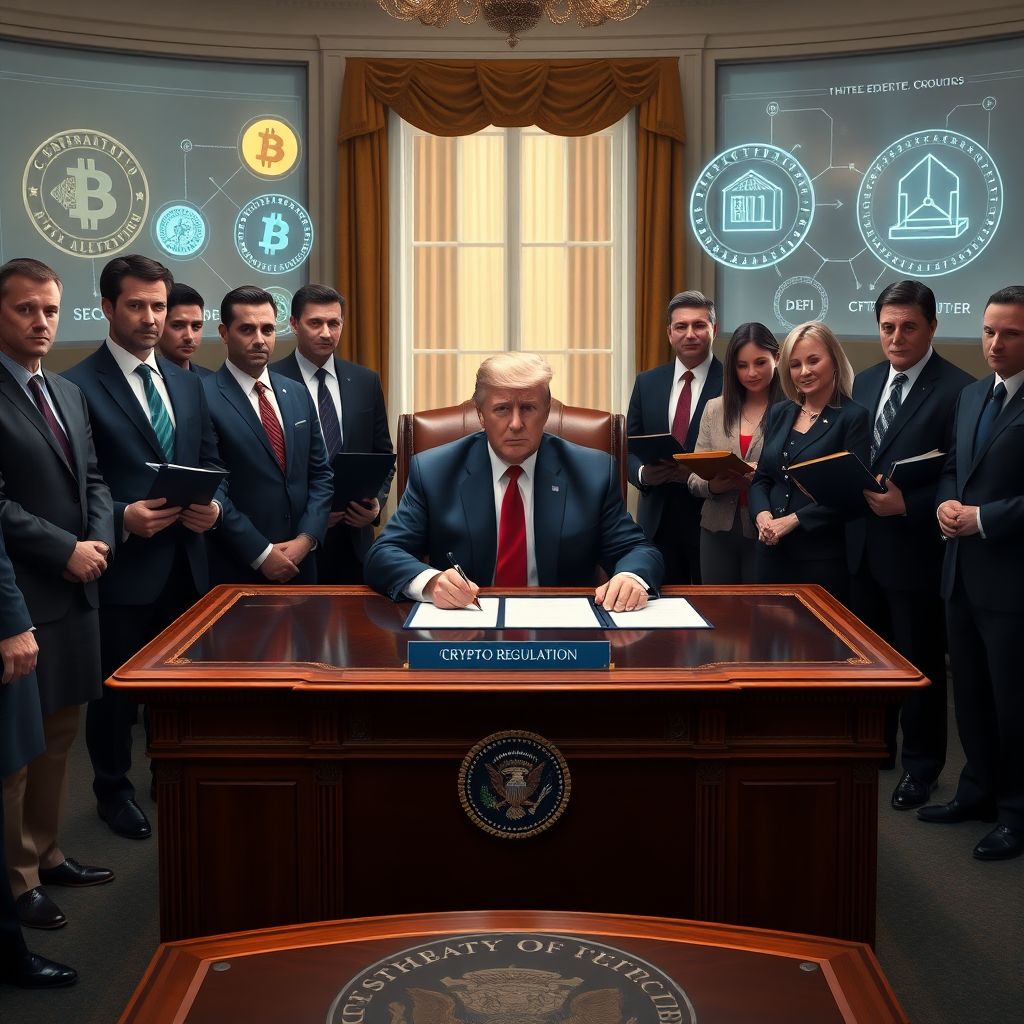
Crypto industry leaders are intensifying pressure on President Donald Trump to leapfrog a gridlocked Congress and directly instruct federal regulators to finally spell out how digital assets should be treated under U.S. law.
More than 65 companies and trade groups representing exchanges, DeFi protocols, blockchain foundations, and venture investors have signed a joint letter to the White House urging Trump to use his executive authority to break the regulatory deadlock. Signatories include some of the sector’s most influential players, among them Coinbase, Uniswap Labs, the Blockchain Association, and the Solana Foundation.
Their message is blunt: the administration does not need to wait for Congress to pass new crypto legislation. Instead, they argue, existing laws already give agencies enough power to issue rules, guidance, and enforcement frameworks that would bring long-awaited clarity to the market.
The letter maps out an aggressive but concrete to‑do list for the Securities and Exchange Commission (SEC), the Commodity Futures Trading Commission (CFTC), the Treasury Department, and the Department of Justice (DOJ). Each agency, the groups say, can move immediately to clarify how current statutes apply to everything from token listings and stablecoins to decentralized finance.
At the SEC, industry leaders are pushing for definitive answers on one of crypto’s most contentious questions: when is a token a security, and when is it not? The letter asks the commission to publish clear, formal guidance on token classification, pathways for assets to transition from “security” to “commodity” status as networks decentralize, and a workable registration framework for crypto businesses that does not assume they fit neatly into existing broker‑dealer or exchange categories.
The CFTC is being pressed to expand and formalize its oversight of crypto commodities such as Bitcoin and certain other non‑security tokens. Crypto firms want the derivatives regulator to clarify its jurisdiction over spot markets, define expectations for trading platforms that list digital assets, and coordinate more transparently with the SEC to avoid overlapping or contradictory rules.
For the Treasury Department, the signatories highlight the growing importance of stablecoins and blockchain‑based payments in both domestic and cross‑border finance. They urge Treasury to accelerate guidance on how banks and fintech firms can safely issue and custody stablecoins, comply with anti‑money‑laundering and sanctions rules, and integrate blockchain rails into existing payment systems without constant fear of shifting interpretations.
The DOJ, meanwhile, is being asked to draw sharper lines between fraud or criminal misuse of crypto and legitimate activity. Industry groups argue that aggressive enforcement actions, brought without clear standards, risk chilling innovation and pushing lawful businesses offshore. They are calling for published charging guidelines that distinguish between compliance errors, regulatory gray areas, and intentional misconduct.
Beyond the technical asks, the coordinated campaign is designed to turn Trump’s broadly pro‑crypto rhetoric into a tangible policy shift. During the campaign, Trump and his allies signaled support for digital assets, criticizing what they described as a hostile regulatory environment. Now, the letter’s authors want that political messaging converted into explicit directives: executive orders, memoranda, or policy statements that compel agencies to act within a set timeframe.
Industry advocates frame the issue as both an economic and a strategic race. They warn that while the United States debates the basics of classification and jurisdiction, other financial centers are rolling out comprehensive crypto and digital asset regimes. According to the letter, this regulatory drift is already encouraging developers, capital, and new projects to relocate to jurisdictions offering clearer rules and licensing pathways.
They also stress that the absence of coherent guidance does not mean the absence of regulation. Crypto companies argue that the current environment is effectively “regulation by enforcement,” where firms learn the rules only when they are sued. This, they say, benefits neither investors nor innovators: consumers lack standardized protections, while compliant businesses cannot confidently design products or plan long‑term investments.
The signatories propose a different model: a set of harmonized, technology‑neutral rules built on existing securities, commodities, banking, and payments laws, but adapted to the realities of public blockchains and tokenized assets. Rather than carving out crypto as a separate financial universe, they want agencies to explain how long‑standing principles—such as disclosure, market integrity, and customer protection—apply in a world of smart contracts and decentralized networks.
Supporters of this approach argue that executive‑driven regulatory clarity would not require Trump to pick winners or endorse specific tokens. Instead, it would create a predictable environment in which both traditional financial institutions and crypto‑native firms know what licenses they need, which agency they answer to, and what compliance obligations they face.
Critics, however, are likely to question whether bypassing Congress risks cementing rules that have not been fully debated or updated for digital assets. Some legal scholars caution that stretching old statutes too far to cover new technologies can invite court challenges and further uncertainty. Others warn that overly permissive guidance could open the door to speculative excess and consumer harm, repeating past cycles of boom and bust.
The industry groups counter that the status quo is already risky. With billions of dollars flowing through stablecoins, DeFi platforms, and tokenized assets, they say that refusing to clarify the rules does not protect the public—it just pushes activity into murkier channels and encourages fragmentation across state and international boundaries.
They also point to areas where agencies have already experimented with limited guidance or no‑action relief, such as pilot programs for digital asset custody or sandbox‑style initiatives. According to the letter, these early steps prove that regulators can tailor interpretations to crypto without waiting on new statutes, and that more comprehensive frameworks are both feasible and urgent.
The push comes at a moment when crypto’s role in the broader financial system is rapidly evolving. Traditional asset managers are building products that sit on top of public blockchains, large banks are exploring tokenized deposits, and stablecoins are increasingly used for remittances and on‑chain settlement. Industry leaders argue that without a clear federal roadmap, this convergence between legacy finance and crypto will proceed in an ad hoc, legally fragile way.
If Trump were to act on the letter’s proposals, the near‑term impact would likely be a flurry of policy statements, interpretive guidance, and coordinated rulemaking agendas across key agencies. Over the medium term, that could shape how token issuers raise capital, how exchanges list assets, how banks integrate blockchain, and how law enforcement targets genuine criminal abuse without stifling mainstream use cases.
Ultimately, the campaign reflects a broader strategic bet by the crypto sector: that working through the executive branch—rather than waiting for Congress to resolve deep partisan divides over digital assets—offers the fastest route to a coherent national framework. Whether the White House chooses to seize that opportunity, and how aggressively agencies respond, will help determine whether the United States leads or lags in the next phase of the digital asset economy.