
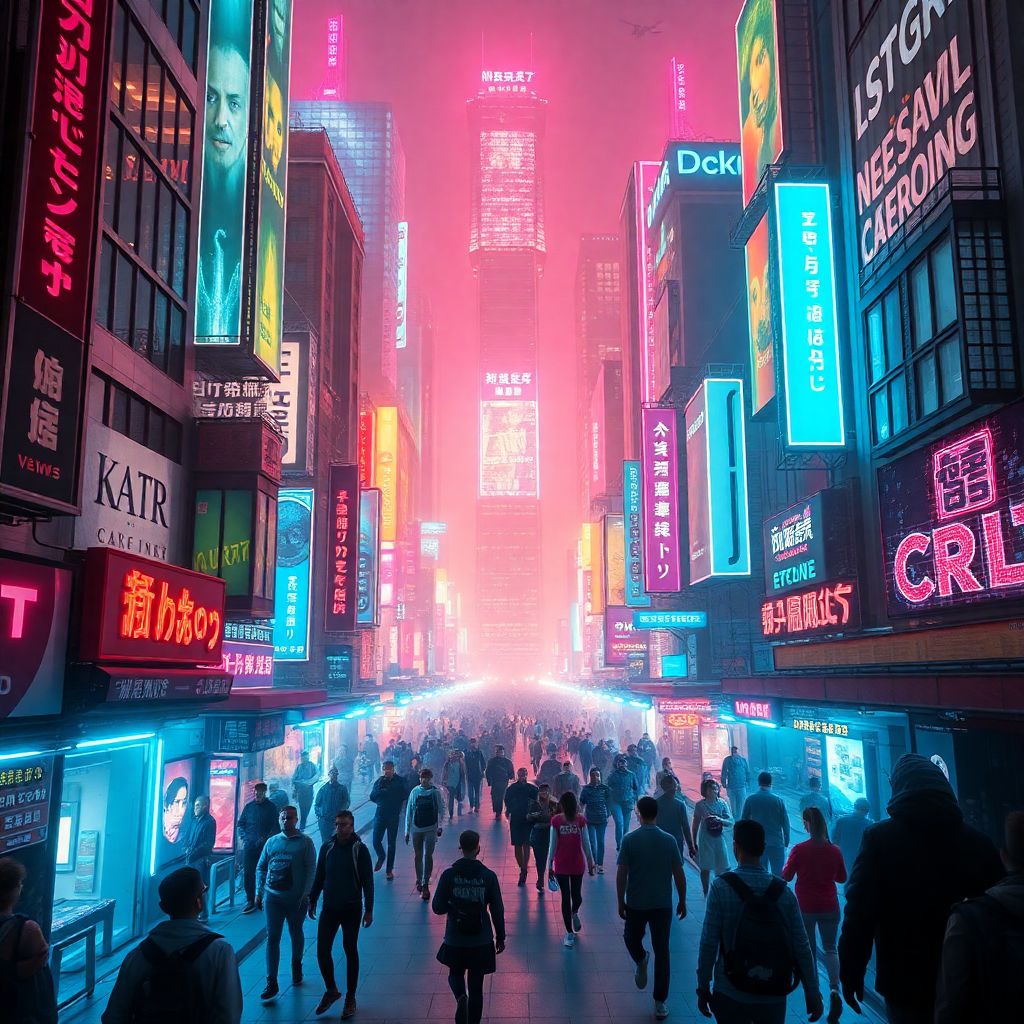
The neon-drenched futures of classic cyberpunk once felt like distant dystopias. Today, they look uncomfortably familiar.
Brain-computer interfaces are being surgically implanted into volunteers. AI assistants generate code, art, and propaganda on command. Corporations control platforms where billions of people work, socialize, and shop. City streets glow with LED billboards and digital surveillance. We do not live in Night City or Neuromancer’s Matrix-but we can see them from here.
What cyberpunk got right, however, was never just the gadgets. It was the power structures wrapped around them.
From Fictional Implants to Real Neural Links
The defining image of cyberpunk has always been the wired human: jacked-in hackers, mercenaries with cybernetic arms, street kids with enhanced eyes and artificial organs.
Today’s equivalents are primitive by comparison, but the direction is unmistakable:
– Brain-computer interfaces like invasive neural implants are being tested to help paralyzed people move robotic limbs or interact with computers purely by thought.
– Non-invasive neural headsets already read brain activity to control cursors, drones, and simple devices.
– Robotic prosthetics can now be moved by residual nerve signals and provide limited sensory feedback.
– Bionic eyes and cochlear implants restore forms of hearing and vision once lost forever.
What’s missing is the glossy aesthetic and the instant, plug-and-play integration. Real-world cybernetics are clunky, expensive medical devices, not underground upgrades you can buy in a back alley. But the underlying concept-directly wiring human beings into machines-is no longer fantasy.
Augmented Vision, Not Quite Cyberspace
Cyberpunk authors imagined hackers diving into “cyberspace,” a fully immersive 3D representation of the internet, navigated like a physical world. We don’t have that in the purest sense-but we’ve built something functionally similar in pieces.
– Augmented reality glasses and headsets overlay digital information on the real world: directions, translations, facial recognition hints, notifications.
– VR environments host meetings, games, and events with avatars standing in for physical bodies.
– Persistent online identities span social networks, games, and work platforms, blurring who we are “online” and “offline.”
Instead of a single global Matrix, we have a fragmented ecosystem: corporate-owned platforms, walled gardens, and incompatible virtual spaces. The immersive internet is here, but it’s siloed and monetized rather than anarchic and open.
AI: From Background Detail to Central Character
In early cyberpunk, artificial intelligence was often a shadowy background force-rogue military AIs, corporate supercomputers, or emergent digital ghosts. In our world, AI is less mystical and more mundane-but arguably more pervasive.
– Generative AI writes text, composes music, edits images and video, and even designs software.
– Recommendation algorithms shape what billions of people watch, read, buy, and believe.
– Automated systems approve loans, screen job applicants, and flag “risky” behavior.
Cyberpunk anticipated AI as a formidable power; it often missed how boring and bureaucratic it would look day to day. Our AIs are less like godlike entities and more like mass-produced, corporate-owned brains quietly restructuring culture, politics, and labor.
And crucially, in most cyberpunk stories, AIs eventually slip their chains. In reality, we see the opposite: a tight race to centralize advanced AI inside a handful of organizations under intense commercial and geopolitical pressure.
The Real Prediction: Corporate Power, Not Chrome
The “punk” in cyberpunk was never about leather jackets; it was about resistance to systems of control. On that score, the genre was eerily prophetic.
Corporate States in Everything but Name
Cyberpunk worlds are notorious for mega-corporations acting as de facto governments. Today:
– Tech giants control communication platforms, digital marketplaces, app ecosystems, and increasingly, AI infrastructure.
– Platform policies can determine which opinions are visible, which businesses survive, and which creators get paid.
– Data collection at planetary scale allows companies to know more about citizens than many governments do.
We don’t yet have literal corporate city-states with private armies on main streets. But private security, corporate campuses functioning as semi-sovereign zones, and corporate lobbying that effectively writes policy all echo those fictional worlds.
Government vs. Corporate: A Tense Alliance
Cyberpunk often posited a world where governments had withered and corporations openly ruled. Reality is more tangled. States remain powerful-but they lean increasingly on private tech companies:
– Governments outsource infrastructure, cloud services, biometric ID systems, and sometimes surveillance tools to private vendors.
– Law enforcement agencies request user data, location history, and communication metadata from platforms.
– AI policy and regulation are heavily informed-sometimes dominated-by the very corporations building frontier models.
Instead of corporations replacing states, we see a hybrid system of mutual dependence, with citizens caught in the middle.
Surveillance: The Dystopia We Actually Built
On cameras, cyberpunk futures tended to imagine obvious surveillance-drones hovering overhead, omnipresent security cams, facial recognition scanners at every checkpoint. We built something at once subtler and more invasive.
– Smartphones track location, communication patterns, browsing habits, and biometrics.
– Wearables log heart rates, sleep data, and activity levels.
– Smart home devices “listen” for wake words, but often collect far more than that.
The result is a mesh of data streams that form detailed behavioral profiles. While state surveillance does exist and can be intense in some regions, the frontline is consumer surveillance: tracking driven by advertising, engagement metrics, and product optimization.
In this, cyberpunk was directionally right-life in the future would be heavily monitored-but it underestimated how cheerfully we would participate, trading privacy for convenience and entertainment.
The Aesthetics Were Off-But Only Slightly
Cyberpunk worlds are drenched in rain, neon, and physical decay-a mashup of high-tech interfaces and crumbling concrete. Our cities, by comparison, look cleaner and brighter. But some visual rhymes are hard to ignore:
– LED billboards, animated building façades, and saturation advertising recreate the sensory overload once confined to fiction.
– “Smart cities” embed sensors in streets, traffic systems, and public spaces, often with little transparency about data use.
– Public-private partnerships push branded infrastructure-scooters, rideshares, delivery drones, camera-equipped vehicles.
If the cyberpunk city was a noisy, crowded, hacked-together machine running on desperation and light pollution, our urban future feels like its polished beta version: optimized, monitored, and quietly monetized.
Where Cyberpunk Misjudged the Future
For all its insight, the genre also missed key aspects of our present.
The Smartphone Revolution
Few early cyberpunk texts predicted a single device in every pocket that combines:
– Global communications
– High-resolution camera and microphone
– Personal assistant
– Payment device
– Entertainment hub
– Location tracker
In many stories, characters still seek out terminals or “jack in” physically at specific points. In real life, we carry our access portals constantly-and with them, our vulnerabilities and dependencies.
The Social Media Economy
Cyberpunk was suspicious of mass media and propaganda, but it rarely foresaw:
– User-generated content driving global narratives.
– Influencer economies and micro-celebrities shaping politics, beauty standards, and consumer behavior.
– Attention as a quantifiable, tradable commodity measured in likes, shares, and watch time.
The idea that ordinary people would willingly build detailed, public dossiers of their own lives for social validation didn’t fully feature in early cyberpunk pessimism. Yet it is one of the defining characteristics of the actual digital age.
The Slow Creep of Dystopia
Cyberpunk worlds often feel like overnight catastrophes: a collapse, a war, a single invention that breaks everything. Our reality is more incremental.
– Privacy erodes bit by bit through new terms of service and small legal changes.
– Work automation spreads gradually-not a single robot uprising, but a steady remapping of job markets.
– Algorithmic influence builds over years as small tweaks change what content we see and reward.
Instead of a dramatic fall into dystopia, we live through a series of trade-offs and updates, always one software patch away from “normal.”
The Human Condition: Cyberpunk’s Deepest Accuracy
Under the neon and chrome, cyberpunk stories were always about the same questions:
– What does it mean to be human when your body is modifiable?
– Who owns your mind when your thoughts can be measured and influenced?
– How do you resist, or even define yourself, in systems that map, monetize, and predict your every move?
In these questions, the genre feels more relevant than ever.
Identity in a Fragmented Reality
We juggle multiple digital selves: professional profiles, anonymous accounts, private group chats, avatars in games and virtual spaces. Each identity can be curated, edited, or abandoned.
This mirrors cyberpunk’s fascination with:
– Characters who swap bodies or consciousness.
– “Ghosts in the machine”-digital copies, backups, or simulations of people.
– Street names and hacker handles that matter more than legal identities.
Our versions are still primitive; we don’t yet upload consciousness or jump between bodies. But conceptually, living with layered identities and persistent online “ghosts” is now everyday reality.
Inequality and Access to Enhancement
Cyberpunk worlds often divide people by how augmented they are-and who controls those augmentations. We already see early-stage parallels:
– Advanced prosthetics and implants are expensive and limited to those with funding or specific medical coverage.
– Access to top-tier AI tools, private health services, or cutting-edge experimental treatments is unevenly distributed.
– High-income knowledge workers benefit most from productivity-boosting tech, while other jobs face displacement.
If the future body is a platform, the question becomes: who gets the premium upgrades, and who becomes a test subject, consumer, or resource?
Where We Could Still Diverge from Cyberpunk
The future is not locked into a cyberpunk script. Recognizing the parallels can be a warning, not a prophecy.
Regulation and Public Pushback
Unlike many fictional worlds where resistance is purely underground and doomed, there are growing real-world efforts to:
– Regulate AI deployment, especially in policing, employment, and critical infrastructure.
– Challenge mass surveillance and demand transparency in data collection.
– Build privacy-focused tools, decentralized systems, and open standards.
These movements are fragmented and imperfect, but they exist in a way many cyberpunk stories didn’t account for. Civic institutions and public opinion can still shape technology’s path.
Alternative Tech Paradigms
Cyberpunk usually assumes a future driven by a few megacorps and militaries. In reality, there are competing models:
– Open-source software communities building transparent tools outside corporate control.
– Cooperative or community-owned networks and infrastructures.
– Local, small-scale hardware and maker movements that favor repair and modification over disposable consumption.
These trends are smaller than the dominant corporate platforms, but they hint at futures that are not strictly cyberpunk dystopias.
Culture as a Counterforce
Cyberpunk emphasized bleakness: a sense that culture had become either commodified or weaponized. Our world certainly trends that way at times, but culture also resists:
– Artists use the very same generative models, social platforms, and XR tools to critique and remix the systems that control them.
– Subcultures form around slow tech, analog experiences, mental health, and digital minimalism.
– Educational initiatives and public discourse try to demystify complex technology, empowering more people to understand and challenge it.
The fight over the future is cultural as much as technical.
So, How Right Was Cyberpunk?
Measured by gadgets alone, cyberpunk was impressively prescient but not perfect. We have:
– Early-stage brain-computer interfaces, not seamless neural jacks.
– Widespread prosthetics and implants, but mostly for medical rather than elective use.
– AR and VR experiences instead of one unified cyberspace.
– Pervasive AI, but as corporate infrastructure rather than independent digital gods.
Where cyberpunk was stunningly accurate is in its social and political vision:
– Concentrated corporate power and privatized infrastructure.
– Blurred lines between state and platform control.
– Omnipresent surveillance woven into daily life.
– Deep inequalities amplified by technology.
– Individuals struggling to maintain agency and identity in an increasingly quantified world.
The unsettling conclusion is that the genre’s biggest “prediction” was not technological at all. It was a warning about what happens when powerful tools are developed inside economic and political systems that prioritize profit and control over human dignity.
We’re not condemned to follow that script to the end. But to change the story, we first have to recognize the one we’re acting out-and in that sense, cyberpunk may be one of the most accurate mirrors we have.