
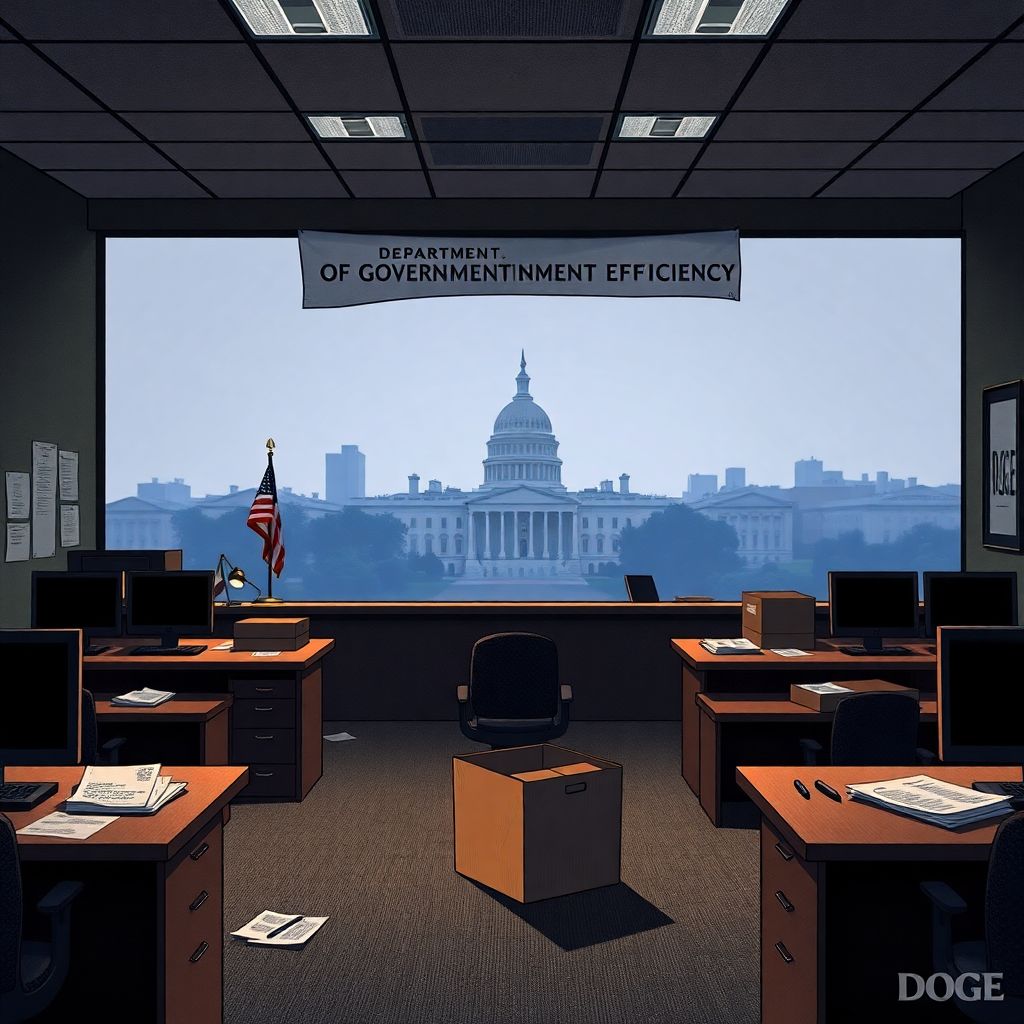
Department of Government Efficiency Quietly Winds Down Months Ahead of Schedule: Report
The Department of Government Efficiency (DOGE) — a specialized office launched by executive order to push President Donald Trump’s cost-cutting agenda — has effectively gone dormant, even though its mandate was supposed to run for another eight months, according to a new report.
Reuters, citing current and former officials, reported that DOGE has stopped functioning as a “centralized entity.” The administration’s top personnel official has acknowledged that the office is no longer active in any meaningful way, despite its charter formally remaining in place.
The move undercuts the formal timeline set when DOGE was created and raises questions about how the administration intends to pursue its stated goals of trimming federal spending and streamlining operations. Decrypt has requested comment from the White House on the apparent early shutdown and the future of the office’s remaining responsibilities.
DOGE was initially rolled out as a key instrument of Trump’s pledge to rein in what he described as wasteful government practices. Established by executive order, the office was tasked with identifying redundancies, cutting administrative overhead, and recommending structural changes intended to deliver taxpayer savings. Its mission placed it at the center of efforts to reshape how agencies organize their staff, programs, and long-term projects.
Yet, rather than ramping up as it approached the end of its charter, DOGE appears to have slowly faded from the scene. Staff have reportedly been reassigned or allowed to move into other roles, while ongoing initiatives have been scattered across existing departments or allowed to stall. Without a clear, centralized leadership structure, insiders say the office exists largely on paper, not as a functioning driver of reform.
The apparent early wind-down comes at the same time the administration is considering a broader regulatory shift that would make it significantly easier to dismantle federal units and scrap entire programs. Investigations published last week detailed a draft framework that would lower procedural hurdles for closing offices, consolidating departments, and ending long-standing initiatives across the federal government.
Under the emerging approach, agencies could face fewer requirements to justify closures or provide detailed long-term impact assessments, according to people familiar with the discussions. Supporters inside the administration see this as a way to act more quickly on cost-cutting proposals and avoid what they view as paralyzing bureaucratic inertia.
Critics, however, warn that combining the quiet shutdown of DOGE with a looser rule for dismantling federal units could have the opposite effect of “efficiency” in the long run. They argue that eliminating oversight and review processes risks shutting down programs that provide critical services or long-term savings that are not immediately visible on a balance sheet. Without DOGE actively coordinating reforms, there is also concern that changes will be driven by short-term political goals rather than rigorous analysis.
The timing has prompted speculation about whether DOGE’s early hibernation is itself a test case for the new rule-making direction. By effectively allowing the office to fade away without a formal public announcement or extensive justification, the administration may be signaling how future closures could proceed: quietly, internally, and with limited opportunity for external input.
For civil servants, the uncertainty is more than symbolic. Offices like DOGE often act as hubs for cross-agency collaboration, data collection, and performance measurement. When such a coordinating body dissolves, the underlying projects — from modernizing IT systems to revising procurement processes — can easily splinter or stall. Some analysts note that government reform efforts have historically struggled when they lack a stable institutional home and sustained political backing.
The shutdown also underscores the fragility of initiatives created solely by executive order. Because DOGE was never codified by legislation, it can be reshaped, sidelined, or effectively dissolved without congressional approval. That flexibility is attractive to any White House seeking rapid change, but it also means that ambitious reforms can vanish as quickly as they appeared, leaving little lasting infrastructure behind.
Budget and oversight experts are now watching to see what, if anything, replaces DOGE’s functions. In theory, individual agencies could absorb the work of efficiency reviews, but the loss of a centralized watchdog may weaken the pressure to deliver meaningful savings. Without a visible champion pushing cross-government benchmarks and timelines, efforts to overhaul sprawling bureaucratic systems often lose momentum.
There are also broader political implications. Trump’s early embrace of DOGE was held up as evidence of his administration’s commitment to “draining the swamp” and tackling government waste. Allowing the office to effectively close its doors ahead of schedule gives opponents fodder to argue that the cost-cutting campaign has stalled or shifted toward more opaque methods, such as internal rule changes that are less visible to the public.
Policy observers caution that the impact of these developments may only become clear over time. If the new rule for shuttering federal units is adopted and aggressively used, it could reshape the federal bureaucracy far more dramatically than DOGE ever did. Entire layers of government could be consolidated or dismantled with relatively limited public debate, fundamentally altering how services are delivered and which priorities are funded.
For now, DOGE’s story serves as a case study in how quickly high-profile reform tools can be created — and then quietly retired — within the executive branch. The office that once symbolized a structured, centralized approach to government efficiency has, by the administration’s own admission, largely ceased to exist in practice, months before its official expiration date. What replaces it, and under what rules, will determine whether the push for “efficiency” leads to smarter government — or simply less of it.