
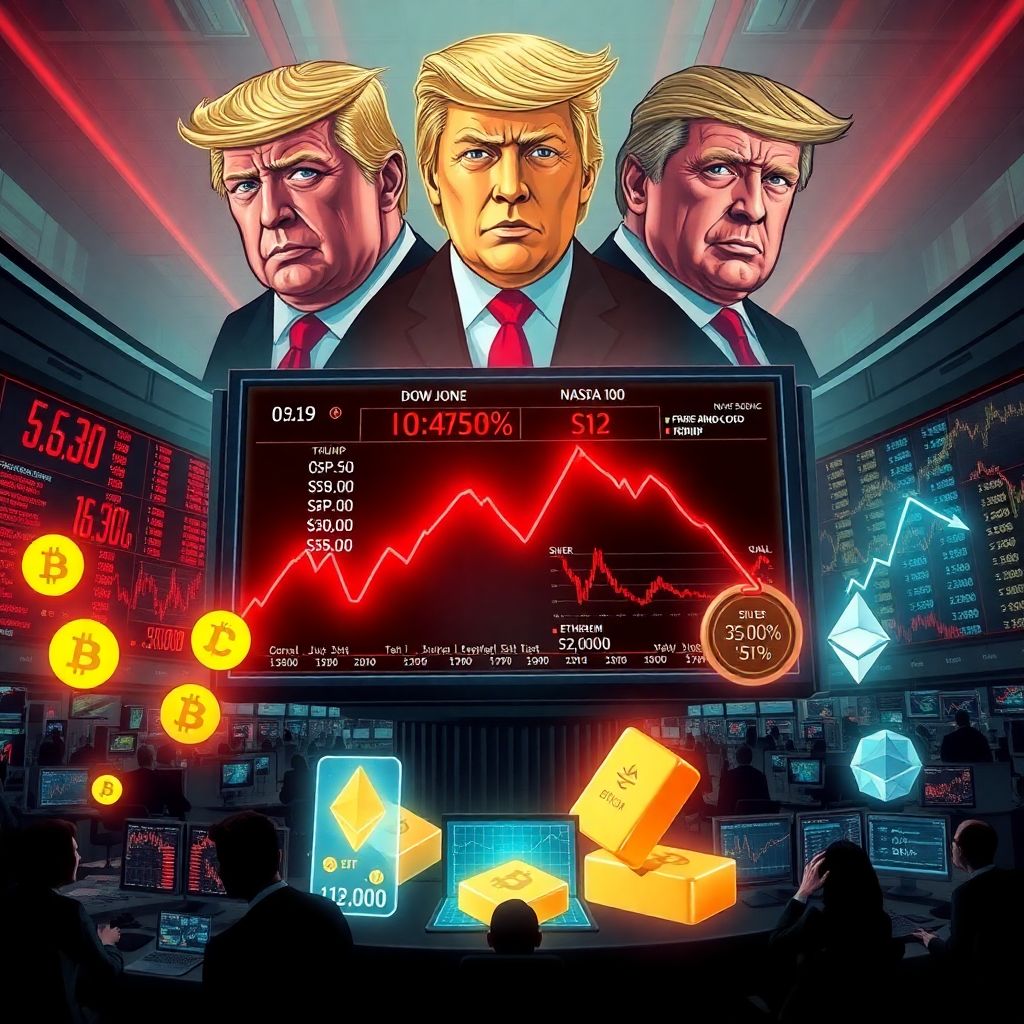
Dow Jones and crypto tumble after Trump taps Warsh for the Fed: what’s really spooking markets
The Dow Jones Industrial Average and the broader crypto market sank after Donald Trump unexpectedly named Kevin Warsh as his choice for the next Federal Reserve Chair. The move jolted investors who had largely positioned for a different outcome, triggering a synchronized sell-off across stocks, digital assets, and even precious metals.
Major US equity benchmarks — the Dow Jones, S&P 500, and Nasdaq 100 — all slipped more than 40 basis points as traders repriced the outlook for interest rates and liquidity. The pullback coincided with an accelerating downturn in digital assets: Bitcoin (BTC) slid below $82,000 for the first time in weeks, Ethereum (ETH) retreated to around $2,700, and total crypto market capitalization shrank to roughly $2.8 trillion.
The shockwaves did not stop there. Precious metals, which often serve as a defensive hedge, also suffered sharp losses. Gold dropped more than 6% and briefly fell under $5,000 per ounce, while silver broke below the $100 mark. The simultaneous decline in risk assets and traditional safe havens underscored the depth of uncertainty triggered by Warsh’s nomination.
Why Warsh’s nomination rattled investors
Markets had spent days pricing in a different outcome: the appointment of Rick Rieder, seen as more aligned with Wall Street’s preferences and more comfortable with using accommodative policy tools to support asset prices. Rieder’s odds of securing the position rose sharply after a widely watched interview last week, and his perceived market-friendly stance had buoyed sentiment.
Kevin Warsh, by contrast, carries a reputation as a monetary policy hawk. During his previous tenure as a Federal Reserve governor, he was among the most skeptical voices on ultra-loose policy. Notably, he voted against the Fed’s quantitative easing program in 2011, even as the US unemployment rate remained above 9%. At a time when the central bank was focused on stimulating a fragile recovery, Warsh was already warning about the risks of excess liquidity and inflated asset valuations.
More recently, he has been a consistent critic of aggressive rate cuts and large-scale asset purchases. During the pandemic-era easing cycle, Warsh opposed deep interest rate reductions and blasted the Fed’s reliance on quantitative easing. In 2024, he again criticized what he saw as insufficiently aggressive tightening, arguing that modest rate adjustments failed to address underlying inflation risks and distorted market signals.
A hawk in a political minefield
Warsh’s record suggests he is unlikely to fully embrace the dovish, pro-liquidity stance that Trump has frequently called for. That raises the prospect of a rare dynamic: a president publicly pushing for cheaper money and a Fed chair historically inclined toward restraint. Markets are now grappling with the possibility of open tension between the White House and the central bank.
This creates a no-win scenario for Warsh in the eyes of many traders. If he cuts rates quickly and deeply, he risks being cast as a political appointee who abandoned his long-standing principles under pressure, undermining perceptions of Fed independence. If he refuses to move aggressively and keeps rates elevated for longer, he could become the target of public criticism from Trump, as Jerome Powell once was when he resisted political pressure.
Complicating matters further, the Fed chair is only one vote on the Federal Open Market Committee (FOMC). Even if Warsh were inclined to strike a more dovish tone to calm markets, he would still need to persuade other committee members to support significant rate cuts or balance sheet expansion. Investors now must assess not just Warsh’s personal stance, but the likely coalitions and power dynamics within the FOMC under his leadership.
Why all risk assets sold off at once
The broad-based pullback reflects a rapid shift in expectations regarding the cost of capital. Stocks, cryptocurrencies, and even precious metals had been buoyed by the assumption that the next Fed chair would lean toward lower rates and supportive liquidity conditions. When that thesis collapsed, leveraged positions and speculative bets became vulnerable.
For equities, higher-for-longer rates translate into more expensive borrowing, pressure on corporate margins, and lower valuations for future earnings. For crypto, the story is similar but amplified: digital assets have thrived in environments with abundant liquidity, low yields, and strong risk appetite. A hawkish Fed leadership threatens all three pillars.
The metals market reaction may seem counterintuitive, as gold and silver often benefit from policy uncertainty or fears of inflation. However, in periods of rapid repricing and margin calls, investors frequently sell what they can — including gold and silver — to cover losses elsewhere. That “dash for cash” dynamic can temporarily drag down even traditional safe-haven assets.
Earnings season adds fuel to the sell-off
Warsh’s nomination hit just as corporate earnings added a fresh layer of anxiety. The Dow Jones weakness was exacerbated by results from heavyweight companies, especially in the tech sector.
Microsoft shares plunged more than 10% after the company reported slower-than-expected growth in its cloud computing division, a core driver of its recent valuation. The deceleration raised questions about whether the explosive demand for cloud and AI-related services is beginning to normalize, a worrying sign for one of the market’s key leadership stocks.
Apple, meanwhile, posted solid headline numbers, but its stock also came under pressure. Management flagged ongoing memory chip shortages and persistent supply chain constraints, signaling that hardware production and device availability could be affected in the coming quarters. For a market already on edge about growth, any hint of operational headwinds was enough to trigger profit-taking.
The combination of a potentially more restrictive Fed, disappointing tech trends, and elevated valuations formed a potent cocktail for volatility.
How traders are repricing the Fed’s path
In the wake of the announcement, rate futures and bond markets began to adjust. Expectations for rapid, aggressive cuts faded, replaced by a more cautious path where any easing is likely to be slower, smaller, and more conditional on data. Longer-dated yields held firm or edged higher, tightening financial conditions.
For equities, that means investors may no longer assume that the central bank will ride to the rescue if markets wobble. The so-called “Fed put” — the belief that policymakers will ease policy to support asset prices — looks weaker under a chair known for skepticism toward stimulus.
For crypto, the implications are equally significant. Many participants had bet that a gentler policy stance would sustain inflows into digital assets and support high valuations. A Warsh-led Fed is perceived as less inclined to underwrite speculative behavior with easy money. That perception alone can chill sentiment and spur deleveraging.
What this means for Bitcoin, Ethereum, and altcoins
Bitcoin’s drop below $82,000 broke a key psychological level that had held for weeks. Technical traders now watch for whether buyers step in to defend lower support zones or whether a deeper correction unfolds. Liquidity on derivatives platforms, leveraged long positions, and funding rates will play a major role in determining the next leg.
Ethereum’s pullback to around $2,700 has a slightly different nuance. ETH sits at the intersection of macro sentiment and ecosystem-specific drivers such as network activity, DeFi usage, and the profitability of staking. If broader markets remain under stress and risk appetite continues to fade, even strong on-chain metrics may struggle to offset macro headwinds in the short term.
Altcoins, especially smaller-cap tokens, are typically the most vulnerable in this kind of environment. When volatility spikes and liquidity thins, traders tend to rotate out of high-risk bets into assets perceived as more resilient, such as BTC, ETH, cash, or stablecoins. That rotation can trigger outsized declines in less-established projects.
Investor psychology: from “dovish hope” to “policy uncertainty”
Beyond the hard numbers, sentiment has clearly shifted. Going into the announcement, many investors built narratives around a Fed that would prioritize growth and market stability, potentially tolerating higher inflation in exchange for easier financial conditions. The Warsh nomination punctured that narrative and replaced it with questions about policy rigidity and political clashes.
Uncertainty is often more damaging to markets than definitively bad news. Traders can price in a clearly hawkish or dovish stance; what they struggle to manage is a scenario where the Fed’s reaction function is unclear and the risk of political interference is elevated. Warsh’s hawkish history, combined with Trump’s well-known preference for low rates, injects exactly that kind of ambiguity.
Possible scenarios from here
In the coming months, several paths are possible:
1. Hawkish continuity
Warsh could stick close to his long-standing views, keeping rates elevated and balance sheet policies tight. This would likely cap equity and crypto rallies and maintain pressure on speculative segments of the market.
2. Pragmatic pivot
Facing political pressure and volatile markets, he might adopt a more flexible stance, signaling conditional openness to rate cuts if data deteriorates. That could stabilize sentiment without fully restoring the “easy money” era.
3. Open conflict with the White House
If Trump publicly pushes for aggressive cuts and Warsh resists, markets could price in institutional instability and higher risk premiums, weighing on both the dollar and US assets in the short term.
4. FOMC-driven moderation
Even if Warsh leans hawkish, a centrist majority on the FOMC could steer policy toward a middle ground. In this scenario, communication and forward guidance will be critical to avoiding fresh bouts of volatility.
How long could the turbulence last?
Market reactions to Fed leadership changes often evolve in phases. The initial shock — which we are seeing now — tends to be driven by surprise and rapid repositioning. Once the nomination is formalized and Warsh begins to communicate more clearly about his priorities and framework, some of the uncertainty can fade.
What matters next is not only what he says about the near-term path of interest rates, but how he frames the Fed’s broader mandate: tolerance for inflation overshoots, willingness to respond to financial instability, and views on asset bubbles. Those signals will help traders refine their expectations and decide whether the sell-off is a temporary adjustment or the start of a longer repricing.
What investors can do in this environment
For market participants, the key is to recognize that the policy backdrop is shifting from a presumed dovish future to a more contested and uncertain one. That usually rewards a more selective, risk-aware approach:
– Reassessing leverage and exposure to highly speculative positions.
– Stress-testing portfolios against scenarios of higher yields and slower growth.
– Diversifying across asset classes and time horizons, rather than relying on a single macro narrative.
– Paying closer attention to Fed communications, FOMC voting patterns, and incoming economic data.
The immediate drop in the Dow, crypto markets, and precious metals reflects a collective repricing of risk around one central figure: Kevin Warsh. Whether this episode becomes a short-lived scare or a defining turning point for the current cycle will depend on how he balances his hawkish instincts with the political and market realities that await him at the helm of the Federal Reserve.