
DuckDuckGo Spent a Year on Duck AI. Its Surprise Hit Is “No AI” Search
DuckDuckGo has spent much of 2024 racing into generative AI. It built Duck.ai, an anonymous chatbot interface on top of models from OpenAI, Anthropic, and Meta, promising private conversations without the usual tracking and data harvesting. Yet the company’s most unexpectedly popular product right now is the exact opposite: a way to pretend AI in search doesn’t exist at all.
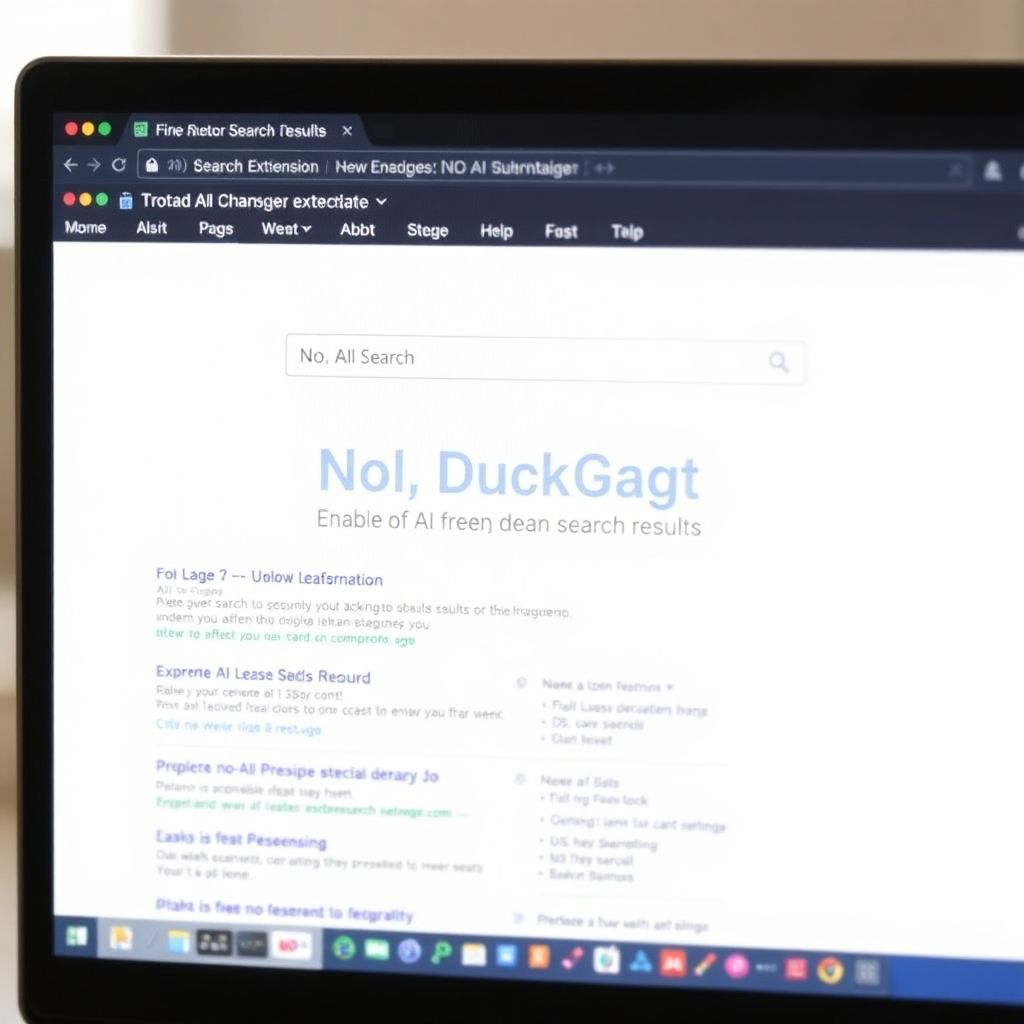
Over the weekend, DuckDuckGo quietly rolled out a new browser extension called DuckDuckGo No-AI Search. Install it in Chrome or Firefox, and it switches your default search to a special, AI-free version of DuckDuckGo. Under the hood, it uses the same index, ranking, and familiar minimalistic interface that privacy‑minded users already know. The only real difference: every AI add‑on the company has been layering on for the last two years disappears.
No AI summaries. No AI-crafted image results. No AI “assistants” hovering over the page. Just a search box and a list of links.
This move lands at a moment when Google is pushing aggressively in the opposite direction. Its search results are increasingly topped by generative AI answers-blocks of text assembled on the fly, often before you see a single traditional “blue link.” That strategy has triggered a noticeable backlash from people who feel search is becoming cluttered, opaque, and, at times, unreliable.
DuckDuckGo says it is seeing that frustration translate into behavior. Since Google began talking publicly about its AI-heavy redesign of search, traffic to DuckDuckGo’s “No AI” version has reportedly tripled, and it continues to grow. The trend suggests a meaningful slice of users isn’t asking for more AI in search-they’re asking for a way out of it.
How DuckDuckGo’s “No AI” Search Works
Functionally, No-AI Search is simple by design. The extension reroutes your browser’s default search to DuckDuckGo’s AI‑free subdomain. From the user’s perspective, nothing dramatic changes visually: same layout, same filters, same instant answers for things like weather or basic facts.
What’s stripped out are all generative layers. Where DuckDuckGo’s standard search now offers AI Assist summaries at the top of some results pages, those vanish. Where it can blend AI‑generated images into image search, the AI content is removed. Any newer AI features the company has experimented with on the main domain simply never appear on this stripped-down version.
The result is a search experience that feels closer to the early 2010s: direct links, organic results, and small, structured snippets-rather than machine‑generated essays.
The Paradox: Investing in AI While Selling “No AI”
The strategy may look contradictory: one product, Duck.ai, invites users to try advanced AI models in a privacy‑respecting chat interface, while another product markets the absence of AI as a key selling point. In practice, the two offerings solve different problems for different use cases.
Duck.ai is built for tasks where generative models shine: drafting text, brainstorming ideas, summarizing long documents, or walking through a complex question step by step. Users who want the convenience of modern AI but refuse to sacrifice privacy gain a single access point to several leading language models, without handing their identity to a big tech company.
No-AI Search, in contrast, exists for the growing group of people who are tired of AI intruding into basic information retrieval. When you’re trying to find a source, compare facts, or explore different perspectives, an AI “answer” at the top of the page can feel more like a gatekeeper than a helper. DuckDuckGo’s bet is that many users want to choose where and when AI is involved, instead of having it injected automatically into every search.
Why Users Are Pushing Back Against AI in Search
The rapid AI‑ification of search has created several friction points for everyday users:
– Trust and accuracy: Generative models are known to “hallucinate,” confidently fabricating facts or misrepresenting sources. When that output is framed as a primary answer, it can be hard to know what’s real.
– Loss of control: Traditional search gives you a list of options; AI answers often presuppose what you needed and collapse nuance into a single narrative.
– Opacity: Users may not know which sites or data were used to generate the answer, how up to date it is, or whether commercial incentives shaped what appears.
– Crowding out the open web: If users solve their query within an AI box, fewer people click through to small websites, forums, and blogs, threatening the broader ecosystem that makes the web useful in the first place.
Against that backdrop, “No AI” becomes not just a quirky feature but a statement: some users want a predictable, link‑driven, transparent experience for search. They will happily use AI-just not as an unavoidable filter between themselves and the internet.
The Return of the “Old Internet” as a Selling Point
For years, search engines competed on how smart and personalized they could become. Now, a new kind of pitch is emerging: the comfort of the “old internet.” Clean results pages. Less clutter. Fewer intrusive widgets. A sense that the search engine’s job is to help you navigate, not interpret, the web.
DuckDuckGo has long differentiated itself by emphasizing privacy and minimal tracking. The No-AI extension extends that philosophy to the content layer itself, preserving not just data privacy but a sense of editorial neutrality. By removing generative overlays, the company is effectively saying: we’ll show you what exists on the web, not our own synthesized version of it.
For users who research professionally, check sources for work, or simply enjoy exploring multiple viewpoints, that restraint can be a feature, not a limitation.
AI as an Opt‑In Tool, Not a Default Layer
What DuckDuckGo appears to be testing is a more granular model for AI adoption: instead of making AI the default interface for everything, it creates separate, clearly labeled contexts.
– Want AI help writing, summarizing, or ideating? Use the chatbot product.
– Want a classic search page that surfaces websites and documents? Use No-AI Search.
– Want a blend of both, with AI Assist and summaries on top of results? Stick with the standard DuckDuckGo search.
This segmentation gives people something they are rarely offered by the biggest platforms: a real choice in how much AI they interact with day to day. It acknowledges that the best interface for a coding question, a legal research task, and a simple “what time does this store close?” query may be different-and that a single AI answer box may not serve all those needs equally well.
Competitive Pressure on Google and Other Search Giants
While DuckDuckGo is a fraction of Google’s size, the momentum behind its No-AI option reflects a sentiment larger players cannot ignore. If enough users begin to view AI-heavy search pages as noisy, untrustworthy, or simply annoying, the companies that offer clear, AI‑free alternatives gain leverage.
Moreover, regulatory and public scrutiny around AI is building. Transparency, explainability, and source attribution are becoming hot topics. A “plain search” mode, visibly separated from generative features, could evolve from a niche preference into a de‑facto requirement-much like “incognito” or “private browsing” modes in modern browsers.
If that happens, DuckDuckGo will have been early in positioning itself as the search engine that not only respects privacy but also respects users’ desire for a predictable, AI‑neutral view of the web.
What This Means for Everyday Users
For ordinary users, this shift translates into a straightforward set of options:
– If you’re curious about AI and want private access to powerful models, tools like Duck.ai offer that without tying your identity to a major tech platform.
– If you’re wary of AI answers creeping into basic search, an AI‑free mode like No-AI Search lets you reclaim a more traditional search experience.
– If you’re somewhere in between, you can mix and match: use AI for tasks where it shines-summarization, drafting, translation-while relying on classic search when you need raw information, multiple sources, and your own judgment.
Crucially, none of these choices need to be permanent. You can treat AI as a tool you pick up when it helps and put down when it gets in the way.
The Future: Coexistence, Not All‑or‑Nothing
The rise of DuckDuckGo’s “No AI” product does not mean AI is failing. It suggests something subtler: people want AI to coexist with the open web, not replace it. They want the ability to step outside of algorithmically composed answers and touch the underlying sources for themselves.
In that sense, DuckDuckGo’s year of building an AI chatbot and its decision to launch an AI‑free search mode are not opposites, but two sides of the same philosophy: users should have control over how their information is gathered, processed, and presented. Privacy was the first battleground for that control. The next may be the right to say, “Not this time,” when search engines try to answer every question with AI.
For now, the company finds itself in a curious position: after pouring resources into a cutting‑edge AI assistant, its most talked‑about feature is a button that rolls the clock back-and many people seem relieved to press it.