
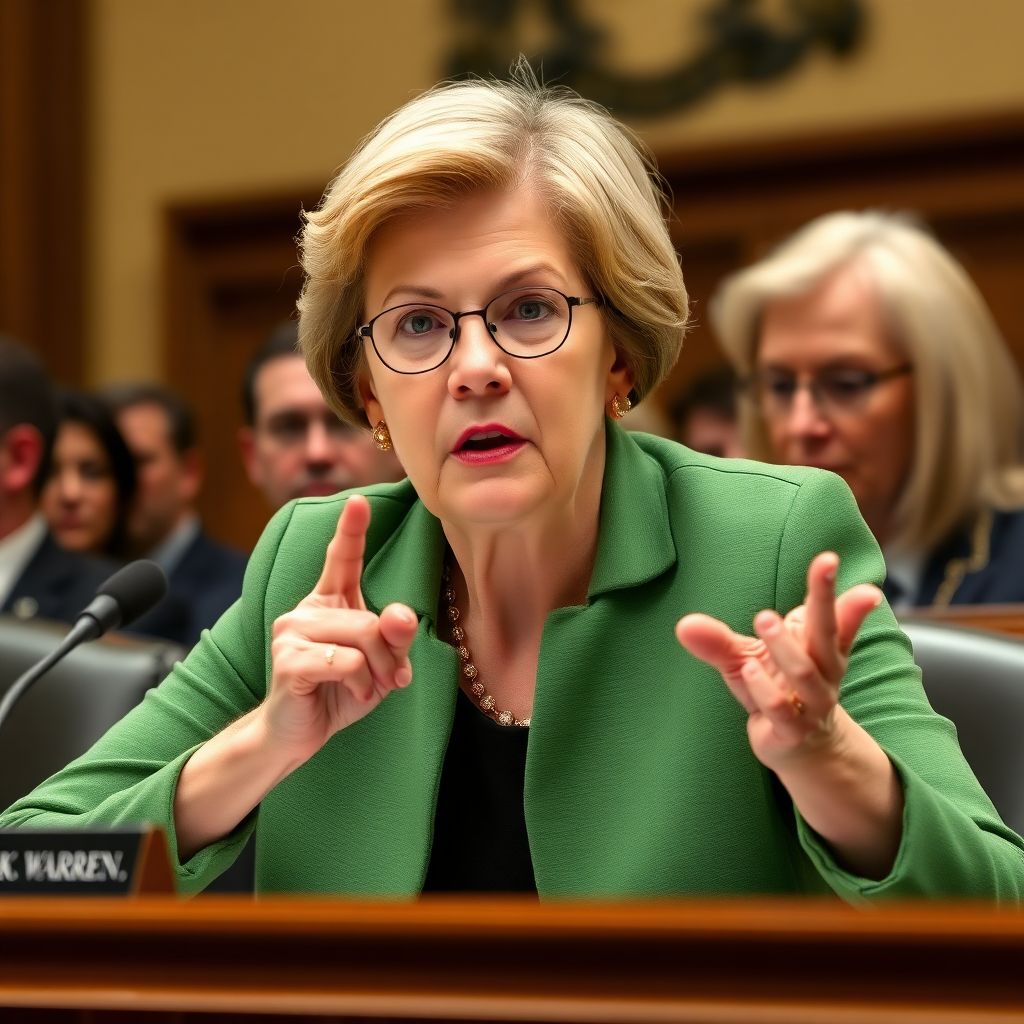
Elizabeth Warren escalated her long-running clash with the crypto industry by taking direct aim at the country’s chief banking regulator over a charter application from a digital asset firm tied to former President Donald Trump.
During a sharply contentious Senate Banking Committee hearing on prudential regulators, Ranking Member Elizabeth Warren (D-Mass.) pressed Comptroller of the Currency Jonathan Gould to either reject outright or temporarily halt review of World Liberty Financial’s bid for a national trust bank charter.
World Liberty Financial, a crypto-focused financial institution linked to Trump’s business empire, is seeking a federal trust charter that would effectively allow it to operate under the national banking regulatory framework. Warren argued that the application is riddled with conflicts and ethical red flags that should disqualify it from moving forward.
She pointed to what she described as three central problems: a substantial foreign investment from the United Arab Emirates, Trump’s ongoing and unresolved financial entanglements, and Gould’s own role as a political appointee serving the very president whose company stands to benefit from the charter.
According to Warren, the UAE has committed roughly $500 million to World Liberty Financial, a level of foreign backing she said raises national security concerns and questions about foreign influence over both a U.S. financial institution and a company associated with a former president. She warned that allowing such an arrangement would blur the line between private financial interests, foreign governments, and American political power.
Warren further argued that Trump’s continuing financial interests in the venture make the situation especially dangerous. Because Trump remains an active political figure and potential future officeholder, she said, granting a bank charter to a company closely tied to him would risk turning the banking system into an instrument of political and personal enrichment.
The senator also cast Gould’s position as inherently conflicted. As Comptroller of the Currency, he is responsible for reviewing and potentially approving the application. But as a senior official appointed by President Trump, Warren claimed, he cannot credibly oversee a charter request that would benefit the business interests of his own appointing authority.
“President Trump’s crypto company is now at the heart of what may be the most shameful presidential corruption scandal in modern U.S. history,” she said, adding that moving ahead with the application would “make you an accomplice to that corruption.”
Gould pushed back firmly, defending both the Office of the Comptroller of the Currency (OCC) and the integrity of its charter review process. He stressed that the agency evaluates all bank charter applications according to established legal standards and supervisory criteria, regardless of who is behind them.
The Comptroller emphasized that OCC examiners and legal staff conduct detailed, multi-layered reviews that include assessments of ownership structure, capital adequacy, risk management, governance, and compliance with anti-money laundering and sanctions rules. He argued that these procedures are designed to insulate the process from politics and personal influence.
“I will not prejudge any application,” Gould said, noting that it would be inappropriate for him to commit to rejecting or pausing the filing based on political pressure. He insisted that decisions are made on the merits of the application and the requirements of banking law, rather than on the identity of the owners or their political connections.
Warren was unsatisfied with that answer, insisting that the situation is not “business as usual” but rather a test of whether regulators are willing to stand up to political power and foreign money when they intersect with the banking system. She accused Gould of hiding behind procedure to avoid confronting a clear ethical crisis.
Beyond the personal clash, the exchange highlighted a deeper policy battle over how, and even whether, crypto-native institutions should be allowed to integrate into the traditional banking system. A national trust bank charter would provide World Liberty Financial with critical credibility, access to certain payment and custody activities, and the ability to operate under a single federal framework rather than a patchwork of state licenses.
Supporters of chartering crypto firms argue that bringing them into the regulated banking perimeter is the best way to control risks. Under this view, subjecting a company like World Liberty Financial to bank-like supervision would give regulators more oversight of its custody, lending, token issuance, and related activities, potentially making the broader crypto ecosystem safer and more transparent.
Critics counter that the opposite could happen: granting a bank license to a politically connected crypto entity might give it an undeserved stamp of legitimacy and open the door for undue influence, regulatory arbitrage, or even systemic risk if the institution grows large and interconnected. Warren has long argued that the crypto industry enables money laundering, sanctions evasion, and consumer abuse, and she framed this application as a culmination of those concerns.
She also underscored that foreign sovereign wealth participation in a Trump-linked financial firm is fundamentally different from a typical international investment. In her view, a foreign government injecting hundreds of millions of dollars into a company tied to a former president raises questions about whether the investment is purely commercial or partly political, with an eye toward buying influence or favorable policy.
Gould responded by noting that existing regulations already require rigorous scrutiny of foreign owners, including background checks, source-of-funds analysis, and ongoing monitoring for sanctions and anti-money laundering compliance. He maintained that any foreign investment would be reviewed through that lens, regardless of the political sensitivities.
Still, Warren pressed him to acknowledge that there are circumstances where the appearance of corruption itself should be enough to pull the plug. She suggested that even if every law and regulation were technically followed, the public’s trust would be badly damaged if a Trump-affiliated crypto bank with massive foreign backing was granted a federal charter.
The dispute also reflects a broader tension over the independence of financial regulators. Banking supervisors are expected to operate at arm’s length from partisan politics, even though their leaders are typically presidential appointees. In this case, the question is whether that independence can truly hold when the regulator is asked to approve a charter for a firm linked to the person who appointed him.
Legal experts watching the debate have noted that the OCC does have the discretion to deny or delay an application on safety and soundness grounds, or if it determines that the applicant’s business model, ownership, or governance structure poses unacceptable risks. However, using that discretion explicitly because of political optics rather than clearly articulated regulatory concerns could expose the agency to legal challenges.
The hearing also underscored how crypto has become a partisan flashpoint. Democrats like Warren tend to frame digital assets as a threat to financial stability, national security, and retail investors, while many Republicans emphasize innovation, competitiveness, and “financial freedom,” often warning of regulatory overreach. A Trump-aligned crypto bank application sits squarely at the intersection of these narratives.
From a policy perspective, the World Liberty Financial case could become a precedent-setting moment for how U.S. regulators treat politically exposed persons in the context of digital assets. Traditional banks face enhanced due diligence requirements when dealing with politically exposed clients; the open question is whether similar or stricter standards should apply when a politically exposed person or their business interests are the ones actually seeking a bank charter.
The episode also raises the question of whether additional guardrails are needed to prevent current or former top officeholders from owning or controlling chartered financial institutions, particularly those that interact with emerging technologies like crypto. Some ethics advocates have argued that, at a minimum, there should be mandatory blind trusts or complete divestment to avoid any perception that public power can be leveraged for private financial gain through the banking system.
For the crypto sector, the outcome of this fight will be closely watched. If the OCC ultimately approves the World Liberty Financial charter, it could open the door for more crypto-native firms to seek similar licenses, arguing that they are being treated no differently from traditional trust banks. On the other hand, a denial framed around conflicts of interest and national security concerns could send a chilling signal that the political context of ownership will play a decisive role in whether crypto companies can access federal charters.
Consumer advocates are also focused on what this means for everyday users of crypto products. They argue that if a Trump-linked firm with foreign state backing were to gain a national charter, marketing it as a “regulated” bank could mislead ordinary consumers into assuming robust protections that might not cover speculative crypto products, even if the institution itself is supervised.
As of now, the OCC has not indicated a timeline for making a final decision on the application. Gould reiterated at the hearing that he would not comment on the specifics of a pending case, beyond assuring senators that the review would be “thorough, impartial, and consistent with the law.”
Warren, however, made clear that she views this as a defining test for both the OCC and the wider regulatory regime. If the agency proceeds without acknowledging what she sees as glaring conflicts and risks, she warned, it will signal to the public that well-connected political figures and foreign backers can bend the rules of the American financial system to their will.
Whether the OCC stands its ground on process or bows to mounting political scrutiny, the clash over World Liberty Financial has already exposed deep fissures over ethics, regulatory independence, and the future place of crypto in the U.S. banking framework.