
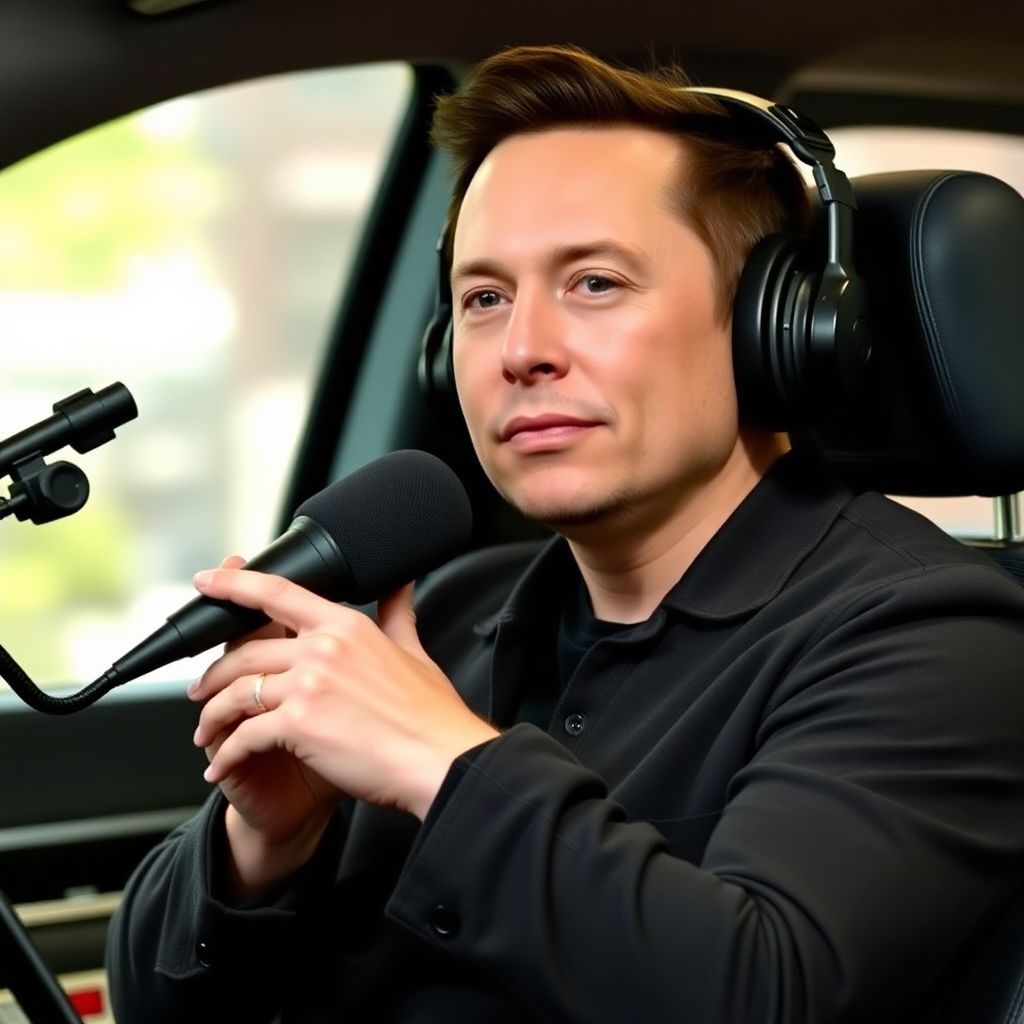
During a wide-ranging three-hour conversation on The Joe Rogan Experience, Elon Musk made a series of provocative claims and predictions, ranging from flying cars to the existential threat posed by artificial intelligence. The Tesla and SpaceX CEO didn’t hold back, touching on topics including government inefficiency, social media manipulation, and what he calls the “woke mind virus.” But perhaps the most headline-grabbing moment came when Musk stated—with a straight face—that the next-generation Tesla Roadster will be capable of flight.
According to Musk, the upcoming Tesla Roadster won’t just push the limits of electric vehicle performance—it will redefine them. He explained that the car will be equipped with a set of small rocket thrusters developed by SpaceX, allowing it to briefly hover above the ground. Musk clarified that this feature won’t allow for sustained flight like an airplane, but rather short bursts of airborne movement, making it closer to a “hovering sports car” than a true flying vehicle. He acknowledged that regulatory hurdles remain, but insisted the technology is real and close to being production-ready.
While the concept of a flying Tesla sounds like science fiction, Musk emphasized that the integration of SpaceX cold gas thrusters is not a gimmick. These rockets, powered by compressed air, would significantly enhance the vehicle’s acceleration, handling, and maybe even enable vertical takeoff—or at least some variation of it. Musk has teased this feature in the past, but on Rogan’s podcast, he appeared more confident than ever that it’s going to happen.
The conversation quickly turned from flying cars to artificial intelligence, a subject Musk has been increasingly vocal about. He warned that AI is advancing at a pace that humanity is not prepared for, and that current oversight mechanisms are woefully inadequate. Musk reiterated his belief that AI could surpass human intelligence in the near future, creating a form of superintelligence that could either solve global problems or cause irrevocable harm.
In a particularly dark moment, Musk suggested that Suchir Balaji, an OpenAI whistleblower who recently died under mysterious circumstances, may have been murdered. Without providing concrete evidence, Musk cited what he called “suspicious details” surrounding Balaji’s death and called for greater transparency within the AI industry. He also claimed he would never commit suicide, implying that if something happened to him, it should be considered suspicious.
Another focal point of the discussion was Musk’s takeover of Twitter, now rebranded as X. He recounted his motivations behind acquiring the platform, stating that he was concerned about increasing levels of censorship and ideological bias. In his view, X should serve as a digital public square where all viewpoints can be expressed freely. Musk also hinted at future AI-powered features being integrated into the platform, including a chatbot named XChat that could rival existing models like ChatGPT.
Musk didn’t stop at AI and flying cars. He criticized government inefficiencies, arguing that bureaucratic bloat and wasteful spending have become major obstacles to innovation. He also voiced concerns about the influence of social media algorithms on public discourse, suggesting that they amplify outrage and division. According to Musk, one of his core missions is to restore rational debate and empathy in online interactions—though paradoxically, he also claimed that empathy is often overrated.
The podcast wasn’t without its more speculative and even conspiratorial segments. Musk floated the idea that powerful entities might be manipulating public perception through media and AI, and he expressed skepticism about the safety of centralized AI development. He suggested that truly beneficial AI should be decentralized and open source to prevent monopolistic control or misuse.
Musk’s vision for the future, while ambitious, also carries a strong undercurrent of caution. He believes that humanity is at a critical juncture, where the choices we make about AI, energy, and digital communication will shape civilization for generations. He urged governments and tech leaders to work together to create ethical frameworks for artificial intelligence, warning that failure to act could lead to catastrophic consequences.
Expanding on his plans for Tesla, Musk mentioned that the Roadster is just one piece of a larger puzzle. He envisions a future where electric vehicles, renewable energy, and AI-driven automation converge to create a more sustainable and efficient world. He also hinted that Tesla is working on next-level battery technology that could revolutionize not just transportation, but also energy storage at the grid level.
On the topic of space exploration, Musk reiterated his commitment to colonizing Mars, describing it as a necessary step to ensure the long-term survival of the human species. He detailed ongoing developments at SpaceX’s Starbase facility, including the latest iterations of the Starship rocket. Musk claimed that interplanetary travel could become a reality within the next decade, provided that engineering milestones continue to be met.
Returning to the theme of AI, Musk warned that the current trajectory of large language models and generative algorithms could lead to an erosion of truth. He suggested that the ability to generate highly realistic fake content—images, videos, and even voices—poses a threat to democratic institutions and the concept of objective reality. In response, he advocated for digital watermarking and authentication tools to help users distinguish between real and synthetic media.
Finally, Musk stressed the importance of individual critical thinking in an age where information is both abundant and easily manipulated. He encouraged listeners to question narratives, seek multiple perspectives, and resist the temptation to conform to ideological extremes. In his view, cultivating independent thought is the best defense against both political polarization and technological overreach.
In sum, Elon Musk’s appearance on The Joe Rogan Experience was a tour de force of futurism, skepticism, and bold vision. Whether discussing airborne Teslas or AI-induced societal collapse, Musk painted a picture of a world on the brink of transformation—one that will demand both innovation and vigilance to navigate.