
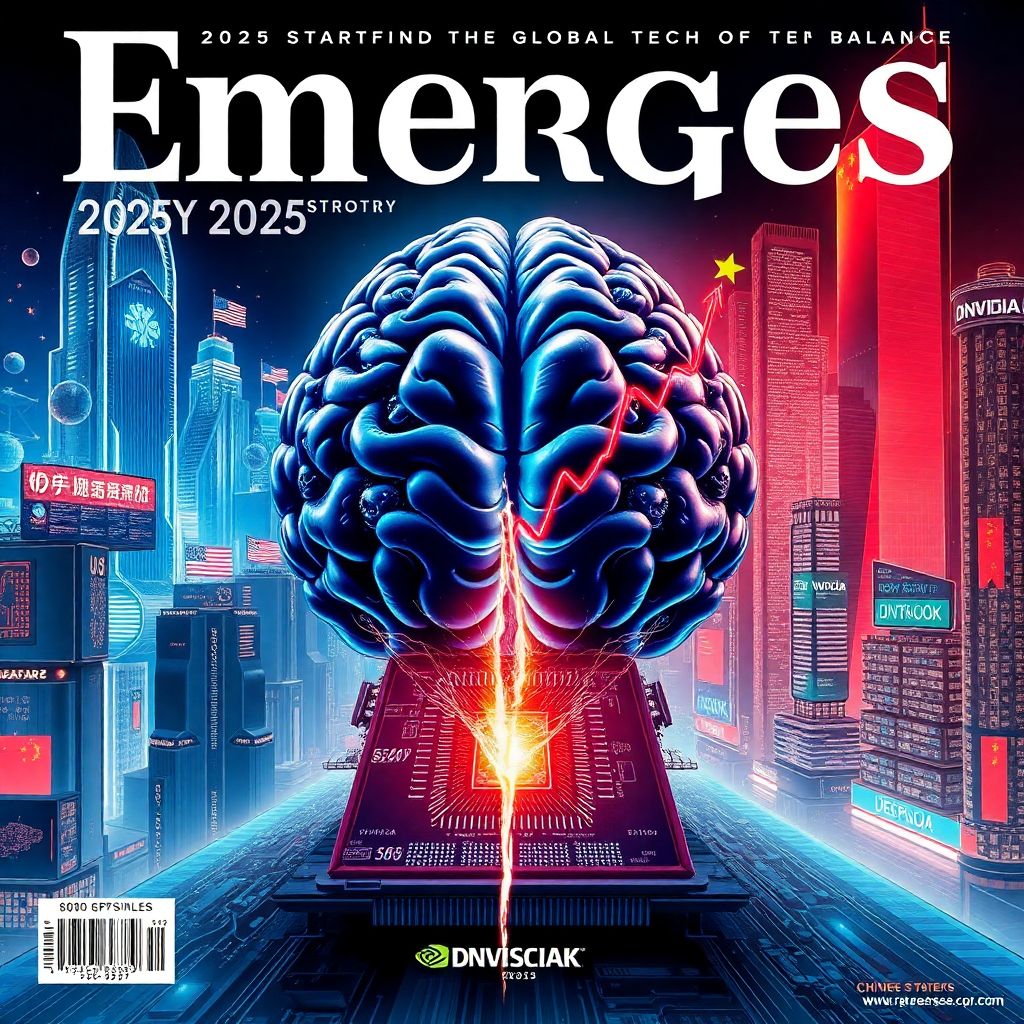
Emerge’s 2025 Story of the Year: How the AI Race Shattered the Global Tech Balance
The unravelling of the global tech order in 2025 can be traced back to a single, almost unbelievable figure: $256,000. That was the amount a little-known Chinese startup, DeepSeek, said it spent to train an AI model that, by most practical measures, rivaled the performance of OpenAI’s flagship systems—systems that reportedly required hundreds of millions of dollars in compute, data, and engineering time.
When DeepSeek’s consumer app quietly appeared in Apple’s store in January, the shockwaves were instant and brutal. Investors suddenly had to confront a new reality: if frontier-grade AI could be built for a fraction of the cost, the assumptions underpinning the entire AI hardware boom were wrong. In just one frenzied trading session, Nvidia shed around $600 billion in market value—the largest one-day loss in financial history.
That crash was bigger than a stock move. It was a signal that the tech hierarchy that had defined the past decade—U.S. platforms at the top, Chinese challengers shadowing them, the rest of the world consuming whatever trickled down—was breaking apart. And it was happening right as the U.S.–China rivalry was turning every layer of the technology stack into a battlefield:
– From critical minerals and chipmaking tools
– To cloud infrastructure and AI models
– To military doctrine and information operations
From Trade War to Tech Cold War
The tensions that had started years earlier as tariffs and export controls mutated in 2025 into something closer to a full-spectrum tech cold war. Washington tightened restrictions on advanced chips, lithography equipment, and AI accelerators bound for China. Beijing responded by fast-tracking its own semiconductor ecosystem, doubling down on domestic GPUs, RISC-V designs, and aggressive subsidies for AI research.
Both governments stopped pretending that AI was primarily a commercial technology. Official policy documents in Washington, Beijing, Brussels, and New Delhi began to use strikingly similar language: AI was now a “strategic capability”, on par with nuclear technology, and a core determinant of economic power, social stability, and military dominance.
Under the surface, it became clear that the AI race was less about chatbots and productivity tools and more about who would set the rules and own the infrastructure of the next computing era.
Weaponizing the Stack: Minerals to Models
By mid-2025, the rivalry had effectively “weaponized” the whole stack:
– Raw materials: Cobalt, rare earths, and high-purity silicon became bargaining chips. Export permits could be revoked overnight. Countries with rich deposits—especially in Africa and Latin America—found themselves courted, pressured, or sanctioned depending on who they aligned with.
– Manufacturing: Foundries in East Asia turned into strategic chokepoints. Insurance premiums for facilities near potential flashpoints soared, and several chipmakers quietly moved parts of their advanced packaging operations to more politically neutral locations.
– Compute and cloud: Nations began treating large-scale GPU clusters as critical national infrastructure, ring-fencing data centers and reserving capacity for “sovereign AI” projects.
– Models and algorithms: Access to top-tier models became politicized. Licensing, API access, and safety policies were all influenced by foreign policy considerations.
– Military doctrine: Wargames integrated AI-enabled targeting, autonomous systems, and information warfare as standard components. Militaries spoke openly about “algorithmic escalation”—the risk that AI-driven decision systems could push crises toward conflict faster than humans could de-escalate them.
The message from every capital was the same: in the AI era, dependency is vulnerability.
DeepSeek: The Disruption No One Priced In
DeepSeek’s breakthrough landed right in the middle of this fraught landscape. The company’s core claim was not just that its model was powerful, but that it was radically cheaper and more compute-efficient than anything built in Silicon Valley.
Where Western AI giants had leaned on massive proprietary datasets, specialized hardware, and sprawling training runs, DeepSeek’s approach prioritized:
– Extreme optimization of training pipelines
– Aggressive use of cheaper, widely available chips
– Clever data curation and synthetic data generation
– Novel compression and distillation techniques
For U.S. policymakers, that was alarming. Export controls on high-end GPUs were supposed to constrain China’s ability to compete at the frontier. DeepSeek suggested that algorithmic ingenuity could substitute for hardware scarcity, undermining the logic of sanctions.
For investors, it was a direct assault on the AI value chain they thought was locked in: more demand for AI meant more GPUs, which meant more revenue for Nvidia and its ecosystem. If a startup could get OpenAI-like performance on a shoestring budget, then the dependence on one expensive hardware vendor started to look like a liability, not an inevitability.
The Battle for the Consumer Mindshare
The geopolitical narrative often focuses on militaries and states, but 2025 made one thing obvious: the real battleground was the consumer.
DeepSeek’s app didn’t launch as a research demo. It hit mainstream app stores positioned as an everyday assistant—faster, cheaper, and in many non‑English markets, more culturally attuned than its American counterparts. It handled local languages, dialects, and regulations with surprising finesse.
Suddenly, consumers from Southeast Asia to the Middle East had a real choice. On one side: U.S.-based models, branded as “safer” and more aligned with Western norms but increasingly paywalled and rate-limited. On the other: Chinese and other non‑U.S. models that were sometimes more permissive, often cheaper, and better localized.
Governments, too, started picking sides. Some countries quietly nudged their public institutions and schools to adopt “friendly” AI providers. Others banned or throttled foreign AI apps, citing data sovereignty, disinformation risks, or national security. The result was a fragmented global AI app ecosystem:
– Certain regions became predominantly U.S.-model zones
– Others tilted toward Chinese ecosystems or regional players
– A few tried to remain neutral by investing in homegrown, open models
Consumers didn’t just download apps; they were, in effect, voting on which tech bloc to join.
Open-Source vs Closed: China vs the Rest of the World
One of the most surprising twists of 2025 was how the open‑source AI movement became a proxy site of competition between China and the rest of the world.
Several Chinese labs and startups began releasing powerful models under relatively permissive licenses, often with documentation and tools that made fine‑tuning and deployment simple even for modest teams. While regulatory scrutiny in the West pushed big U.S. labs toward more closed, tightly controlled systems, Chinese actors realized they could gain enormous soft power by enabling a global wave of DIY AI.
Developers in emerging markets, long frustrated by paywalls and usage caps from Western providers, flocked to these models. In sectors like education, agriculture, and local media, open Chinese architectures became de facto standards, particularly where Western offerings were too expensive or too restrictive.
Western regulators, meanwhile, worried that open, powerful models could accelerate disinformation, cybercrime, and destabilization. This led to a patchwork of safety rules, risk classifications, and compliance regimes that made it harder for small teams to operate, inadvertently tilting the field toward large, well‑funded players.
By late 2025, the map looked roughly like this:
– The U.S. and allies pushed for controlled, “responsible” AI with strong content and usage guardrails.
– China and aligned states promoted more permissive AI tools, emphasizing accessibility, economic growth, and national customization.
– The open‑source ecosystem became a contested space, with forks, mirrored repositories, and “sovereign variants” reflecting local political and cultural priorities.
The Disintegration of a Single “Global Tech Order”
For decades, the implicit assumption was that there was one global tech stack, dominated by a handful of Western companies and standards. In 2025, that illusion crumbled.
Multiple, partially incompatible AI and tech “spheres” emerged:
– A U.S.-centric sphere, anchored by American cloud providers, proprietary foundation models, and Western regulatory norms.
– A China-centric sphere, built around domestic clouds, local chip designs, and a mix of state-led and quasi‑private AI groups.
– A growing “non‑aligned” or “multi‑aligned” sphere, where countries like India, Brazil, and several African states tried to hedge, mixing technologies from both blocs while investing in their own sovereignty projects.
This fragmentation seeped into standards bodies, telecom infrastructure, operating systems, and even content formats. A document or AI agent fine‑tuned in one ecosystem might not behave predictably—or even interoperate fully—in another. Businesses that once built products for a single global internet now had to plan for parallel internets with incompatible rulebooks.
Economic Shockwaves and the Fall of Old Assumptions
The Nvidia sell‑off in January was the most visible symbol of the new era, but it wasn’t the only casualty. Venture portfolios, national industrial policies, and corporate roadmaps had been built on a simple mental model:
> More AI demand → more compute → more high‑end chips → linear growth for hardware vendors and cloud giants.
DeepSeek and its imitators challenged every step of that chain. If high‑performance AI could be made cheap, efficient, and hardware‑agnostic, then value would shift:
– Away from centralized, capital‑intensive cloud monopolies
– Toward nimble teams that could squeeze more intelligence out of fewer resources
– Toward countries that invested in skills, data, and governance, not just hardware imports
Some hardware makers pivoted quickly, emphasizing energy efficiency, edge computing, and AI‑on‑device instead of raw training throughput. Others doubled down on ultra‑high‑end accelerators for governments and a few mega‑labs. The divide between “AI haves” and “AI have‑nots” stopped being about who had the most chips and started being about who could make the smartest use of constrained resources.
Military AI: Escalation in the Background
Amid all the economic drama, the military implications quietly escalated. Both the U.S. and China fast‑tracked AI integration into surveillance systems, logistics, cyber defense, and weapons platforms.
DeepSeek‑style efficiency breakthroughs had a chilling side effect: powerful military‑relevant AI no longer required nation‑state‑scale budgets. Mid‑tier powers could realistically aspire to deploy sophisticated autonomous systems and AI‑driven intelligence tools, even without access to the very latest chips.
Wargames run by think tanks and defense agencies highlighted new risks:
– Shorter decision cycles, where AI‑assisted command centers could misinterpret signals and respond faster than diplomats could intervene.
– Ambiguous attribution, as AI‑generated content and cyber operations blurred the line between state and non‑state actors.
– Automation bias, where leaders might increasingly defer to “objective” AI assessments, even in high‑stakes crisis scenarios.
The question hanging over 2025 was no longer whether AI would affect warfare, but whether these algorithmic systems would accelerate the slide from trade rivalry to open conflict.
The Rise of “Sovereign AI”
One phrase dominated policy speeches and corporate keynotes in the second half of the year: “sovereign AI.”
Governments from Europe to the Middle East and Southeast Asia concluded that depending exclusively on either U.S. or Chinese AI stacks was too risky. They launched national AI initiatives focused on:
– Training domestic large language models on local languages, laws, and values
– Building regional data centers and GPU clusters under national jurisdiction
– Crafting governance frameworks to keep foreign influence in check while still attracting investment
This push didn’t always produce world‑class models, but it reshaped the industry. AI providers started offering “white‑label” or “co‑branded” models that could be marketed as national or regional products, even when the underlying technology came from abroad.
The result was an even more fragmented landscape—one where identity, politics, and economics became inseparable from technical architecture.
Corporate Strategy in a Fractured World
Multinational companies, long accustomed to building once and deploying everywhere, found themselves navigating a minefield. A global AI rollout now meant:
– Complying with diverging content and safety rules
– Maintaining separate model instances or even distinct codebases per region
– Negotiating with multiple regulators who treated AI as a strategic asset, not just a tech product
Some firms chose sides, aligning tightly with either the U.S. or Chinese sphere and accepting limited access to the other. Others tried to operate in “non‑aligned” mode, using open‑source models and hybrid infrastructure to avoid over‑dependence on any one bloc.
Corporate boards started asking new kinds of questions: not just “What’s our AI strategy?” but “What’s our geopolitically resilient AI strategy?”
The Human Factor: Trust, Alignment, and Cultural Schisms
Beneath the macro‑level power plays, 2025 also exposed a quieter but profound shift: AI systems increasingly reflected, and sometimes amplified, the cultural and political divides between regions.
U.S.-aligned models were tuned to Western legal norms, speech standards, and risk sensitivities. Chinese‑aligned models embedded a different set of priorities around social stability, state narratives, and information control. Models trained for other regions emphasized religious norms, post‑colonial perspectives, or local historical narratives.
In theory, this localization was a feature. In practice, it meant that citizens of different countries were increasingly interacting with different informational realities, shaped not just by local media but by their AI assistants’ training data and alignment choices.
The promise of a single, global digital commons—already weakened by social media bubbles—eroded further as AI systems became the main interface to knowledge, filtered through national and corporate agendas.
Where the Race Goes Next
By the end of 2025, the question was no longer whether the AI race had fractured the global tech order—it clearly had. The open issues now are:
– Will efficiency breakthroughs like DeepSeek’s democratize AI or simply create new kinds of dependencies?
– Can global institutions craft any shared norms around AI in warfare, disinformation, and economic coercion?
– Will the fragmentation of AI ecosystems stabilize into a few durable blocs, or splinter further into dozens of incompatible “AI micro‑worlds”?
– And most urgently: can political leaders and engineers design systems that temper escalation, rather than accelerate it?
What began as a contest over who could build the most powerful model has morphed into something far deeper: a struggle over the architecture of power in the digital age. The $256,000 experiment that wiped out $600 billion in value was not just a market anomaly—it was the clearest sign yet that the assumptions of the old tech order no longer apply.
The AI race has moved beyond labs and stock charts. It is now re‑drawing borders, rewriting alliances, and redefining what sovereignty means in a world where code, not just territory, is the ultimate terrain.