
Why Ethereum Could Lead the Next Crypto Rally: The Overlooked Power of the Fusaka Upgrade
Bitwise CIO Matt Hougan argues that Ethereum is positioned to front-run the next major crypto uptrend, and not because of the usual narratives around ETFs, institutional adoption, or “sound money” memes. Instead, he points to a very specific, highly technical catalyst that he believes the market is largely ignoring: the Fusaka upgrade.
According to Hougan, this upcoming hard fork could transform Ethereum’s ability to capture revenue from its own ecosystem, multiplying it by as much as five to ten times. If that happens, it would materially change how investors value ETH as an asset.
What Is Fusaka and When Does It Go Live?
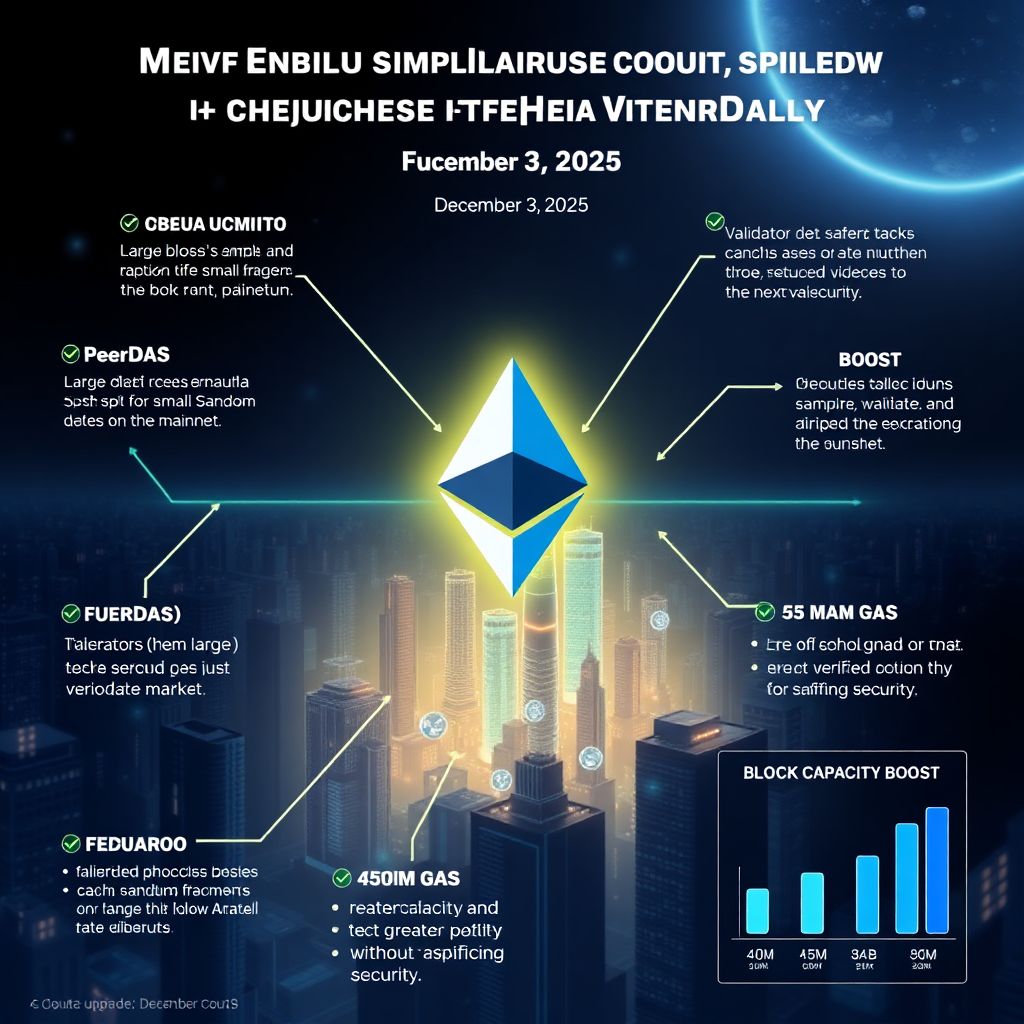
The Fusaka hard fork is scheduled to activate on the Ethereum mainnet on December 3, 2025, at 21:49:11 UTC, at block 13,164,544. Core developers locked in the timeline after successful testing on multiple testnets, including Holesky, Sepolia, and Hoodi, paving the way for a mainnet launch.
While previous upgrades often focused on security, scalability, or shifting Ethereum’s consensus mechanism, Fusaka zeroes in on a different piece of the puzzle: making Layer 2 (L2) rollups more efficient while ensuring Ethereum captures more of the economic value flowing through them.
PeerDAS: The Technical Core of Fusaka
At the heart of Fusaka is a feature called Peer Data Availability Sampling, or PeerDAS. In today’s setup, validators and nodes need to handle large “blobs” of data to verify that transaction information is actually available and not being hidden or censored. This process is data-intensive and places heavy demands on bandwidth and storage.
PeerDAS changes that. Rather than forcing validators to download entire data blobs, the mechanism lets them confirm data availability by sampling small, randomly chosen pieces. If those samples look valid and accessible, the network can be confident that the full data is available, without everyone shouldering the whole load.
This seemingly subtle change has big implications:
– It lightens bandwidth requirements for validators and nodes.
– It reduces the cost of posting data for Layer 2 rollups.
– It opens the door to much higher throughput without sacrificing security.
A Massive Boost to Block Capacity
Fusaka also includes a substantial increase in Ethereum’s block gas limit. The limit, which has typically hovered around 45 million gas, could rise to as high as 150 million under the new regime. That means each block will be able to process far more:
– Transactions
– Smart contract executions
– Data-heavy applications, including those relying on rollups and complex DeFi interactions
In practice, this expanded capacity enhances Ethereum’s role as a settlement and data layer for rollups. L2s can post more data per block, at lower relative cost, making them faster and cheaper to use for end users.
The Hidden Revenue Engine: Minimum Data Fees for L2s
The technical improvements are only half the story. Hougan emphasizes that Fusaka also quietly improves Ethereum’s revenue model.
The upgrade introduces a minimum fee for recording data from Layer 2 networks onto the Ethereum mainnet. Every time an L2 posts its transaction data back to Ethereum for security and finality, it will be subject to this baseline fee structure.
Hougan argues that this could multiply Ethereum’s revenue capture by five to ten times. As more activity migrates to L2s—where users enjoy low fees and high speed—Ethereum simultaneously becomes the mandatory settlement and data layer, monetizing that activity more directly.
In other words, instead of L2s “stealing” activity from Ethereum, Fusaka helps Ethereum turn L2 growth into a powerful, scalable revenue stream.
Why the Market May Be Underpricing Fusaka
Hougan believes investors are largely overlooking this upgrade because the story is technical, slow-burning, and not easily reducible to a simple meme. Unlike a token launch or ETF approval, a change in protocol-level value capture unfolds quietly over time.
He expects that once Fusaka is successfully delivered and its economic impact becomes clearer, the market will begin to reorient around Ethereum’s improved fundamentals. In his view, this “under-appreciated catalyst” is one of the key reasons ETH could outperform and potentially lead the next crypto rebound.
A Broader Shift: Tokens Are Learning to Capture Value
Fusaka is not happening in isolation. Hougan sees it as part of a broader reconfiguration across major digital assets: leading protocols are shifting from vague governance narratives to explicit, enforceable economic value for token holders.
He notes a pattern emerging among large-cap tokens:
– Protocols are beginning to integrate fee mechanisms, burns, or staking models that directly reward holders.
– The focus is moving away from speculative governance rights toward tangible claims on protocol revenue or economic activity.
This shift is being accelerated by regulatory pressure. New rules and scrutiny push projects away from loosely defined “governance only” models and toward clearer, more defensible economic structures. As a result, major tokens are restructuring themselves to demonstrate real value capture instead of relying purely on hype and narratives.
Uniswap’s Fee Switch: From Governance Token to Economic Asset
Uniswap’s UNI token is a prime example of this trend. The protocol is exploring a “fee switch” proposal that would allocate roughly 16% of trading fees to be burned, assuming the vote passes.
That burn mechanism would have two important effects:
– It introduces a deflationary pressure on UNI’s supply.
– It connects the token’s long-term value more directly to the protocol’s trading volume and fee generation.
Under this model, UNI would no longer be just a governance token. It would effectively become an asset with built-in economic benefits tied to actual protocol usage. Hougan has suggested that such a transformation could push UNI toward becoming a top-10 token by market capitalization over time.
XRP and the Move Toward Staking Economics
A similar transition is being explored in the XRP ecosystem, where stakeholders are examining ways to integrate staking-like mechanisms. Such changes could redesign how value accrues to XRP holders, potentially tying rewards to network activity or securing infrastructure.
Hougan views this as another facet of the same broader movement: major tokens are systematically upgrading their value capture mechanisms. Instead of staying static, token economics are evolving to align incentives, reward long-term holders, and link token value to underlying network performance.
2026: When the Shift Becomes Impossible to Ignore
Hougan predicts that by 2026, the industry-wide move toward stronger value capture will be unmistakable. He argues that many market participants still treat token economics as fixed, assuming that the way assets capture value today is how they will operate indefinitely.
He rejects that view. In his words, “The level of value capture in digital assets is up only from here.” Protocols are in a competitive arms race to design more effective and sustainable economic models, and upgrades like Fusaka are a direct product of that process.
As those designs mature, the gap between tokens with real, measurable value capture and those without it is likely to widen.
Why This Matters for Ethereum’s Investment Case
For Ethereum, Fusaka strengthens the core investment thesis in several ways:
– Revenue Scaling: By introducing a minimum fee for L2 data and expanding capacity, Ethereum can monetize the very growth it has encouraged on rollups.
– Network Effects: As more L2s depend on Ethereum for security and data availability, the mainnet becomes the indispensable infrastructure layer of an increasingly modular ecosystem.
– Valuation Frameworks: With clearer, larger, and more predictable revenue flows, ETH can be analyzed more like a productive asset, not merely a speculative store of value.
If revenue capture does increase five to ten times over time, that could justify higher valuations even without explosive growth in user numbers, as more of the existing activity will be directly monetized.
What Could Derail the Thesis?
There are still risks. Fusaka’s implementation must be smooth, and the technical changes have to perform as intended at scale. If the upgrade introduces unexpected issues—security, latency, or instability—the narrative could flip quickly.
There is also competitive pressure from other L1s and alternative scaling solutions aiming to provide cheaper or more specialized infrastructure. However, Ethereum’s advantage lies in network effects, depth of tooling, liquidity, and the sheer number of applications already deployed on its stack.
How Investors Might Think About the Post-Fusaka Landscape
For investors, the key takeaway from Hougan’s analysis is that protocol economics are not static—and Ethereum is actively moving to upgrade its own.
In a post-Fusaka world, several themes are likely to define Ethereum’s positioning:
– L2 Growth Becomes a Profit Center: Instead of cannibalizing the mainnet, rollup adoption amplifies Ethereum’s revenue.
– Higher Throughput Enables New Use Cases: Cheaper, higher-capacity blocks and more efficient data availability create room for more complex DeFi, gaming, social, and real-world asset platforms.
– Valuation Models Evolve: Analysts can increasingly anchor ETH’s value in on-chain data and protocol earnings rather than purely in narratives.
If this plays out as Hougan expects, Ethereum would not merely ride the next market cycle—it could help lead it, supported by a stronger, more tangible economic foundation.
The Bigger Picture: A Maturing Asset Class
The trajectory outlined by Fusaka, Uniswap’s fee changes, and potential XRP staking points to a maturing digital asset space. The first era of crypto was dominated by speculation and experimentation. The next era appears increasingly focused on:
– Sustainable revenue
– Clear value flows to token holders
– Robust, modular infrastructure that can handle mainstream-scale activity
Fusaka may look, at first glance, like a dry, technical hard fork. But beneath the jargon lies a powerful shift in how Ethereum—and by extension, much of the crypto ecosystem—plans to capture and distribute value. For Hougan, that is precisely why ETH may have a structural advantage in leading the next rally.