
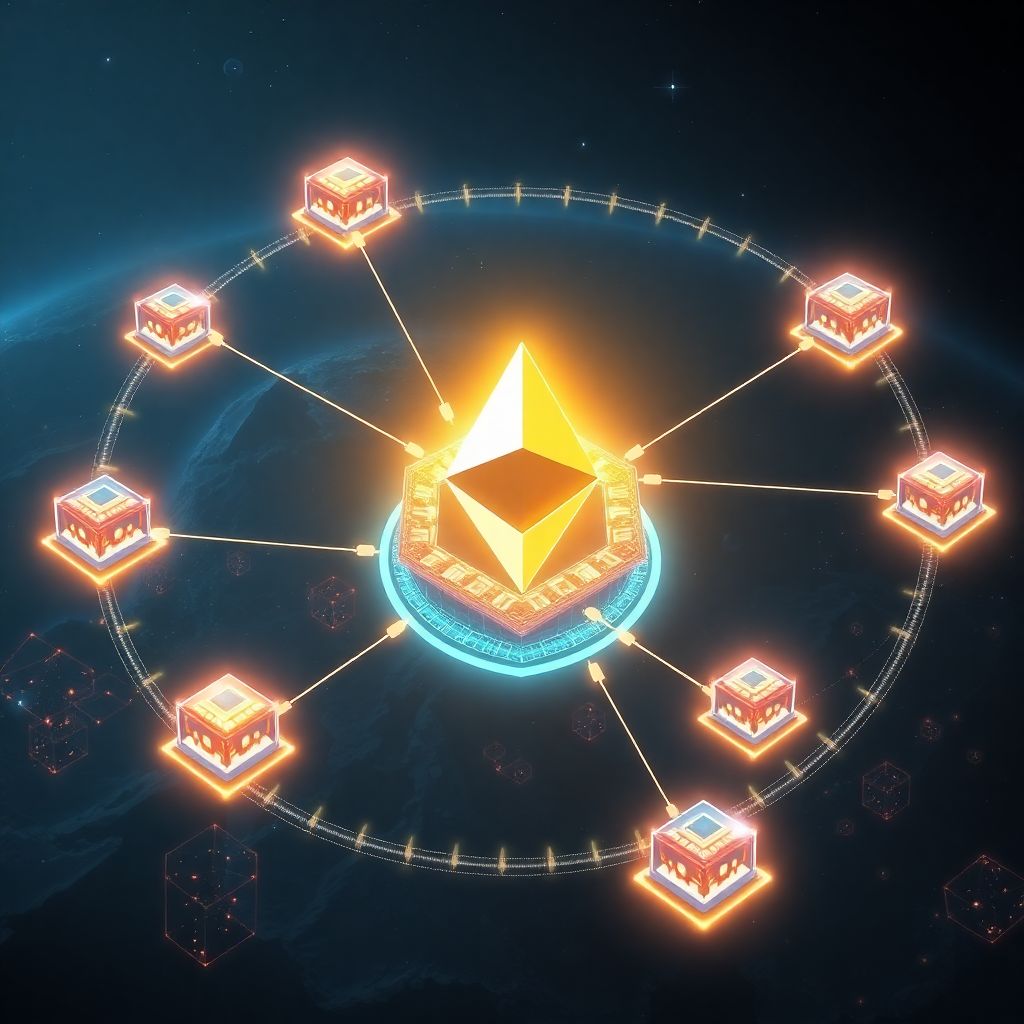
What to Expect From Ethereum’s Fusaka Upgrade?
Ethereum’s next major network overhaul, the Fusaka Upgrade, is scheduled to go live on Wednesday, and core contributors see it as a pivotal step in how the mainnet interacts with its layer-2 (L2) ecosystem. At its heart, Fusaka restructures the way Ethereum gathers and verifies data from rollup networks, with the explicit goal of making L2 transactions cheaper, faster, and more scalable—without sacrificing the security guarantees of the base layer.
Developers describe Fusaka as a maturation moment for Ethereum. Instead of radical, user-visible changes at the protocol’s surface, the upgrade focuses on refining the underlying plumbing: efficiency, decentralization, and resilience. According to Ethereum Name Service co-founder and lead developer Nick Johnson, these changes directly impact where most real activity now happens—on rollup-based L2s that batch and settle transactions back to Ethereum.
By optimizing how L2 data is posted to and checked by the mainnet, Fusaka is expected to lower the costs associated with rollup operations. Today, a big portion of L2 fees comes from paying Ethereum for data availability: rollups must publish transaction data on L1 so anyone can reconstruct and verify the state. Fusaka introduces more efficient data handling and verification pathways, allowing rollups to maintain the same trust assumptions while consuming fewer L1 resources. That translates, over time, into lower user fees and higher throughput on the networks most people use day-to-day.
The name “Fusaka” (short for “Fulu-Osaka”) follows Ethereum’s tradition of theming upgrades and comes on the heels of May’s Pectra upgrade. Pectra focused on enabling more advanced smart contract wallet capabilities and improving validator economics, all while nudging the protocol further along its long-term scalability roadmap. Fusaka builds on those foundations, pushing scalability even further and tightening the base layer’s role as a secure data and settlement engine for an ecosystem of L2s.
Where Pectra made it easier for users to interact with Ethereum through smart contract wallets and helped validators operate more sustainably, Fusaka is about the invisible backbone. It makes the mainnet better at ingesting, organizing, and validating large volumes of rollup data. The result is not just incremental performance gains, but a more future-proof architecture: one that can handle increasing L2 traffic as Ethereum continues to absorb more applications, users, and value.
For everyday users, the upgrade may feel subtle at first. Wallet interfaces and dapps are unlikely to change overnight. The more tangible impact will arrive in the form of gradually lower transaction fees on popular L2 networks and a smoother experience during peak demand. As rollup operators adapt their infrastructure to take advantage of Fusaka’s enhancements, they can pack more activity into each batch and submit it to Ethereum more efficiently, easing congestion and reducing volatility in gas costs.
Developers building on L2s stand to gain more flexibility and predictability. With a more efficient data-availability pipeline, rollups can experiment with richer applications, larger on-chain data footprints, and more complex state transitions without immediately hitting prohibitive costs on the base layer. That opens doors for data-heavy use cases—such as on-chain gaming, social protocols, and high-frequency DeFi strategies—that previously had to work around tight L1 data constraints.
Validators and node operators will experience Fusaka from another angle. The upgrade refines how nodes store, propagate, and verify L2-related data, prioritizing more compact structures and streamlined verification logic. Over time, this is expected to reduce certain operational burdens: nodes can handle growing throughput without a linear explosion in resource requirements, reinforcing decentralization by keeping full participation accessible to a wider range of operators.
From a network-governance perspective, Fusaka also signals that Ethereum has entered a phase where upgrades are less about headline-grabbing shifts and more about careful engineering. Instead of chasing ever more features at the protocol layer, core developers are optimizing Ethereum as a robust settlement and data layer for a modular ecosystem. This aligns with the broader rollup-centric roadmap: L2s handle execution and user-facing complexity, while L1 focuses on security, neutrality, and data integrity.
Security remains a central theme of Fusaka. Any change to how L2 data is processed by the mainnet must preserve — or improve — the security guarantees users rely on when they trust rollups. The upgrade keeps Ethereum’s fundamental trust model intact: the base chain continues to act as the final arbiter of correctness, and rollups still derive their safety from posting data and proofs to L1. Fusaka’s optimizations are built around making that process more efficient, not relaxing or delegating security assumptions.
One key implication is the long-term sustainability of gas markets on Ethereum. As more activity migrates to L2s, the composition of L1 demand changes: instead of millions of individual user transactions, the chain processes large batches of rollup data and proofs. Fusaka adjusts how these operations are represented and charged at the protocol level, aiming for a healthier balance between incentives for validators, affordability for rollups, and overall network stability.
Institutional participants and long-term investors may interpret Fusaka as another de-risking milestone in Ethereum’s roadmap. By strengthening the base layer’s capacity to support a scaling ecosystem of L2s, the upgrade helps ensure that growth does not come at the cost of fragility. Better efficiency and lower friction for rollups can attract more activity and liquidity, potentially reinforcing Ethereum’s position as the default settlement hub for decentralized finance and beyond.
For builders of infrastructure—such as indexers, explorers, and analytics platforms—Fusaka presents both a challenge and an opportunity. Changes in how data is stored and structured on-chain may require updates to indexing logic and tooling. But once adapted, these services can offer richer, more timely insights into cross-layer activity, tracking interactions as value and state move between L2s and the mainnet more fluidly.
Users curious about the upgrade’s immediate impact should temper expectations of dramatic overnight changes. Like many recent Ethereum improvements, Fusaka’s benefits compound over time as tooling, rollup architectures, and application design evolve to make full use of the new capabilities. The pattern is similar to prior upgrades: first, protocol-level changes land quietly; then, months later, new features, lower costs, and better user experiences emerge as the ecosystem catches up.
From a macro perspective, Fusaka underscores Ethereum’s strategy of scaling primarily through rollups rather than by pushing the base layer to process ever more transactions directly. By accepting modularity and specialization—L1 as secure settlement and data availability, L2s as execution environments—the ecosystem can grow without forcing every node to bear the full weight of global activity. Fusaka’s optimizations make this division of labor more efficient and sustainable.
Looking ahead, Fusaka is unlikely to be the final word on data efficiency or rollup integration. Instead, it should be seen as one more step in a multi-year progression: each upgrade incrementally tightens the feedback loop between L1 and L2, lowers costs, and improves performance. Future changes will likely build on Fusaka’s foundations, refining how proofs are handled, exploring further data compression techniques, and continuing to reduce the overhead of running nodes.
In practical terms, users don’t need to take any special action for Fusaka. Wallets, exchanges, and major dapps are preparing for the transition so that the upgrade occurs seamlessly in the background. The main things to watch in the aftermath are L2 fee trends, network congestion during busy periods, and how quickly rollup projects integrate the new efficiencies into their own systems.
Ultimately, Fusaka is about strengthening the layer that most people never see directly. By making Ethereum’s core more capable, leaner, and more resilient, the upgrade lays groundwork for the next wave of growth on L2s—the places where users trade, play, build, and experiment. It is a subtle but crucial evolution: a quieter engineering milestone that, if successful, will be felt not in a single dramatic change, but in a steadily better, cheaper, and more reliable Ethereum experience over the months and years to come.