
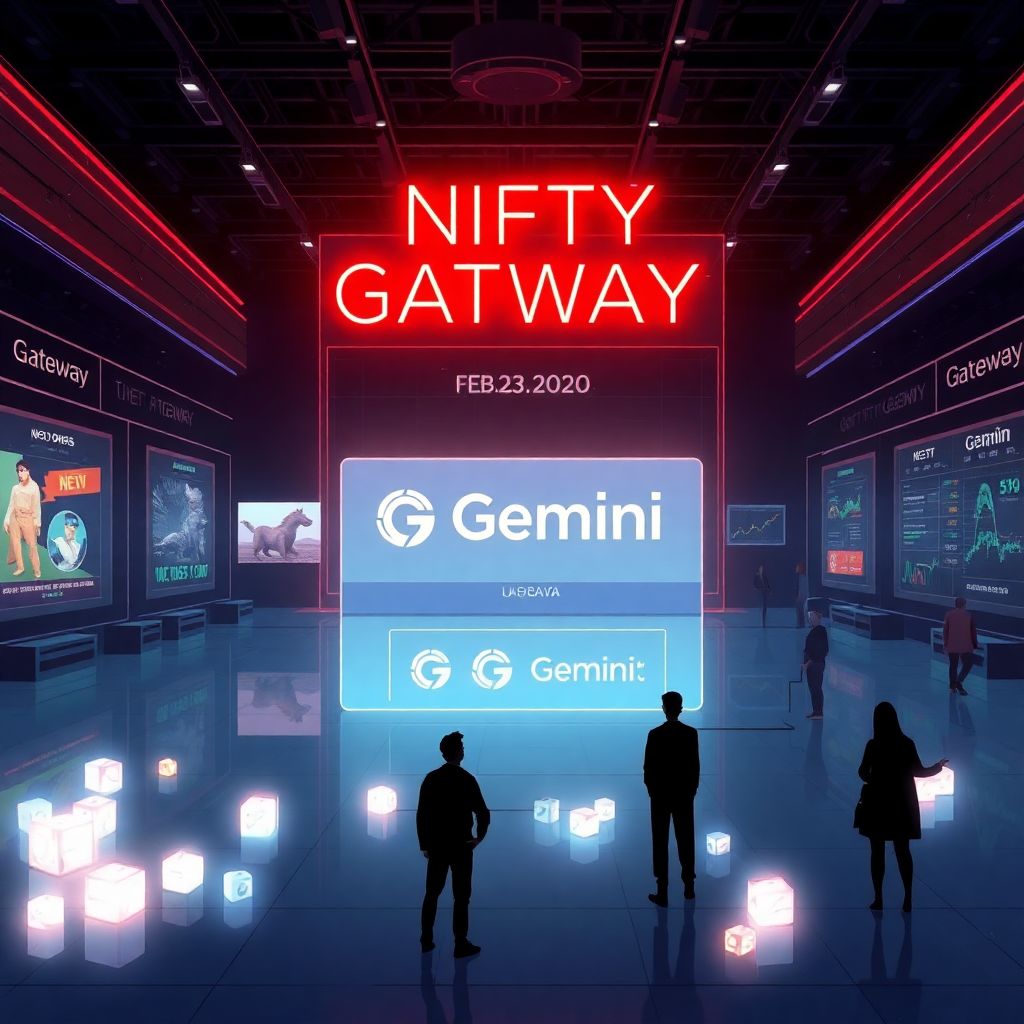
Gemini will wind down its Nifty Gateway NFT marketplace in February, drawing a line under one of the early flagship platforms of the non-fungible token boom. The crypto exchange, founded by Tyler and Cameron Winklevoss, confirmed that Nifty Gateway will be shut down on February 23, turning the service into withdrawal-only mode in the meantime.
Effective immediately, users can no longer trade on Nifty Gateway and are instead limited to withdrawing their assets. Gemini is urging customers to move NFTs, as well as any remaining USD and ether balances, off the marketplace ahead of the final closure date. Detailed instructions are being provided to help users migrate their holdings into other parts of the Gemini ecosystem.
Launched in 2020, Nifty Gateway tried to position itself as a high-end, curated venue for digital art and collectibles. It quickly became known for headline-grabbing NFT drops, often featuring well-known artists, brands, and cultural figures. During the height of the NFT frenzy in 2021, the platform became one of the go-to destinations for collectors looking to participate in “drops” that sold out within minutes.
Gemini credits Nifty Gateway with hosting dozens of “innovative drops” and helping push forward experimental formats for digital art. The platform played a notable role in bringing mainstream audiences into NFT culture, serving as a bridge between traditional art buyers and crypto-native collectors. For a period, it symbolized the optimism that digital collectibles could reshape ownership and monetization in creative industries.
In its statement, Gemini emphasized its appreciation for both the team behind Nifty Gateway and the community of artists and buyers that supported the marketplace. The company described itself as “incredibly proud” of the work done by the Nifty team and thanked customers and creators who participated in its evolution during the NFT bull market.
The decision to shutter Nifty Gateway is part of a larger strategic reorganization at Gemini. The firm is consolidating products and reallocating resources toward what it calls a “one-stop super app” for crypto users. Rather than maintaining a separate, branded NFT marketplace, Gemini plans to integrate NFT functionality more tightly into its core offerings.
While Nifty Gateway as a standalone platform will disappear, Gemini says it is not abandoning NFTs altogether. The company plans to keep supporting non-fungible tokens via the Gemini Wallet, which it says launched in August 2025, positioning that wallet as the central hub for storage and management of digital assets, including collectibles. In practice, this means users will be encouraged to treat their NFTs like any other tokenized asset within Gemini’s broader infrastructure.
Existing Nifty Gateway customers will receive step-by-step guidance on how to move their NFTs and associated balances into Gemini Wallet or other supported services. For many, the process will involve linking accounts, verifying wallet addresses, and confirming that all items have been successfully transferred before the February deadline. Gemini is signaling that, although the marketplace will be gone, it intends to preserve access and custody for users who remain within its ecosystem.
The shutdown comes against the backdrop of a prolonged slump in the NFT sector. Trading volumes and active user numbers have fallen sharply from their explosive 2021 highs, when profile-picture collections, art projects, and game-related NFTs drew billions in speculative capital. As prices cooled and enthusiasm faded, several NFT-focused companies have scaled back operations, pivoted business models, or exited the space entirely.
This cooling trend has been compounded by broader challenges facing the crypto industry: market volatility, rising regulatory scrutiny, and a series of high-profile collapses that undermined investor confidence. NFT marketplaces, which thrived on rapid turnover and speculative trading, have been particularly exposed to declining liquidity. In that context, Gemini’s move to close Nifty Gateway reads as both a cost-cutting decision and a strategic shift toward more resilient, integrated services.
Gemini Trust Co., established in 2014 by the Winklevoss twins, runs a regulated crypto exchange and custodian business serving both individual traders and institutional clients. Based in New York, the company has long leaned into a reputation for compliance and regulatory engagement, aiming to distinguish itself from offshore exchanges that often prioritize speed over oversight. Gemini offers spot trading, custody services, staking options, and a digital wallet, all built around an emphasis on security and regulatory alignment.
Over the past several years, Gemini has trimmed and adjusted its product suite in response to industry headwinds. Market crashes, legal disputes affecting parts of the crypto ecosystem, and uncertainty over new rules have pushed many firms to focus on their most defensible, revenue-generating offerings. Closing Nifty Gateway fits into this pattern: instead of operating a specialized NFT marketplace, Gemini is betting that users will gravitate toward unified wallet-based experiences where they can hold, trade, and manage a wide range of assets through a single interface.
For artists and collectors who once flocked to curated drops on Nifty Gateway, the closure marks the end of a culturally significant platform from the early NFT era. Nifty Gateway was part of a cohort of marketplaces that pushed digital art into mainstream conversation, helping normalize the idea that purely digital files could be bought and sold as scarce, verifiable assets. Its disappearance underscores how quickly the NFT landscape has shifted from exuberant growth to consolidation.
The shutdown also raises questions about the long-term viability of highly curated NFT platforms. During the boom, curation was sold as a value-add: artists gained prestige from being selected, while buyers saw it as a form of quality control. In a subdued market, however, maintaining such operations can be expensive, and the revenue generated from reduced trading activity may no longer justify separate branding, staffing, and marketing for a niche marketplace.
For current Nifty Gateway users, the immediate priority is operational rather than philosophical: ensuring that no assets are left behind. NFT holders must verify that their tokens are correctly visible and transferable, confirm on-chain ownership when possible, and follow Gemini’s official instructions for migration. For those who prefer self-custody, the shutdown is also an opportunity to move NFTs to personal wallets where they control the private keys, rather than relying on centralized management.
From a broader industry perspective, Gemini’s decision highlights a growing emphasis on infrastructure over speculation. Rather than competing in a saturated field of marketplaces, some companies are choosing to build tools—wallets, custody solutions, cross-chain bridges, and token management services—that support multiple asset classes, including NFTs, without needing a hype-driven trading environment. This approach aligns with a more mature phase of crypto, in which sustainability and compliance weigh increasingly heavily alongside innovation.
The end of Nifty Gateway does not necessarily signal the end of NFTs as a concept. Instead, it may reflect a transition from noisy, drop-driven marketing to quieter, more utilitarian use cases. NFTs are being explored for ticketing, loyalty programs, in-game items, intellectual property licensing, and brand engagement. Yet the era when a single curated marketplace could attract global headlines with every drop appears to be fading.
For creators, the lesson is to diversify presence across multiple platforms and ownership models. Artists who previously relied heavily on Nifty Gateway’s curation and promotional reach will need to engage with other marketplaces, experiment with direct sales, and possibly cultivate their own collector bases through independent storefronts and wallets. The underlying technology remains, but the distribution channels and economics are shifting.
Collectors, meanwhile, may adjust their strategies by focusing less on short-term flipping and more on long-term conviction in specific artists, collections, and use cases. The closure of a once-prominent marketplace is a reminder that platforms can be ephemeral, while on-chain ownership is more durable. As long as NFTs remain accessible on public blockchains or through interoperable wallets, their value will depend less on where they were bought and more on the communities, narratives, and utilities that form around them.
Ultimately, the wind-down of Nifty Gateway encapsulates the arc of the NFT market so far: an explosive rise, a period of intense experimentation and speculation, followed by consolidation and a return to fundamentals. Gemini’s pivot toward an integrated super app and wallet-centered model suggests that, in its view, the future of digital assets lies not in standalone hype cycles, but in robust, compliant, and unified platforms where NFTs sit alongside the rest of a user’s crypto portfolio.