
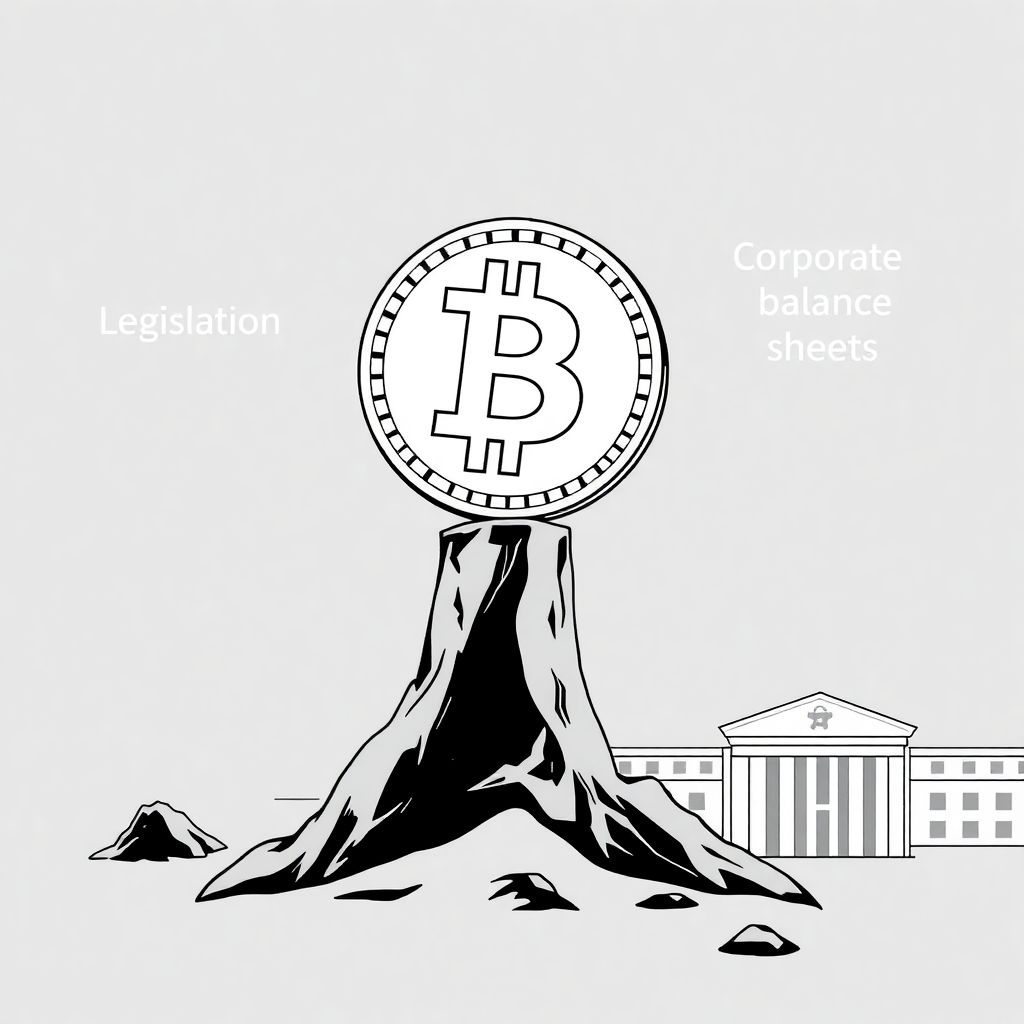
Grayscale warns Bitcoin may not have found its floor yet, especially if US crypto legislation falters and the Federal Reserve turns more aggressive on interest rates. In a new market update, the asset manager argues that Bitcoin is hovering near a potential cycle low only under a relatively benign set of assumptions – and that a less favorable policy and macro backdrop could push prices lower.
According to Grayscale, the near-term trajectory for Bitcoin hinges on three pillars: the fate of the CLARITY Act in the Senate, the health of large corporate digital‑asset balance sheets, and the direction of Fed policy. Its base‑case scenario assumes that the CLARITY Act ultimately passes, major digital asset treasuries stabilize their leverage, and the Federal Reserve refrains from additional rate hikes despite sticky inflation.
Under those conditions, Grayscale believes the bulk of this cycle’s downside could already be behind the market. Zach Pandl, the firm’s head of research, said that if these risks recede, Bitcoin is “likely near its current cycle low.” However, he also laid out a more cautious path in which the opposite happens: the CLARITY Act stalls, digital asset treasuries intensify deleveraging, and the Fed tightens further in response to persistent inflation. In that weaker scenario, he warned, Bitcoin could “fall moderately further.”
The note landed just after Bitcoin slumped below the psychologically important 60,000‑dollar level, amid a sharp risk reset across crypto assets. Recent price action has been driven in part by net outflows from spot exchange‑traded products and a wave of forced liquidations, as leveraged traders attempted to defend key support zones and were caught on the wrong side of volatility.
Grayscale put the current drawdown into historical context. Earlier Bitcoin bear markets have seen peak‑to‑trough declines around 80%, but the firm does not anticipate that kind of extreme capitulation this time. The main reason: institutional participation in Bitcoin and broader digital assets has held up more robustly than in previous cycles, providing a deeper base of structurally longer‑term demand.
A central variable in Grayscale’s framework is the CLARITY Act, one of the most closely watched pieces of US digital‑asset legislation. The bill aims to establish a federal market structure for cryptocurrencies and related tokens, clarifying which agencies oversee different activities and setting out rules for exchanges, developers, and token issuers. In theory, it would give both traditional finance firms and crypto-native businesses a clearer regulatory roadmap.
Procedurally, the bill has made some progress but still faces a complicated path. It has been advanced out of committee and placed on the Senate calendar, yet it must still clear floor debate, survive any amendments, and secure at least 60 votes. As the legislative calendar becomes more crowded, the window for that process narrows, making timing and political trade‑offs more difficult.
Further complicating matters is the need for coordination between key Senate committees with overlapping jurisdiction, including those overseeing banking and agriculture policy. Several contentious policy points remain unresolved, among them conflict‑of‑interest rules for regulators and industry participants, the treatment of stablecoins, provisions targeting illicit finance, and the allocation of limited floor time. Any of these issues could delay or dilute the bill.
From Grayscale’s vantage point, a successful Senate vote would reduce a major source of regulatory uncertainty that has weighed on sentiment for years. A clear set of federal rules, even if imperfect, could unlock the next phase of institutional participation by giving large financial firms more confidence in how digital assets are supervised. Conversely, if the CLARITY Act stalls or is shelved, the market is left with a patchwork of rules and ongoing enforcement‑driven policy, keeping regulation tightly intertwined with price swings and risk appetite.
The second major risk Grayscale highlights is the Federal Reserve’s interest‑rate path. Some market observers have floated the possibility that, if inflation remains stubbornly above target, the central bank could pivot back toward rate hikes rather than cuts, potentially as soon as 2026. Recent Fed projections have already drifted away from an aggressive easing cycle, with several officials signaling that further tightening remains on the table if inflation does not cool convincingly.
Higher policy rates generally pose a headwind to non‑yield‑bearing assets like Bitcoin. When real yields on cash and government bonds rise and the US dollar strengthens, many investors reallocate toward those safer, income‑producing instruments. That dynamic has already pressured both Bitcoin and gold at various points this year, as markets adjusted to the prospect of “higher for longer” interest rates.
Grayscale also draws attention to the role of large, highly visible corporate holders of Bitcoin and other digital assets, which it refers to as part of the broader “strategy” and digital asset treasury (DAT) complex. One widely watched firm has seen the value of its Bitcoin holdings fall billions below its aggregate acquisition cost following the latest decline below 60,000 dollars. At the same time, its own stock has, at times, traded at a discount to the value of its Bitcoin reserves, undermining a key element of the bullish feedback loop that previously supported its strategy.
Earlier in the cycle, that corporate playbook relied on a reinforcing “flywheel”: rising Bitcoin prices boosted the company’s share price, which in turn made it easier and cheaper to issue new equity or debt, then deploy the proceeds into more Bitcoin. As the stock premium has compressed and financing conditions tightened, that flywheel has slowed and, in some respects, begun to reverse. If the firm or other large DATs are forced to de‑risk further, it could add another layer of selling pressure or at least remove a source of incremental demand.
Despite these warnings, Grayscale does not foresee a catastrophic replay of prior crypto winters. Instead, the firm frames the coming period as a test of three interlocking forces: regulatory clarity, monetary policy, and balance‑sheet resilience among key market participants. In its constructive scenario-CLARITY passes, major treasuries stabilize rather than unwind, and the Fed remains on hold-Bitcoin could already be trading in a broad bottoming range, with downside limited and the groundwork laid for a gradual recovery.
In the adverse scenario-legislation stalls, deleveraging accelerates among large holders, and the Fed resumes tightening-the firm expects further downside to be “moderate” rather than a full collapse. That implies a prolonged, choppy market characterized by lower risk appetite, fragile sentiment, and sensitivity to every incremental regulatory or macro headline.
For investors, this framework underlines how much Bitcoin has become entangled with traditional macro and policy drivers. It is no longer a purely idiosyncratic asset governed only by halving cycles and retail speculation. Interest‑rate expectations, inflation dynamics, and legislative calendars now shape demand alongside on‑chain data and technical levels. As a result, monitoring developments in Washington and at the Fed has become as important as tracking exchange flows or miner revenues.
This environment also intensifies the role of narrative. A clear regulatory breakthrough could quickly shift institutional perceptions from “uninvestable” to “strategic allocation,” while a messy legislative failure might reinforce the view that US policy risk remains elevated. Similarly, a surprise dovish turn from the Fed would likely revive the “digital gold” and “macro hedge” narratives that propelled previous rallies, whereas renewed tightening could reinforce the idea of Bitcoin as a high‑beta risk asset.
Long‑term holders may view this phase as an accumulation window, betting that structural drivers-limited supply, gradually expanding institutional participation, and ongoing infrastructure development-will outweigh cyclical headwinds over time. Short‑term traders, by contrast, are likely to remain focused on volatility around central‑bank meetings, legislative milestones, and earnings or financing updates from large corporate holders.
Another layer to consider is how other digital assets react in parallel. Progress or failure on the CLARITY Act would not only affect Bitcoin but the broader market, including tokens closely linked to regulatory debates over securities classification, stablecoins, and cross‑border payments. If the bill is perceived as favorable but narrowly tailored, Bitcoin could benefit as the clearest, least ambiguous asset, while more complex tokens remain in a gray area. If the framework is seen as restrictive, even Bitcoin could face indirect pressure via reduced overall risk appetite.
Over the medium term, much will depend on whether US policy moves toward harmonization or continued fragmentation. A coherent national framework that interacts smoothly with other major jurisdictions could help anchor global liquidity and encourage more conservative institutions to enter the market. Persistent uncertainty, by contrast, might push innovation and trading activity toward friendlier regions, leaving US‑based investors with fewer options and higher perceived risk premia.
In sum, Grayscale’s message is that Bitcoin is approaching an inflection point shaped less by on‑chain metrics and more by laws, rates, and corporate balance sheets. A supportive outcome across those fronts could validate the view that the recent pullback represents a late‑cycle correction rather than the start of a deep bear market. A more hostile combination would not necessarily spell disaster, but it could mean that the path to new highs is longer, more volatile, and more dependent on policy breakthroughs than in previous cycles.