
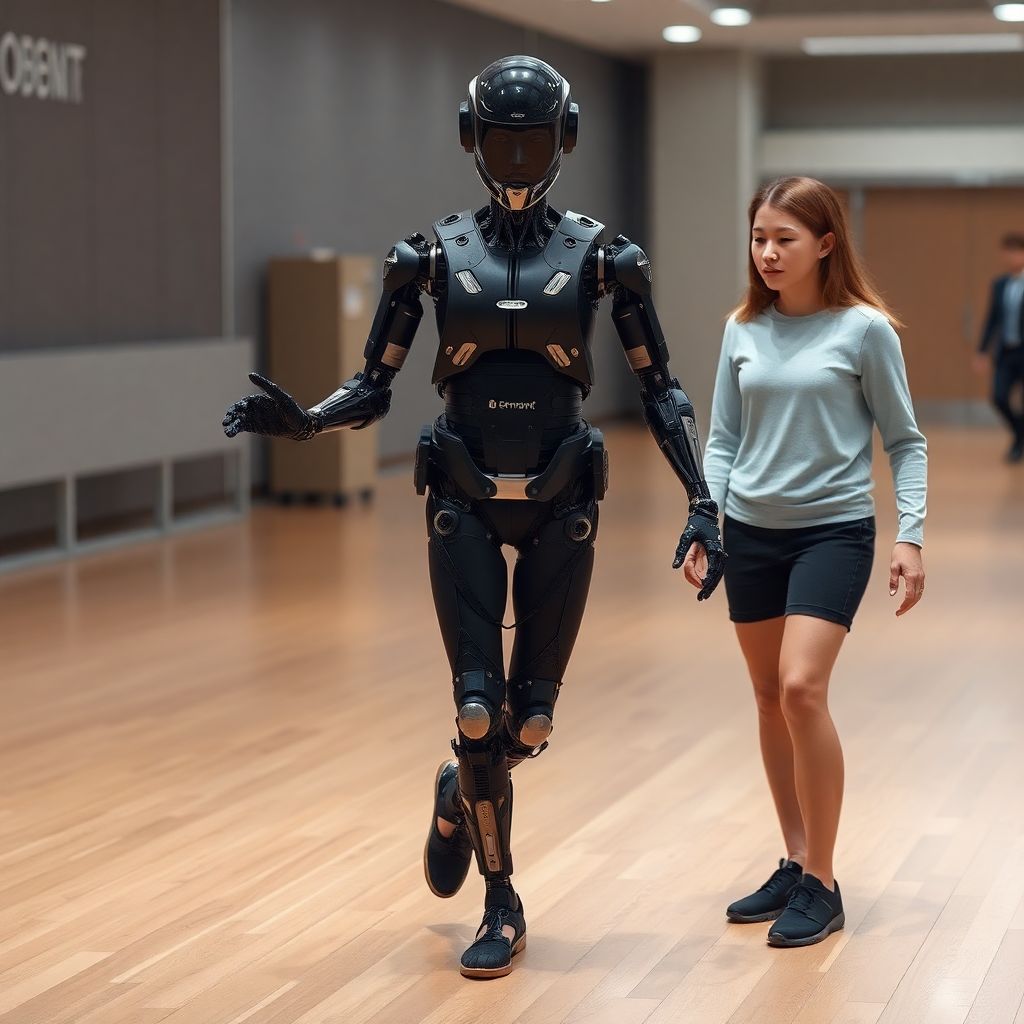
A team of researchers from China’s National University of Defense Technology, in collaboration with the robotics division of Midea Group, has taken a major step toward solving one of the most persistent challenges in robotics: enabling humanoid robots to learn natural, full-body movements without the need for massive volumes of training data. Their solution, called HumanoidExo, is a wearable exoskeleton that captures human motion and translates it into structured datasets that can be directly used to train robots.
Unlike traditional methods that depend on thousands of motion-capture sessions and expensive demonstrations, HumanoidExo offers a more efficient and cost-effective approach. The system is designed as a lightweight, ergonomic suit that tracks movements of the entire human body—including arms, legs, and torso—in real time. This motion data is then converted into structured formats compatible with robotic learning algorithms.
In practical tests, a humanoid robot known as the Unitree G1 was able to learn complex motor tasks using only a limited number of demonstrations generated by the exoskeleton. Among the learned behaviors were walking, balancing, and object manipulation—skills that typically require extensive training data to master.
One of the major breakthroughs of HumanoidExo lies in its ability to drastically reduce the volume of training data needed. Traditionally, humanoid robots require vast datasets collected under controlled conditions. This process is labor-intensive and expensive. By contrast, the exoskeleton-based system allows for the rapid generation of high-fidelity movement data directly from human users, streamlining the training process.
The implications of this technology go far beyond academic research. By making it easier and faster to train humanoid robots, HumanoidExo could accelerate the deployment of intelligent machines in real-world environments—from manufacturing and logistics to elder care and home assistance.
Moreover, the system’s flexibility opens the door to personalized robot training. For instance, robots could be taught specific motion styles or behaviors by individual users, allowing for custom-tailored assistance or interaction. This could be especially beneficial in rehabilitation or therapy settings, where robots need to adapt to the unique movement patterns of patients.
From a technological standpoint, HumanoidExo blends biomechanics, sensor technology, and artificial intelligence. The suit includes a suite of sensors that capture joint angles, acceleration, and orientation, feeding this information into a learning pipeline that allows robots to mimic complex human motions. The collected data is then used to train machine learning models that govern robot behavior.
One of the key challenges in robotics is the so-called “sim-to-real” gap—the difficulty of transferring behaviors learned in simulated environments to physical robots in the real world. Because HumanoidExo collects real-world, human-generated data, it helps bridge this gap by ensuring that the training inputs are grounded in actual human biomechanics.
Another important aspect is the system’s adaptability. The HumanoidExo suit is modular and scalable, meaning it could be customized for different body types or specific applications. Whether it’s teaching a robot to walk across uneven terrain or guiding it through the motions of picking up fragile items, the suit provides a direct, intuitive interface between human skill and robotic capability.
Future iterations of the system may include more advanced machine learning architectures, such as reinforcement learning or imitation learning frameworks, which could further enhance the precision and generalization of the robots’ acquired skills. Additionally, integrating real-time feedback loops could allow the robots to refine their movements on the fly, adapting to changing environments or unexpected obstacles.
There is also potential for this technology to be applied in collaborative robotics, or “cobots”, where humans and robots work side-by-side. With improved locomotion and dexterity, robots trained using HumanoidExo could take on more complex and dynamic roles in human-centric environments like hospitals, warehouses, or homes.
The HumanoidExo project sets a strong precedent for future research in embodied AI, where machines learn through physical interaction with their surroundings, much like humans do. By turning human motion into high-value data, researchers are not only making robots more capable—they’re also making them more human-like in how they learn.
As the field of robotics continues to evolve, systems like HumanoidExo represent a crucial step toward closing the gap between human intelligence and machine autonomy. Whether in industrial automation, healthcare, or everyday life, the ability to teach robots through simple, natural movement could redefine how we interact with technology in the years to come.