
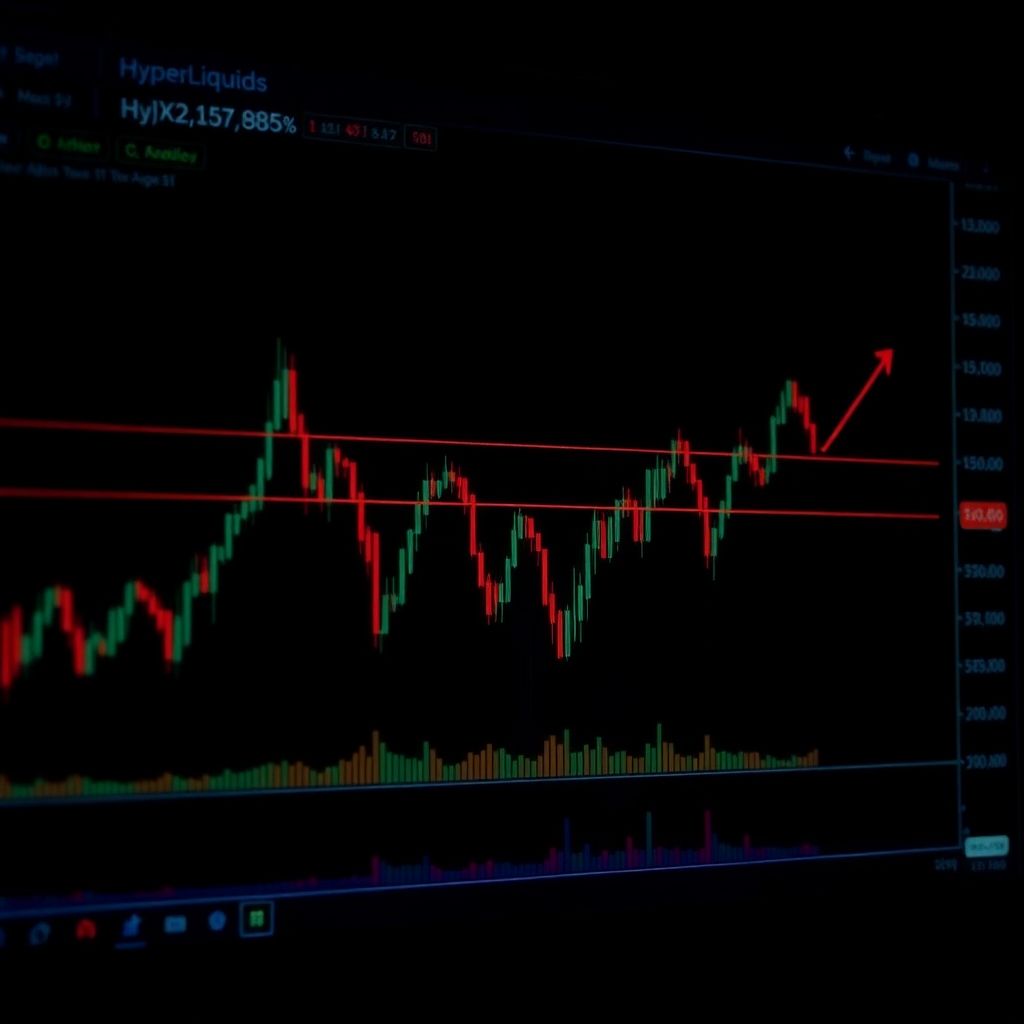
Hyperliquid (HYPE) is still locked in a dominant bearish structure, with the latest rally stalling well below prior cycle highs and printing another clear macro lower high. Instead of signaling a sustainable trend change, recent price action has reinforced downside momentum, keeping sellers in control and shifting focus toward the $22-$21 support band as the next major destination.
On higher timeframes, the chart continues to show a series of lower highs and lower peaks in momentum. Each bounce has been shorter-lived than the previous one, and every attempt to force a trend reversal has been absorbed by aggressive supply. This pattern is typical of a corrective or distributive environment, where rallies are used to exit positions rather than accumulate.
The most recent push higher was rejected in the $35 region, an area now confirmed as a significant high timeframe resistance zone. That level coincided with several key volume metrics: the Volume Weighted Average Price for the broader range and the Value Area High, together forming a dense confluence of supply. Price was unable to build acceptance above this band, and the swift rejection from $35 underlined that sellers still dominate flows at elevated levels.
After rejection from resistance, HYPE rotated back down toward the Point of Control (POC) of the current trading range – the price level that has seen the heaviest concentration of traded volume. The POC is often a battleground where either continuation or reversal is decided. In this case, buyers failed to reclaim or defend the POC on closing timeframes. Instead, price lost acceptance above it, signaling fading demand and validating a bearish continuation rather than a neutral consolidation.
Losing the POC as a support pivot has set in motion the corrective leg now unfolding on the lower timeframes. When markets drop below such high-volume nodes, liquidity often migrates toward deeper demand pockets, where more committed buyers may be waiting. For Hyperliquid, the next meaningful area of interest sits around $22-$21 – a prior swing low that also carries psychological and structural importance as a potential capitulation and re-accumulation zone.
As long as HYPE trades beneath both the POC and the $35 high timeframe resistance, the path of least resistance remains to the downside. A move into the $22 area would be a technically coherent rotation within the prevailing range structure. While that would extend the current drawdown and may look decisively bearish in the short term, it could also become a critical stress test of long-term demand. A sharp, high-volume reaction from $22-$21 might form the base for a more serious recovery attempt.
Conversely, if the $21 swing low fails to hold, the implications go beyond a routine dip. A confirmed breakdown below that zone would carve out a new macro lower low and firmly reassert the downtrend. That would extend bearish projections further, potentially opening the door to deeper discount areas and prolonging the corrective cycle that has been shaping Hyperliquid’s price for months.
Volume behavior currently does little to support the bullish case. Buy-side participation remains muted, and intraday pumps regularly stall without follow-through. Rallies appear more corrective than impulsive – short squeezes or mean reversion bounces rather than the start of a new trend leg. Without a clear expansion in bullish volume and a decisive reclaim of lost resistance zones, any short-term strength is likely to be faded.
From a structural standpoint, the market remains under the influence of a corrective, seller-led environment. Hyperliquid’s price action is gradually rotating lower as it searches for areas of stronger liquidity and genuine long-term interest. Notably, this is happening even as the Hyperliquid ecosystem has grown significantly in derivatives activity, surpassing some major centralized exchanges in total notional trading volume and underscoring the rise of decentralized perpetual futures. That fundamental backdrop, however, has not yet translated into sustained buy pressure in the spot and token markets.
In practical terms, the key technical map looks as follows: resistance is clustered around $35 and the overhead POC/volume resistance zone, while the primary support to watch sits at $22-$21. As long as price remains capped below the upper band, the bias favors continued testing of lower supports. The market’s next decisive clue will likely emerge from how it behaves when – or if – it taps into that $22-$21 area.
Bullish scenario: What would a constructive reversal look like?
For a more optimistic trajectory to gain credibility, several conditions would need to align. First, HYPE would have to stabilize above the $22-$21 support with clear evidence of buyer absorption: long lower wicks, rising spot volumes, and a slowing of downside momentum on daily and higher timeframes. Ideally, this would be followed by a clean reclaim of the POC, turning it from resistance back into support.
A convincing bullish pivot would also require a break above the $35 resistance zone, not just a brief intraday spike. That would invalidate the current sequence of macro lower highs and signal a potential trend transition from distribution to accumulation. Without such structural shifts, isolated green candles are more likely to be short-covering than genuine trend reversals.
Traders looking for early bullish signals might watch for bullish divergences on momentum indicators, declining sell volume as price approaches $22, or a shift in funding rates and open interest that suggests shorts are becoming crowded and vulnerable. None of these are guarantees, but together they can offer context for a potential inflection point.
Bearish continuation: How deep could the downside extend?
If $22-$21 fails to attract meaningful support, the market would confirm an extension of the existing macro downtrend. In that scenario, selling could accelerate as late longs capitulate and risk systems trigger forced exits. A breakdown below $21 would likely drag price toward previously untested lower liquidity pockets, with each new low reinforcing the bearish market structure.
From a risk perspective, such a move would cement the current cycle as a prolonged corrective phase rather than a brief pullback. Market participants who treat every dip as a buying opportunity without respecting structural signals may find themselves trapped in a grinding downtrend with limited exit liquidity on bounces.
Timeframe alignment and trader behavior
Another key element in reading HYPE’s chart is the alignment – or misalignment – of different timeframes. On lower timeframes, intraday rallies can look impressive, but when placed against the backdrop of the daily or weekly chart, they often resolve as minor fluctuations inside a broader downtrend. Traders who ignore this context may overestimate local strength and underestimate the influence of macro resistance.
Swing traders and position traders typically place more weight on high timeframe structures such as macro lower highs, major value areas, and multi-week POC levels. Intraday scalpers might profit from small bounces, but until the larger trend shifts, the overarching bias favors selling strength rather than buying breakouts.
Fundamentals vs. technicals: Why price can lag growth
It may seem paradoxical that Hyperliquid’s ecosystem can expand – especially in derivatives volume and protocol usage – while the token’s price remains under pressure. This disconnect is not uncommon in crypto. Token price can lag fundamental growth, especially during phases when liquidity is rotating between narratives, when risk appetite is suppressed, or when early holders are still unlocking or distributing positions.
In such phases, strong fundamentals often act as a floor over a longer horizon, but do not prevent deep corrections or extended consolidation. For technically driven market participants, this means respecting the chart even when the underlying protocol metrics look robust. For longer-term investors, it suggests patience and a focus on accumulation at strategically favorable levels rather than chasing temporary spikes.
Risk management considerations
Given the current setup, risk management is critical. For participants considering exposure to HYPE, several principles apply:
– Avoid sizing aggressively while price remains below major resistance and the POC.
– Treat $22-$21 as a high-risk, high-reward inflection zone rather than guaranteed support.
– Assume that any bounce under $35 is guilty until proven innocent from a trend perspective.
– Use clearly defined invalidation levels – for example, below $21 for bullish swing ideas, or above $35 for bearish ones – instead of emotional decision-making.
Leveraged traders, in particular, should be cautious around the $22-$21 area, where volatility and liquidation cascades can spike. This region is likely to be heavily watched, and that attention alone can amplify both fakeouts and genuine reversals.
Outlook: Key levels to watch
In summary, Hyperliquid’s price is still shaped by a macro bearish structure defined by successive lower highs and the loss of critical volume supports. The failure to hold above the POC and the firm rejection from $35 highlight sellers’ continued control. The $22-$21 band now stands out as the next major technical battleground.
If buyers manage to defend that zone with conviction and subsequently reclaim the POC and $35, the narrative could shift toward a medium-term recovery. If not, a breakdown below $21 would confirm an extension of the downtrend and likely push the market into a new phase of capitulation and price discovery to the downside.
Until evidence of structural change appears, the dominant theme for HYPE remains cautious: corrective pressure persists, rallies are suspect, and the market is still searching for a durable floor – with $22 as the next logical waypoint on that journey.