
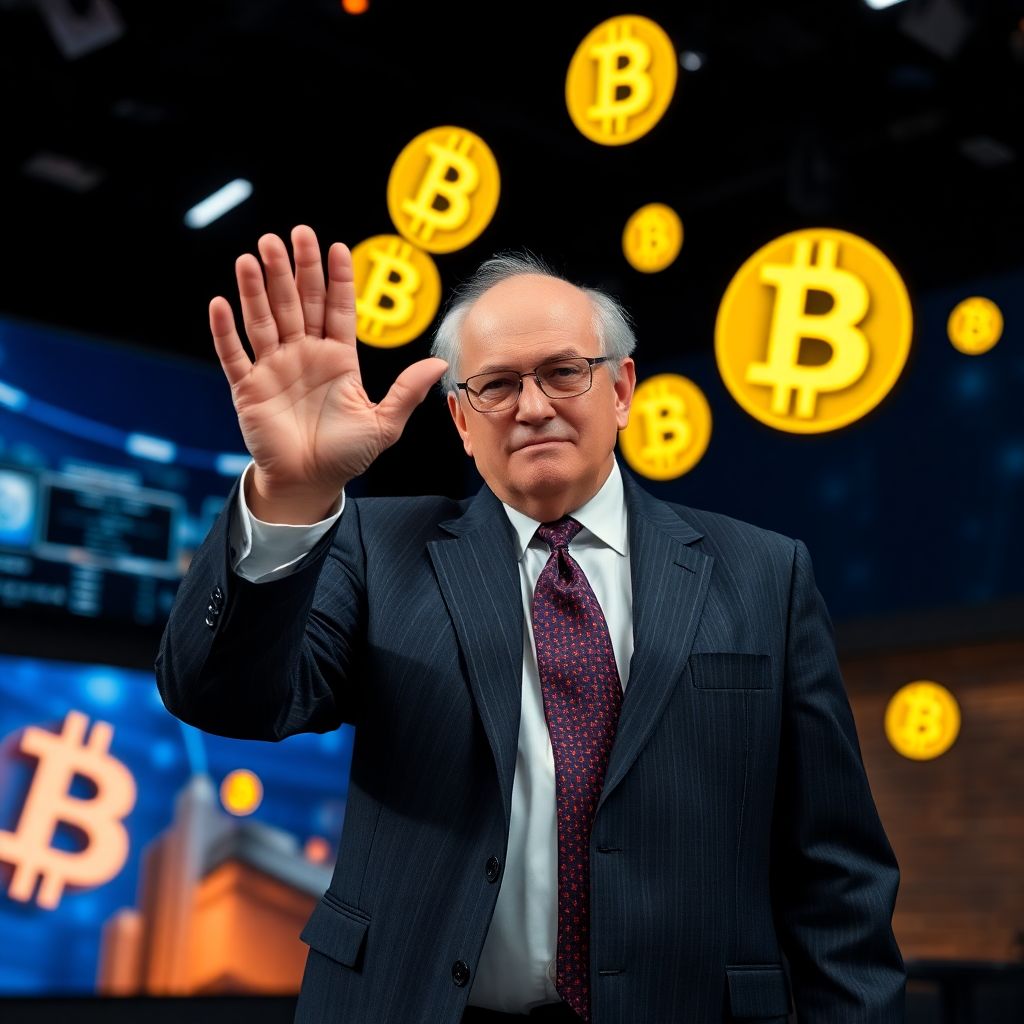
Billionaire investor Jeremy Grantham has no intention of touching Bitcoin or any other cryptocurrency-and he doesn’t think future generations will, either.
The co-founder of asset management firm GMO laid out his view during an appearance on CNBC’s “Squawk Box,” where he dismissed digital assets as nothing more than a “useless, speculative mechanism.” In his view, the entire crypto market is destined to fade over time rather than collapse in one dramatic moment.
“Years and years, decades and decades-it will dwindle away, I suspect,” Grantham said, predicting a long, gradual decline in interest and value. “Not with a bang, but with a whimper.”
Bitcoin’s volatility undercuts the ‘store of value’ narrative
Grantham focused particularly on Bitcoin, criticizing its reputation as “digital gold” or a safe haven asset. He highlighted its severe volatility, pointing to a steep 52% pullback from its all‑time high of $126,080 set last October. That drawdown, he argued, occurred despite broadly favorable economic conditions and a period in which gold-traditionally viewed as a defensive asset-was delivering strong gains.
For Grantham, that contrast is telling. Gold, a commodity with centuries of history as a store of value, has held up and even appreciated, while Bitcoin has whipsawed in price. To him, that makes it difficult to treat the cryptocurrency as a reliable long‑term holding.
A store of value, he implies, should preserve purchasing power and offer some stability across economic cycles. By comparison, Bitcoin’s behavior has looked more like that of a highly speculative tech stock than a monetary anchor.
Why Grantham is so skeptical of crypto
Grantham has long been known as a market historian and bubble spotter, regularly warning about overvalued assets and speculative manias. His criticism of crypto fits into that broader framework: he views digital assets as another chapter in the long history of financial fads driven more by psychology than by fundamentals.
By calling crypto a “useless, speculative mechanism,” he is essentially arguing that:
– It lacks intrinsic cash flows, unlike stocks or bonds.
– It has limited practical use for most investors and consumers.
– Its price is driven primarily by sentiment and momentum rather than underlying value.
From this vantage point, crypto looks less like a new monetary system and more like a high‑risk trading instrument that will lose relevance as enthusiasm wanes and capital flows elsewhere.
A long fade, not a sudden crash
Interestingly, Grantham isn’t predicting an immediate collapse in Bitcoin or the broader crypto market. Instead, he envisions a slow erosion of interest “over years and years, decades and decades.”
That outlook suggests:
– There may still be sharp rallies and new speculative waves along the way.
– Crypto could linger as a niche asset class, even as mainstream adoption fails to materialize at the scale once imagined.
– The ultimate decline may be driven less by regulation or a single crisis, and more by simple investor fatigue and better opportunities elsewhere.
The phrase “not with a bang, but with a whimper” implies that, in his view, the endgame for crypto is irrelevance rather than catastrophe.
What Grantham’s comments mean for investors
For individual and institutional investors, Grantham’s stance raises a crucial question: should crypto play any role in a diversified portfolio?
From his perspective, the answer is no. If an asset has no clear cash flows, no stable store‑of‑value properties, and depends heavily on speculative enthusiasm, he sees little justification for owning it-especially for long‑term, risk‑conscious investors.
That doesn’t mean short‑term traders can’t profit from volatility, but it does suggest that treating Bitcoin or other cryptocurrencies as core holdings in retirement accounts or conservative portfolios is, in his view, fundamentally misguided.
Investors who admire Grantham’s track record in identifying bubbles may see his critique as a warning that the most explosive growth period for crypto is already in the past, and that the risk‑reward profile is increasingly skewed to the downside over long horizons.
The clash between the crypto narrative and traditional finance
Grantham’s remarks also highlight the deep divide between much of traditional finance and the most vocal crypto advocates.
Crypto supporters argue that:
– Bitcoin is a hedge against inflation and monetary debasement.
– Blockchains enable new forms of finance and ownership that legacy systems can’t match.
– Limited supply, particularly in Bitcoin’s case, should ultimately support higher prices.
Grantham effectively rejects these claims, at least from an investor’s standpoint. He points to actual performance-especially during recent macro conditions-as evidence that Bitcoin has not consistently behaved like “digital gold” or a dependable hedge. For him, the narrative has not been backed up by the data in a way that justifies the hype.
This tension underscores a broader question: is crypto primarily a technological experiment, a speculative vehicle, or a true long‑term financial asset? Grantham’s answer is firmly in the second category.
Crypto’s future: niche asset or fading relic?
Even if Grantham is correct that crypto will “dwindle away,” that does not necessarily mean it disappears completely. Historical precedents show that many speculative assets:
– Shrink dramatically in market relevance after bubbles burst.
– Continue trading at lower volumes and prices for years.
– Retain small, dedicated communities of users and traders.
In that sense, the sector could eventually resemble a niche corner of the market rather than a system‑shaking innovation. Crypto might survive as a specialized tool for cross‑border transfers, high‑risk trading, or particular blockchain‑based applications, even as mainstream investors move on.
Grantham’s argument is less about whether the technology can persist and more about whether there is a compelling, enduring investment case.
Comparing Bitcoin with traditional stores of value
The contrast Grantham draws between Bitcoin and gold is central to his skepticism. Gold’s role has been shaped by:
– Centuries of acceptance across cultures and regimes.
– Physical scarcity and industrial uses.
– A long track record as a crisis hedge.
Bitcoin, by comparison, is just over a decade old. While it has a mathematically limited supply and a growing history, it lacks the same depth of real‑world testing across multiple economic eras. Its price has repeatedly been driven by liquidity, speculation, and cycles of enthusiasm rather than slow, steady accumulation by conservative capital.
Grantham appears to be saying that, in a world where proven stores of value already exist, there is little reason to embrace a far more volatile and unproven alternative purely on faith in a digital narrative.
Risk management in a world of speculative assets
Whether one agrees with Grantham or not, his comments underscore the importance of risk management when dealing with speculative instruments. For investors who still choose to hold crypto, his critique implies a few practical considerations:
– Treat crypto as a high‑risk satellite position, not a core holding.
– Size exposures so that a large drawdown does not jeopardize long‑term financial goals.
– Anchor portfolios in assets with clear fundamentals-cash flows, earnings, or established store‑of‑value characteristics.
Grantham’s stance is ultimately a call for discipline: in an environment full of new products and narratives, he argues that many investors underestimate how quickly speculative enthusiasm can reverse.
Will time prove Grantham right about Bitcoin?
History is full of examples where skeptics of new technologies were ultimately wrong-and others where critics of bubbles were vindicated. Grantham’s view places Bitcoin and crypto firmly in the latter camp, as part of a speculative cycle that will gradually unwind.
Supporters will counter that adoption, regulation, and infrastructure are still evolving, and that it is too early to write off the asset class. They may also argue that temporary drawdowns do not invalidate the long‑term trajectory of transformative technologies.
The final verdict will likely take years, if not decades, to emerge. For now, Grantham’s message is clear: in his eyes, crypto is not the future of money or investing, but a passing phase that will slowly lose its grip on the financial imagination-“not with a bang, but with a whimper.”