
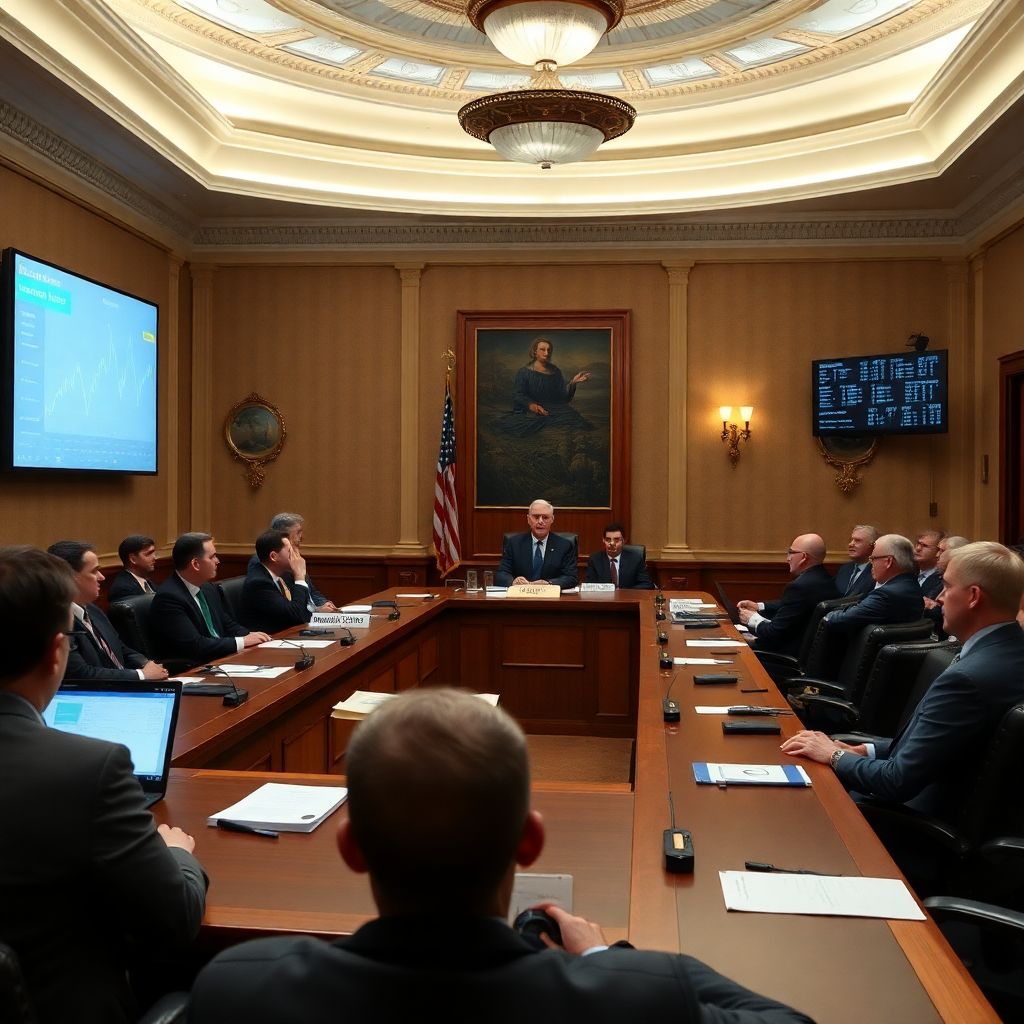
Kevin Warsh didn’t move interest rates at his first Federal Reserve meeting – but he completely rewrote the script for where they go next. For crypto, that is what matters, and it is why the market’s favorite narrative for 2026 just broke.
What actually happened at Warsh’s first Fed meeting
On 17 June 2026, the Federal Open Market Committee (FOMC) kept the federal funds rate unchanged at 3.50%-3.75%. It was the fourth straight meeting with no change, and traders had fully priced in that outcome. By itself, the decision was a nonevent.
The shock came from the forecasts.
The Fed’s quarterly Summary of Economic Projections – and especially the so‑called “dot plot,” where each official marks where they think rates will be in coming years – flipped its message:
– Back in March, under the previous Fed chair, no policymaker foresaw rate hikes in 2026, and the collective outlook implied cuts.
– In June, under Warsh, that picture turned upside down: nine of eighteen officials now expect at least one rate increase in 2026, and six of those nine anticipate two hikes.
– Only one official still projects a cut.
As a result, the median forecast for the federal funds rate at the end of 2026 rose from 3.4% to 3.8% in just one quarter. In practical terms, the Fed went from signaling, “We’ll likely be easing,” to, “At best we hold; more likely we tighten further.”
That is a material regime shift, not a nuance.
A new tone: short, blunt, and laser-focused on inflation
The policy statement that accompanied the decision was just as telling as the dots.
Language that had hinted at a future tilt toward easier policy – the gentle nods toward “adjustments” and “appropriate normalization” that traders interpreted as future cuts – was stripped out. In its place was a much more concise statement emphasizing a single goal: restoring and maintaining price stability.
Warsh made it clear that the era of detailed forward guidance is over. The Fed, he stressed, will no longer pre‑announce or hint at rate moves months in advance. Instead, policy will be driven meeting‑by‑meeting by incoming data, with the 2% inflation target as the anchor.
In other words, the market just lost its roadmap.
On top of that, Warsh launched a comprehensive review of how the Fed operates, introducing five task forces focused on:
– Inflation dynamics
– Communication strategy
– Economic measurement
– Productivity trends
– The labor market
That is not the move of a caretaker. It signals an intent to redesign how the central bank thinks and talks about policy. Combined with a hawkish dot plot and a no‑nonsense message on inflation, the new chair effectively told investors: this Fed is not preparing to cut, and it is not here to soothe markets.
Why crypto sold off even though rates did not move
When the decision hit, the headline number – “Fed holds rates” – looked benign. But crypto markets read between the lines immediately.
Most major coins fell around 1%-3%, with Bitcoin sliding toward $64,000. That reaction had little to do with the unchanged policy rate and everything to do with expectations being repriced:
– For much of 2026, crypto bulls had been betting on a “rate‑cut trade”: the idea that the Fed would soon lower borrowing costs, boost liquidity, and push investors into riskier assets.
– That assumption underpinned a large part of the bullish thesis for the second half of 2026.
– Warsh’s first meeting effectively removed that pillar.
Markets did not sell on what the Fed did today; they sold on what the Fed now says it expects to do tomorrow.
Why a hawkish Fed is a headwind for crypto
Crypto is not uniquely sensitive to interest rates, but it is near the top of the risk spectrum. When policy is loose and money is cheap, investors are more willing to move out along the risk curve – into tech stocks, growth names, and speculative assets like cryptocurrencies.
A hawkish central bank stance reverses that dynamic:
1. Higher yields compete with crypto
As expected interest rates drift higher, government bonds and cash‑like instruments offer more attractive returns with far less risk. That can pull capital away from speculative plays.
2. Tighter financial conditions reduce liquidity
Higher rates generally mean tighter credit, less leverage, and more disciplined risk-taking by institutions. Trading volumes can shrink, and the marginal buyer of high‑beta assets becomes more cautious.
3. Valuations get compressed
In a world of higher discount rates, the present value of future cash flows – or, in crypto’s case, future adoption and revenue – falls. Even narrative‑driven assets feel that repricing.
4. “Macro beta” rises
Crypto has increasingly traded in sync with other risk assets on big macro days. A Fed that keeps markets on edge with data‑dependent decisions raises volatility across the board.
In short, the rate‑cut tailwind that crypto investors expected for late 2026 has turned into a potential headwind.
The inflation backdrop forcing the Fed’s hand
The shift to a more hawkish stance is not happening in a vacuum. Inflation has been sticky:
– Core prices have remained above the Fed’s 2% target for longer than policymakers were comfortable with.
– Wage growth has cooled somewhat but not enough to eliminate concerns about second‑round inflation effects.
– Services inflation in particular has proven resistant, reflecting tight segments of the labor market and still-elevated demand.
In that context, moving too quickly toward rate cuts risks reigniting price pressures just as they start to moderate. Warsh’s message is that the Fed would rather keep financial conditions somewhat restrictive for longer than repeat the mistake of declaring victory prematurely.
For crypto, that means the hope of a near‑term “liquidity flood” from lower rates is increasingly unrealistic.
What changes for crypto markets now
The most important change is psychological: the “easy money is coming” story is no longer credible on current Fed projections.
That forces crypto investors and builders to rethink their frameworks:
– Macro‑driven rallies may be smaller and shorter-lived.
Without the expectation of rate cuts, broad “everything rally” scenarios are less likely. Crypto will have to fight harder for inflows.
– Narrative and fundamentals gain relative importance.
In the absence of central bank tailwinds, themes like real-world asset tokenization, layer‑2 scaling, decentralized finance revenues, and protocol fee growth become more significant drivers.
– Leverage becomes more dangerous.
In a data‑dependent, hawkish regime, surprises can cut both ways. Over‑leveraged positions are more vulnerable to sharp liquidations on macro news.
– Correlation patterns can shift.
If markets internalize that rates will stay higher for longer, some investors may differentiate between crypto sectors – for example, favoring assets with clear cash‑flow models over purely speculative meme coins.
The bottom line: crypto’s bull case can no longer lazily lean on the promise of cheaper money. It needs new pillars.
What this means for investors
For anyone exposed to digital assets, Warsh’s first meeting sends several clear signals:
1. Stop assuming a Fed rescue in 2026.
The base case is no longer a series of cuts; it is a prolonged period of restrictive or at least non‑accommodative policy, with some risk of additional hikes if inflation reaccelerates.
2. Expect more volatility around data releases.
If the Fed is genuinely data‑driven, then key economic reports – inflation, employment, wage growth, productivity – gain outsized importance. Crypto may increasingly react to those prints.
3. Portfolio construction matters more.
In an environment without guaranteed tailwinds, position sizing, diversification across sectors, and risk management become central, not optional.
4. Time horizon is critical.
A hawkish Fed complicates short‑term trading but does not automatically negate long‑term adoption trends in blockchain, digital payments, or tokenization. Distinguishing between trading and investing horizons is essential.
Can crypto still rise in 2026 without rate cuts?
Yes – but on different drivers.
Crypto has rallied in the past under a variety of macro conditions, including periods of relatively high rates. The difference is that in those episodes, sector‑specific catalysts carried more weight:
– Major technological upgrades and network improvements
– Regulatory clarity in key jurisdictions
– Institutional adoption and integration into traditional finance
– New applications that attract users and fees
In 2026, those types of catalysts will need to do more of the heavy lifting. A genuinely strong bull market in crypto can still happen, but it would likely be powered by adoption and innovation, not a flood of central‑bank liquidity.
What crypto investors should watch from here
With the rate‑cut trade off the table for now, several signposts matter more:
1. Inflation trends
Successive monthly declines in core inflation would reopen the conversation about future cuts. Persistent or re‑accelerating inflation would cement the “higher for longer” scenario.
2. Labor market data
A sharp cooling in employment or wage growth could push the Fed to reconsider its hawkish stance more quickly, while ongoing strength gives it cover to stay restrictive.
3. Financial stability signals
Stress in credit markets, funding strains, or disorderly volatility in traditional assets might force the Fed to balance its inflation fight with stability concerns – sometimes a catalyst for more accommodative measures.
4. Crypto‑specific flows and positioning
On‑chain data, derivatives positioning, funding rates, and exchange balances can reveal whether the market is deleveraging, accumulating, or simply waiting for clarity.
5. Regulatory and institutional developments
New products from large financial institutions, clearer rules for stablecoins and exchanges, or major corporate integrations can partially offset macro headwinds.
How strategies inside crypto may need to adapt
With the macro backdrop shifting, strategies that thrived on the rate‑cut narrative may need revision:
– Yield‑chasing:
When real yields in traditional markets rise, low‑quality on‑chain yields become less attractive. Investors may demand more transparent, sustainable income streams from DeFi protocols.
– Momentum trading:
Pure momentum plays become riskier if every key macro event can reverse the prevailing trend. Liquidity pockets shrink when marginal buyers are more cautious.
– Long‑duration narratives:
Projects promising distant, undefined future value may face heavier discounting. Tokens tied to immediate, measurable utility may command a premium.
A more hawkish Fed effectively raises the bar for what counts as an investable crypto story.
The new reality: the rate‑cut trade is over
For most of 2026, a large slice of the crypto community treated future Fed cuts as a given. That conviction supported risk‑taking, leverage, and optimistic timelines for new highs.
Kevin Warsh’s first meeting has taken that assumption off the board. Rates were left unchanged, but the policy outlook was turned on its head:
– Projections moved from cuts to potential hikes.
– Forward guidance was largely abandoned.
– The central bank’s communication shifted to a strict focus on price stability.
For crypto, that means the easy narrative – “the Fed will cut, liquidity will return, and prices will fly” – is gone. The sector now has to re‑anchor its thesis on fundamentals, adoption, and innovation, not on monetary easing.
Understanding that shift is crucial to understanding where digital assets go next.
—
Frequently Asked Questions
What did Kevin Warsh do at his first Fed meeting?
He kept interest rates unchanged at 3.50%-3.75%, as markets expected. The real change came in the Fed’s forecasts and messaging: the dot plot shifted from anticipating cuts in 2026 to expecting, on balance, holds or hikes. Warsh also removed much of the prior forward guidance and emphasized a strict focus on price stability.
Why did crypto fall if the Fed held rates steady?
The hold was fully priced in. Crypto sold off because the outlook changed: instead of cheaper money and easier financial conditions later in 2026, the Fed now signals a willingness to keep policy relatively tight and even raise rates if needed. That undermines the “rate‑cut trade” that had supported bullish sentiment.
Why is a hawkish Fed generally bad for crypto?
A more restrictive central bank makes safe assets relatively more attractive, tightens liquidity, and pressures valuations of riskier investments. Crypto, being one of the highest‑risk asset classes, tends to suffer when investors become more cautious and capital becomes more expensive.
Why is the Fed turning more hawkish now?
Because inflation has proven more persistent than desired. With core price pressures still above target and certain parts of the economy remaining firm, policymakers worry that easing too soon could reignite inflation. The Fed is choosing to lean against that risk, even at the cost of less support for asset prices.
Does this mean crypto cannot go up in 2026?
No. It means that macro tailwinds from lower rates are no longer a base‑case assumption. Crypto can still rise on the back of technological progress, broader adoption, and sector‑specific catalysts. However, rallies may have to overcome rather than ride on central‑bank policy.
What should crypto investors focus on now?
Key areas include inflation and labor data (which will shape Fed decisions), signs of changing liquidity conditions, on‑chain and derivatives positioning, and concrete adoption metrics for specific protocols. With the rate‑cut story gone, differentiated research and risk management become far more important than simply betting on a macro tide lifting all boats.