
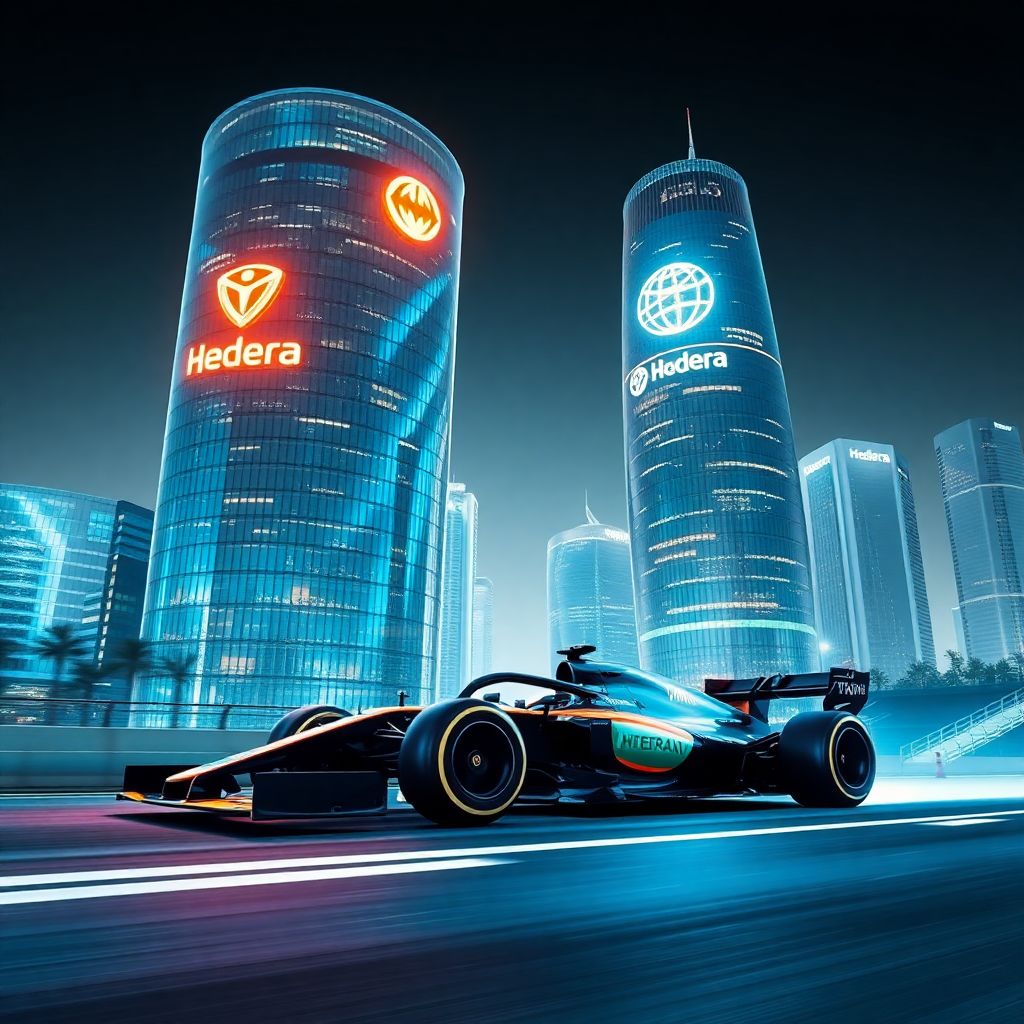
F1 powerhouse McLaren Racing has become the newest member of the Hedera Council, stepping into a formal role in the governance of the enterprise-focused blockchain network. The move places the British team alongside global brands such as Google, FedEx, IBM, and other major corporations that collectively oversee the strategic direction and technical evolution of Hedera.
Based in Surrey, UK, McLaren Racing competes at the top level in both Formula 1 and IndyCar. The team has recently dominated the sport, securing the last two F1 Constructors’ Championships and last season’s Drivers’ Championship with star driver Lando Norris. Now, the racing outfit is extending its high-performance philosophy beyond the track into the realm of distributed ledger technology.
As a Council member, McLaren will take part in the governance of Hedera’s core software and services. That includes contributing to decisions on network upgrades, standards, and future development, as well as participating in committees and working groups. Crucially, McLaren’s vote carries the same weight as every other Council member, giving the team an equal say in the platform’s long-term roadmap.
“McLaren Racing is built on performance and innovation, and that extends to how we engage our fans,” said McLaren Racing Co-Chief Commercial Officer Nick Martin in a statement. “Joining Hedera Council enables us to help shape the Hedera network’s evolution, while delivering a seamless, secure, and scalable fan experience worldwide.”
The partnership is not starting from zero. McLaren has already experimented with Web3 tools by launching free-to-mint digital collectibles for its supporters. These assets, issued on Hedera, give fans a way to own verifiable digital memorabilia tied to the team’s brand, results, and history, without the friction of high fees or complex onboarding.
Hedera’s technology is designed with enterprises in mind: fast finality, low transaction costs, and governance by a council of global organizations rather than an anonymous group of miners or validators. For a brand like McLaren, whose reputation depends on reliability, security, and global scale, this combination is attractive. The team can roll out fan-facing applications that must handle spikes in demand around race weekends without compromising user experience.
From a fan engagement perspective, McLaren’s deeper involvement with Hedera opens several possibilities. Digital passes linked to specific races, tokenized loyalty points, authenticated digital collectibles commemorating podiums or record-breaking laps-all of these can be built on the same network the team now helps govern. Integration with mobile apps and existing fan programs can make Web3 features largely invisible to the end user, turning blockchain into an infrastructure layer rather than a marketing buzzword.
McLaren’s entry into Hedera’s governance structure also illustrates a broader trend: major sports organizations are no longer content to simply license their logos to third-party crypto projects. Instead, they are moving closer to the core technology and taking part in the decision-making processes that shape it. By sitting on the Council, McLaren gains early insight into upcoming features, security models, and standards-intelligence that can directly influence its digital strategy.
There is a strategic branding element as well. Formula 1 increasingly positions itself as a technologically advanced, sustainability-conscious sport. Hedera emphasizes energy-efficient consensus and governance transparency, aligning with motorsport’s ongoing push to reduce environmental impact while showcasing advanced engineering. McLaren’s presence on the Council allows the team to associate its name not just with speed and design innovation, but also with forward-looking digital infrastructure.
For Hedera, bringing in a globally recognized F1 team is a statement of intent. Beyond the publicity, McLaren represents a demanding, real-world use case: millions of fans, high-stakes sponsorships, and strict expectations from partners. If Hedera’s network can power McLaren’s fan and data initiatives reliably, it becomes a more credible option for other rights holders, brands, and entertainment companies exploring blockchain-backed experiences.
The collaboration could also affect how commercial partners interact with McLaren. Sponsors may gain access to co-branded digital assets, data-driven loyalty campaigns, or authenticated digital tickets tied to activations at race events. Because Hedera supports tokenization and verifiable transactions, such programs can be auditable and measurable, adding another layer of accountability for sponsors who want to see clear returns on engagement.
Over time, McLaren’s feedback as a Council member may influence how Hedera supports high-volume consumer applications. Requirements around user-friendly wallets, KYC-compatible flows for regulated markets, or integration with traditional payment methods could all be shaped by insights from a team that operates in multiple jurisdictions and deals with fans at a global scale.
On the competitive front, McLaren’s move highlights how sports teams are differentiating themselves in the digital arena. While some organizations have experimented with speculative tokens or one-off NFT drops, McLaren appears to be positioning its Web3 strategy on infrastructure and utility: governance, reliability, and long-term fan relationships, rather than short-lived hype cycles.
Ultimately, the partnership between McLaren Racing and the Hedera Council is a two-way bet. McLaren is wagering that an enterprise-grade, council-governed network is the right foundation for the next phase of digital fan engagement. Hedera, in turn, is betting that embedding a high-profile, innovation-driven sports brand into its governance structure will strengthen its appeal across mainstream industries. Both sides are aiming to prove that blockchain can power large-scale, real-world experiences-without sacrificing speed, security, or user-friendliness.