
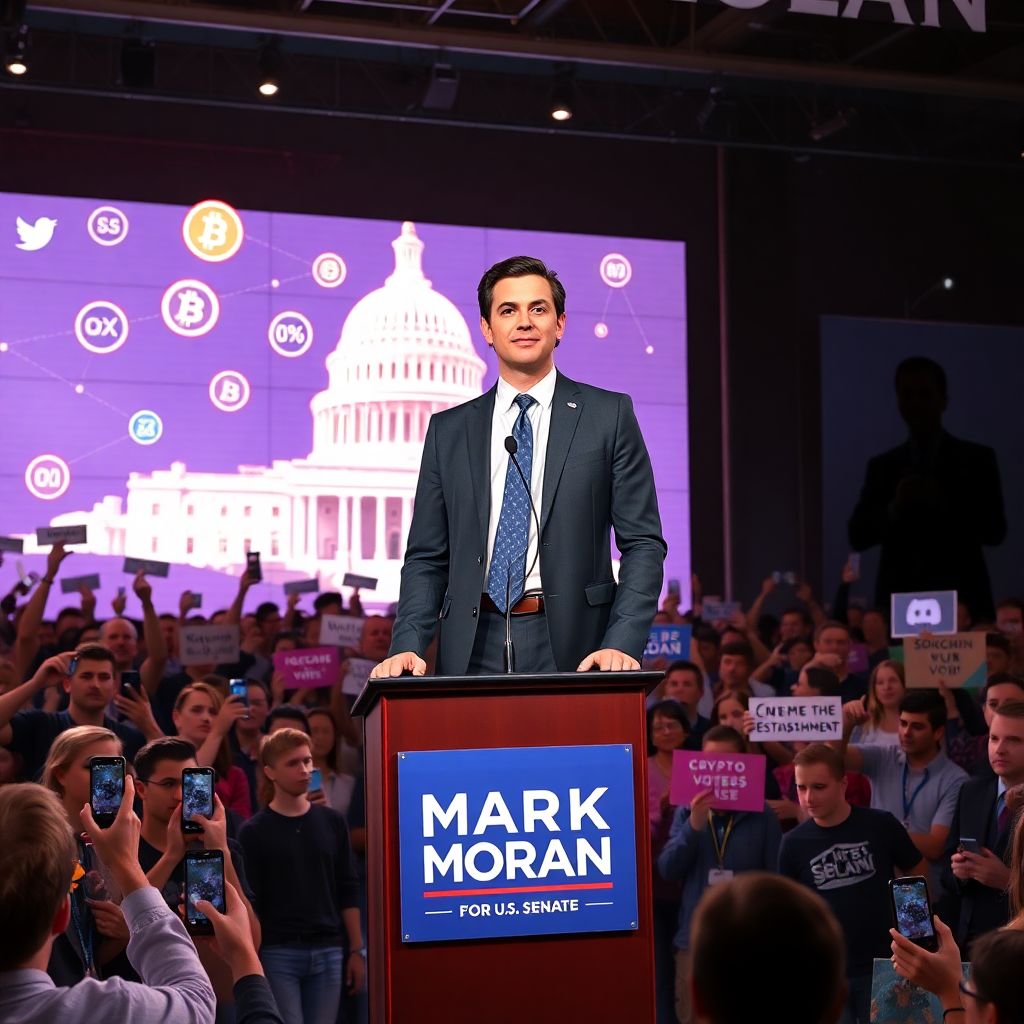
Can a joke token bankroll a serious run for Congress? In Virginia, Mark Moran is betting that the answer is yes—and that the road to the U.S. Senate might just run through Solana.
Moran, a 34‑year‑old former Wall Street banker and reality TV participant, is a newcomer to electoral politics but not to high‑risk, high‑reward environments. Now he’s taking that appetite for experimentation into his bid to unseat incumbent Senator Mark Warner in Virginia’s Democratic primary, turning to one of the most volatile corners of crypto: meme coins.
Rather than relying solely on conventional fundraising tools and social media messaging, Moran has embraced a meme coin on the Solana blockchain as a centerpiece of his outreach to crypto‑savvy voters. The idea is simple but radical for mainstream politics: use an internet‑native, highly shareable token to turn speculators, traders, and crypto enthusiasts into a passionate, energized political base.
Moran frames the initiative as a deliberate attempt to innovate within a system he sees as stagnant. To him, a modern campaign is less about yard signs and TV spots and more about capturing and sustaining attention in digital spaces where communities already live and spend their time. Crypto, and meme coins in particular, sit right at that intersection of culture, speculation, and online identity.
“In a political campaign, everything comes down to attention and community,” he said, describing why he leaned into the meme coin experiment. Once he concluded that the token itself was not an outright scam and had organic traction, he saw an opportunity: if people were already talking about it and trading it, why not channel that noise into a political project?
Moran began prominently highlighting the token across his social media presence and even integrated references to it into his campaign website. That move instantly distinguished him from typical candidates—and just as quickly raised red flags. Any time a political figure appears to endorse, promote, or benefit from a tradable asset, questions follow: Is this a campaign tool or an investment product? Is it an unregistered security? Are supporters being fairly warned about risks?
Moran is acutely aware of those concerns. He openly concedes that stepping into the meme coin arena invites scrutiny from regulators, watchdogs, and rival campaigns alike. In an era when financial authorities are still wrestling with how to classify and police digital tokens, a candidate tying their political fortunes to a volatile crypto asset is almost guaranteed to provoke attention—from both voters and enforcement agencies.
That tension seems to be part of the calculation. Moran understands that any unconventional move in politics will be attacked as reckless or unserious, but he appears to be counting on the upside: intense online engagement, viral reach, and the loyalty of crypto investors who feel ignored or misunderstood by traditional politicians. His bet is that the value of that enthusiasm outweighs the reputational risk of being associated with a speculative asset class that can surge or crash overnight.
After initially leaning into the token’s branding, Moran has reportedly dialed back its most prominent placements, including removing some references from official campaign materials. That adjustment suggests a recognition of the fine line he must walk: leveraging crypto culture without appearing to run a pump‑and‑dump scheme under the guise of civic engagement. It also hints at behind‑the‑scenes legal advice—campaigns must comply not only with election law but also with securities and consumer protection rules.
Meme coins themselves are a peculiar choice of tool for a serious federal race. They are notorious for explosive volatility, thin liquidity, and vulnerability to hype cycles and manipulation. What makes them attractive to “degens”—high‑risk crypto traders who embrace chaos and speculation—is exactly what makes regulators nervous. For Moran, though, that chaotic energy is a feature, not a bug. The same dynamic that can send a joke token’s market cap into the stratosphere can also mobilize thousands of online participants around a shared story or common enemy.
In this case, that “enemy” is not crypto itself, but what Moran portrays as an outdated political establishment—even when that establishment includes figures broadly seen as friendly to digital assets. His opponent, Senator Warner, has at times backed or tolerated pro‑crypto positions, but Moran is appealing to a different audience: voters who live on‑chain, trade on Solana, and see meme culture as a political language in its own right.
The approach reflects a deeper shift in how some candidates understand power in the digital age. Traditional campaigns focus on building mailing lists, courting donors, and courting coverage from legacy media. Crypto‑driven campaigns, by contrast, try to bootstrap a movement the way a token project does: launch a product, create a narrative, cultivate early adopters, and hope the story catches fire. A meme coin becomes both symbol and infrastructure—part funding mechanism, part identity marker for the campaign’s most zealous supporters.
Yet that strategy comes with glaring trade‑offs. Voters who are skeptical of crypto—or who associate meme coins with scams and lost savings—may see Moran’s experiment as a warning sign. They might question whether someone willing to tie their candidacy to a speculative token will show similar judgment when confronted with complex policy decisions in Washington. Opponents can easily frame the whole enterprise as a stunt aimed at speculators, not a serious effort to represent ordinary Virginians.
On the other hand, Moran is positioning himself as a candidate who speaks directly to a generation that watches politics through the lens of Twitter threads, Discord chats, and on‑chain metrics rather than cable news. To that audience, using a Solana‑based meme coin is not a joke; it is evidence that he actually participates in the same digital economy they do, instead of just name‑dropping “blockchain” in speeches.
Crucially, Moran’s gamble is unfolding against a broader national backdrop in which crypto is maturing as a political issue. Industry players are funding political action, retail traders are becoming a vocal voting bloc, and lawmakers are increasingly pressed to pick a side on regulation, taxation, and innovation. If Moran can show that meme coin holders can be transformed into reliable donors, volunteers, and voters, he will hand future candidates a blueprint—however controversial—for tapping into that energy.
To make the model sustainable, though, a campaign like his must grapple with mechanics. How do you ensure that any value created by the token is transparently handled under campaign finance rules? How do you separate an organic community token from pay‑to‑play behavior or undisclosed financial interests? How do you protect unsophisticated supporters who might interpret a candidate’s backing as financial advice or an implicit guarantee?
These are the kinds of questions regulators and ethicists are likely to ask as meme coins creep closer to mainstream politics. If a token surges because a candidate promotes it, is that akin to insider trading? If campaign staff or the candidate hold significant amounts of the token, should that be disclosed like other financial interests? And if the token crashes and wipes out supporters’ holdings, what responsibility, if any, does the campaign bear?
For now, Moran is using the ambiguity as space to experiment. He casts his initiative as a test case of how to merge democratic participation with crypto infrastructure. Instead of giving twenty dollars to a campaign that disappears into ad buys and consultants’ fees, he suggests, why not engage with a token that lives on a public ledger, can be tracked in real time, and might even appreciate in value if the movement grows?
Whether that framing resonates beyond a niche of online traders remains to be seen. The average voter may be less interested in liquidity pools and more interested in healthcare, wages, or infrastructure. Moran’s challenge is to translate a highly technical, speculative tool into a clear narrative about empowerment, transparency, and technological progress—one that connects the dots between meme coins, economic opportunity, and citizens’ day‑to‑day concerns.
His experiment also raises a larger philosophical issue: should political participation itself be “financialized”? Some critics worry that turning campaigns into token economies will encourage short‑term speculation over long‑term civic engagement. If people support a candidate primarily because they hope the associated meme coin will pump, what happens to that support if the chart turns red?
Supporters of Moran’s approach counter that politics has always involved incentives—tax breaks, subsidies, patronage—and that crypto simply makes those incentives more transparent and programmable. In their view, a public ledger of contributions and token activity could, in theory, reduce backroom deals and increase accountability.
Ultimately, Moran’s Solana‑powered run is less a referendum on one candidate and more a stress test for how far crypto’s influence can reach into American institutions. If he gains traction, others will copy and refine the model. If he flames out, establishment figures will point to his campaign as proof that meme coins and serious governance do not mix.
What is certain is that the experiment has already achieved one of its goals: attention. By stepping into the arena with a meme coin at his back, Mark Moran has ensured that his campaign will be watched closely—not only by voters in Virginia, but by regulators, political strategists, and anyone wondering whether the next wave of political disruption will come not from talk radio or cable news, but from a wallet app on Solana.