
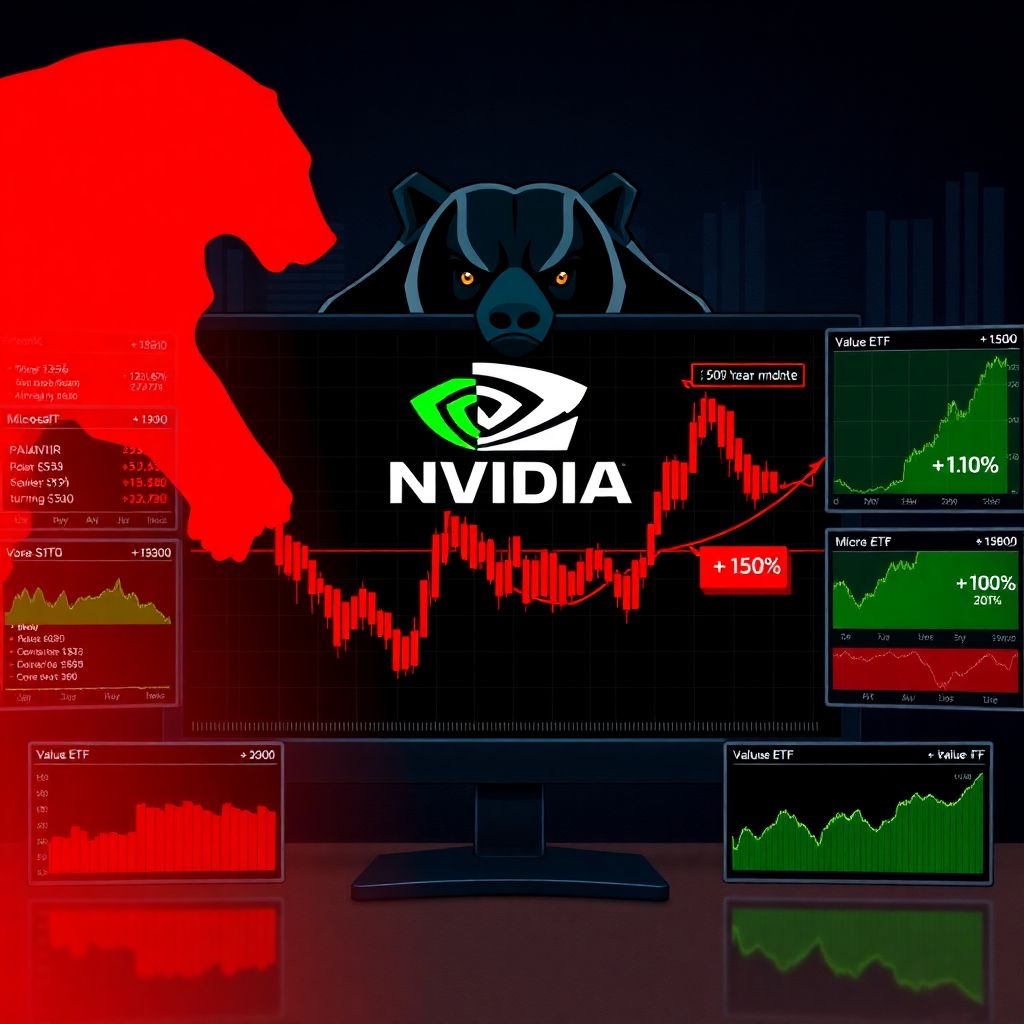
Nvidia tumbles into bear market as investors dump growth for value
Nvidia’s spectacular rally has flipped into a sharp reversal. The chipmaker’s shares have slipped more than 20% from their recent record highs, pushing the world’s most valuable company into official bear‑market territory. The selloff is unfolding alongside a broader rotation out of high‑growth, AI‑linked names and into cheaper, dividend‑paying value stocks.
The damage is not limited to Nvidia. Palantir, another market darling of the AI era, has also slumped, sliding toward the 130‑dollar area just as some analysts had warned ahead of its latest earnings release. This synchronized decline underscores how aggressively investors are backing away from the growth trade that dominated markets over the past two years.
The downturn in Nvidia’s share price mirrors a wider pullback across the growth complex. Advanced Micro Devices, Nvidia’s closest rival in cutting‑edge chips, has fallen to about 194 dollars, a drop of roughly 27% from its December peak. The software sector has also tipped into a technical bear market: a broad basket of tech‑software names is now down more than 20% from its highs as anxiety over the long‑term implications of AI intensifies.
A growing cohort of investors fears that autonomous AI agents could disrupt or even replace traditional software licensing models, compressing margins and undermining long‑term profitability. Those concerns have weighed heavily on companies like Palantir, whose business model is closely tied to data analytics platforms and enterprise software contracts. As these worries have spread, selling pressure in software and AI‑exposed names has accelerated.
Not everyone buys the doomsday narrative. Wedbush analyst Dan Ives has characterized the recent rout as a “software garage sale,” arguing that the market is extrapolating an extreme, unlikely scenario in which AI instantly erodes the value of entrenched software systems. According to Ives, enterprise software is deeply embedded in corporate IT stacks, and real‑world obstacles such as data‑security requirements, compliance obligations, and the high costs of migrating to new platforms will slow any potential disruption. He continues to view Palantir, Microsoft, Snowflake, Salesforce, and CrowdStrike as structural winners over the long run, even if the near‑term volatility remains uncomfortable.
While growth stocks slide, value strategies are enjoying a rare moment in the spotlight. Funds tracking value and dividend‑oriented companies, including large value and dividend ETFs, are up close to 10% since the start of the year and are trading at or near all‑time highs. Investors spooked by lofty valuations and uncertain AI payoffs appear to be rotating toward businesses with steady cash flows, lower earnings multiples, and consistent dividend streams.
For Nvidia, the selloff is being driven by several overlapping concerns. One key question is whether hyperscale cloud providers and tech giants can sustain their torrid pace of AI‑related spending. These companies have been the primary buyers of Nvidia’s high‑margin data‑center chips, fueling the firm’s explosive revenue and profit growth. Any slowdown in that capex cycle would quickly reverberate through Nvidia’s top line.
Those worries intensified after a recent quarterly report from Microsoft showed a deceleration in cloud‑revenue growth in the fourth quarter. Microsoft’s own stock pulled back to around 400 dollars, roughly 27% below its record high, feeding a broader narrative that cloud and AI spending might be approaching a more measured, mature phase. If hyperscalers re‑prioritize profitability and free cash flow to appease investors, aggressive AI infrastructure buildouts could be scaled back, at least temporarily.
Another pressure point is geopolitics. Nvidia’s valuation assumes continued robust demand from around the world, yet its business with Chinese customers remains under a cloud of regulatory uncertainty. According to reports, the US administration is still reviewing the sale of Nvidia’s advanced H200 chips to China, a process that has injected significant ambiguity into the outlook for one of the company’s largest end markets. At the same time, authorities in Beijing have reportedly allowed giants such as ByteDance, Tencent, and Alibaba to purchase hundreds of thousands of high‑end chips, highlighting both the scale of demand and the sensitivity around export controls.
Compounding these issues, Nvidia’s biggest customers are increasingly trying to wean themselves off dependence on its products by developing in‑house silicon. Google continues to ramp up its Tensor Processing Units, Amazon is iterating on its own AI accelerators, and both Microsoft and OpenAI are working on proprietary chip solutions. Over time, such custom ASICs could partially displace Nvidia’s GPUs in certain workloads, especially where power efficiency and cost optimization are critical. While this transition is unlikely to be immediate or total, investors are pricing in the risk that Nvidia’s dominance will gradually erode as customers diversify their supply chains.
Despite the current turbulence, expectations for Nvidia’s headline financial performance remain extremely ambitious. The next major catalyst for the stock will be its upcoming earnings release, which should offer fresh detail on demand trends, data‑center orders, and management’s outlook. Analysts are forecasting revenue of roughly 67 billion dollars, a gain of more than 50% compared with 2024 levels. Some long‑range projections even envision Nvidia’s annual revenue surpassing 500 billion dollars by 2027 or 2028, a trajectory that would place it among the largest companies in history by sales.
From a technical perspective, however, the chart is flashing clear warning signs. On the daily timeframe, Nvidia’s stock has carved out a textbook head‑and‑shoulders pattern, a formation widely seen as a classic bearish reversal signal. The price has now slipped down to the pattern’s neckline, an area technicians closely watch for confirmation that the uptrend has definitively broken.
The shares have also fallen through the 23.6% Fibonacci retracement level drawn from the recent rally, reinforcing the idea that the bullish momentum has weakened. In addition, Nvidia now trades below its 50‑day moving average, a line that had acted as dynamic support throughout much of the prior advance, and it has dipped under the Supertrend indicator. Taken together, these signals point to a market that is no longer willing to chase the stock higher at any price.
If selling pressure persists, many chart watchers see room for a deeper correction. A logical downside target is the 50% Fibonacci retracement zone near the 150‑dollar mark, where buyers might be more inclined to step back in. Reaching that level would represent a substantial reset of expectations and could bring Nvidia’s valuation multiples closer to those of other mega‑cap technology firms, potentially making the risk‑reward profile more attractive for long‑term investors.
Why Nvidia is falling now: beyond the headlines
Several additional dynamics help explain why the reversal in Nvidia has been so abrupt:
1. Positioning and crowded trades
Nvidia became one of the most crowded trades in global markets as hedge funds, retail traders, and institutions alike piled in. When a stock is owned by almost everyone, even a modest negative surprise or shift in sentiment can trigger a cascade of selling as investors rush to lock in profits. That unwinding of crowded positions tends to amplify price moves on the downside.
2. Valuation fatigue
Even believers in Nvidia’s long‑term AI story have grown uneasy with its valuation after a parabolic run. At its peak, the stock was trading at earnings multiples that assumed years of uninterrupted hyper‑growth. As soon as any doubt emerged about the pace or sustainability of AI spending, those stretched multiples became harder to justify.
3. Macro uncertainty and interest rates
Higher interest rates disproportionately hurt growth stocks because much of their perceived value lies in profits far in the future. When bond yields rise or stay elevated, the discounted value of those future cash flows falls. Any hint that central banks may keep rates higher for longer often triggers a rotation into value and dividend names, exactly what the market is exhibiting now.
4. AI moving from hype to implementation phase
The narrative around AI is slowly shifting from pure excitement toward concrete questions about return on investment. Corporate customers are asking how quickly AI deployments will translate into savings or new revenue. That more sober mindset can lead to delays or reprioritization in AI projects, impacting near‑term demand for hardware like Nvidia’s GPUs.
What this means for growth vs. value investors
The current rotation is a reminder that market leadership is cyclical. For more than a decade, growth and tech stocks dramatically outperformed traditional value sectors. Now, with AI‑exposed names under pressure and economic uncertainty lingering, investors are rediscovering the appeal of lower‑volatility, cash‑generating companies.
Value‑tilted portfolios have benefitted from:
– More modest starting valuations
– Less sensitivity to interest‑rate expectations
– Stable or rising dividends that cushion volatility
That does not necessarily mean the AI or growth story is over. Instead, the market may be entering a phase where investors demand clearer evidence of durable earnings growth and more reasonable entry points before paying premium prices for high‑growth names.
Could Nvidia’s long‑term thesis still hold?
Despite the current bear market in its stock, the structural forces behind Nvidia’s rise have not vanished. Demand for computing power remains on an upward trajectory, driven by:
– The rapid adoption of generative AI in consumer and enterprise applications
– Growing use of AI in sectors such as healthcare, automotive, financial services, and manufacturing
– The expansion of edge computing and AI‑enabled devices
Even if hyperscalers temporarily moderate spending, AI workloads are likely to continue expanding over the medium to long term. Nvidia’s technology stack—spanning GPUs, networking hardware, software libraries, and developer tools—gives it a powerful ecosystem advantage that new entrants cannot easily replicate.
However, the pace of growth and the share of economics Nvidia ultimately captures are open questions. Increased competition from custom ASICs, regulatory risks, cyclical spending patterns, and potential price pressure will all shape the company’s earnings trajectory. The market is now recalibrating expectations to reflect this more complex, less linear reality.
What to watch next for Nvidia
Investors tracking Nvidia’s next moves should focus on several key indicators:
– Earnings guidance and commentary: Management’s tone on data‑center demand, Chinese sales, and customer diversification will be critical. Any sign that large buyers are delaying or reducing orders could fuel further downside.
– Capex plans from hyperscalers: Updates from Microsoft, Amazon, Google, and other major cloud providers will offer direct clues about future GPU demand.
– Regulatory developments: Clarifications on export restrictions, especially regarding high‑end chips to China, could either remove an overhang or introduce new constraints.
– Competitive landscape: Announcements about new in‑house chips from major customers or rival offerings from other semiconductor companies will shape perceptions of Nvidia’s long‑term moat.
– Technical levels: How the stock behaves around key support zones—such as the neckline of the head‑and‑shoulders pattern and the 150‑dollar retracement area—may influence short‑term traders and algorithmic flows.
The bottom line
Nvidia’s slide into a bear market is less about a single bad headline and more about a broad, multifaceted reset. A crowded trade is unwinding, investors are rotating from lofty growth names into value, and the AI narrative is evolving from unchecked enthusiasm to more grounded scrutiny.
The company still sits at the center of the AI hardware ecosystem, with revenue expectations that remain extraordinarily high by any historical standard. Yet the market is no longer willing to overlook execution risk, regulatory uncertainty, and emerging competition. How Nvidia navigates this transition—from hyper‑momentum stock to mature AI infrastructure giant—will determine whether the current correction becomes a buying opportunity or the beginning of a longer period of consolidation.