
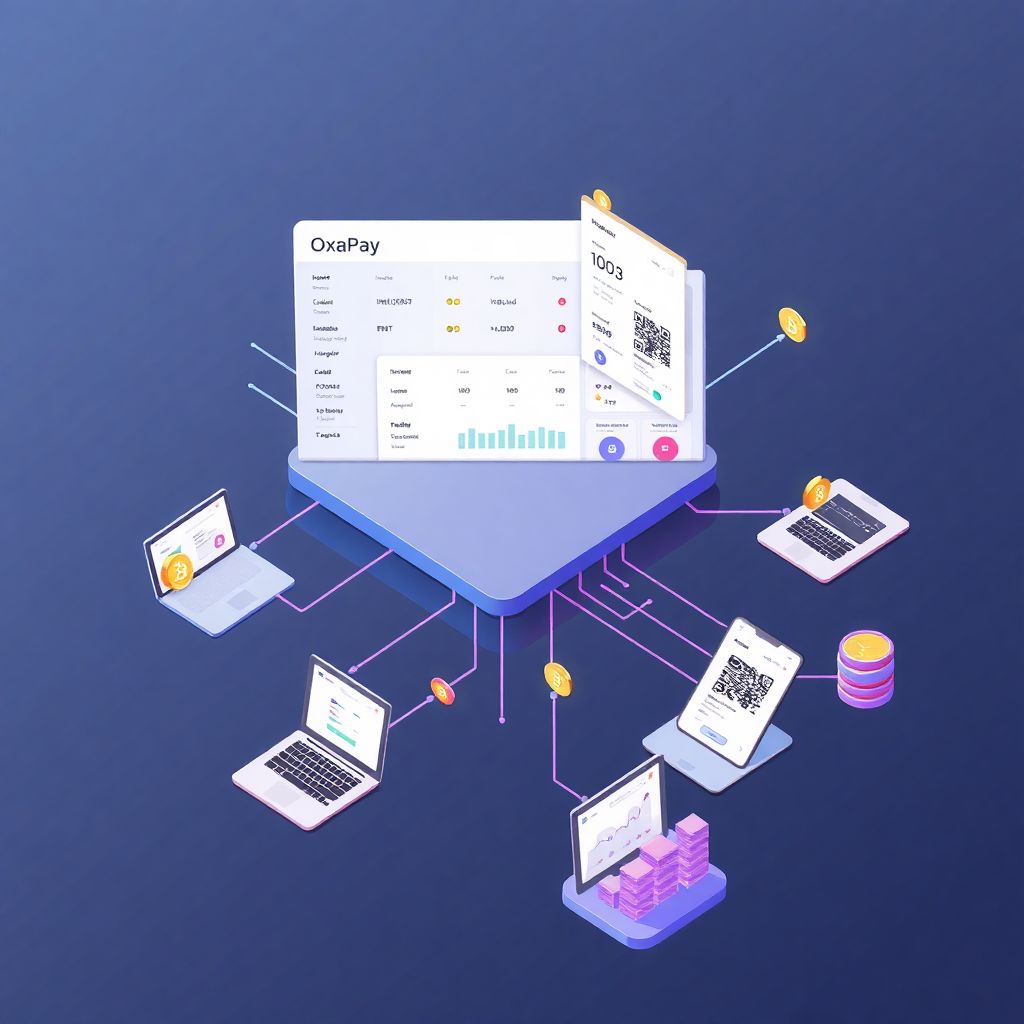
OxaPay: A crypto invoicing engine designed for real-world online businesses
As global commerce expands, traditional cross‑border payments often become a bottleneck: transfers arrive late, fees are unpredictable, and buyers are forced through clumsy payment flows. Crypto invoice generators are emerging as a practical answer to these problems, giving merchants a way to accept multiple digital assets while keeping settlement predictable, auditable, and easy to manage. OxaPay sits in the center of this shift, focusing not on hype, but on payment flows that actually work for merchants at scale.
A checkout layer that removes friction, not adds it
Every extra click at checkout increases the risk that a customer will give up. For international merchants, this risk is even higher: buyers hold different assets, use different wallets, and often face unfamiliar payment options.
OxaPay addresses this directly with a unified invoice link that accepts a wide range of assets in a single flow. Whether a customer holds BTC, ETH, USDT, TON, or other supported currencies, they can pay the same invoice without being asked to convert funds first or jump between platforms. This single‑entry checkout dramatically reduces drop‑off.
The payment page itself is intentionally simple and registration‑free. Customers do not have to create accounts, pass lengthy KYC flows, or fill out complex forms. They can scan a QR code, connect their wallet, and confirm the payment in a format that feels familiar. This design increases trust and reduces confusion, especially for first‑time buyers or those new to crypto payments.
Another common real‑world challenge is that many users hold funds in several wallets or across different assets. OxaPay’s support for partial and multi‑asset payments directly reflects that reality. If a customer does not have the full amount in a single token, they can complete payment using combinations, which limits failed invoices and support tickets. For merchants, this means more completed orders and fewer abandoned carts.
Fiat‑denominated, predictable settlement
Businesses do not plan payroll, inventory, or marketing budgets in BTC or ETH; they plan in fiat. That is why the core of OxaPay’s invoicing logic is fiat‑based.
Each invoice is created with a defined fiat amount, and that value becomes the anchor for settlement. No matter which supported asset a customer uses to pay, OxaPay prices the transaction based on the original fiat figure at the time of payment. This approach shields merchants from intraday market swings that could otherwise turn a profitable sale into a loss.
After receiving payment, OxaPay converts incoming funds into stablecoins by default, reducing day‑to‑day volatility. For finance teams, this has two immediate benefits:
– Cash flow becomes more predictable and easier to forecast.
– Accounting and reconciliation do not require constant manual adjustment for market movements.
The platform also handles edge cases that usually generate operational overhead. Underpayments and overpayments are recognized and managed automatically rather than becoming support issues. Combined with a dashboard that shows revenue and settlement values in local currency, OxaPay turns settlement from a manual chore into a stable, repeatable process.
Automation that lightens the operational load
The real cost of payments often appears after the customer has paid: someone has to match transactions to invoices, verify confirmations, move funds, process refunds, and keep internal systems aligned. For a fast‑growing business, doing this by hand quickly becomes unsustainable.
OxaPay is built with automation as a default, not an add‑on. Merchants can configure automatic withdrawals to their own wallets or directly to exchanges, reducing the need for daily manual transfers. One‑click refunds eliminate the back‑and‑forth of requesting addresses from customers and verifying them.
Real‑time callbacks through APIs and webhooks allow internal systems to update instantly when an invoice is paid, partially paid, expired, or refunded. Many merchants plug OxaPay directly into their backend: invoices are generated programmatically, status changes are reflected immediately in order management systems, and human intervention is needed only for exceptions rather than for every transaction.
As transaction volume increases, these automations go from “nice to have” to critical. They allow small teams to manage enterprise‑level throughput without expanding their finance or support headcount at the same pace.
Documentation that satisfies accounting and compliance
To be truly useful, payments must fit into existing financial and compliance frameworks. A simple hash on a blockchain explorer is rarely enough for auditors or accounting teams who are used to structured documentation.
OxaPay generates formal, structured PDF invoices that resemble traditional financial documents rather than informal payment notes. Each invoice includes:
– The fiat amount defined by the merchant
– The crypto asset(s) used for payment
– Timestamps of issuance and settlement
– Conversion rates and details
– Transaction identifiers and payment metadata
These details make it much easier for finance teams to match crypto payments with orders, contracts, or subscriptions without building complicated custom tools.
In addition, merchants can export detailed reports for a chosen period. These reports simplify bookkeeping, internal audits, tax preparation, and regulatory checks. Instead of piecing together information from multiple platforms, businesses can rely on a single, consistent data source that covers the full invoice lifecycle.
Security, trust, and risk control at checkout
A payment system only works if both sides trust it. In crypto, small mistakes can have irreversible consequences, so the design of the invoice and checkout flow matters as much as the underlying technology.
OxaPay provides a verified and guided payment environment. It helps customers avoid common errors such as:
– Sending funds on the wrong network
– Using incorrect or outdated addresses
– Under‑ or overpaying by accident due to misread amounts
By flagging irregular activity and validating payment parameters, the system reduces the risk of misrouted funds and disputes. For merchants, that translates into fewer support requests and less time spent manually investigating transactions. For customers, it creates a sense of safety when paying for higher‑value items or business‑critical services.
Built around the needs of real merchants, not speculation
For many businesses, crypto invoicing has shifted from an experiment to part of their regular payment mix. They are less interested in speculation and more focused on operational reliability:
– Will payments arrive on time?
– Will cash flow be predictable?
– Can our existing tools and processes handle this without major changes?
OxaPay’s feature set directly reflects these priorities. Multi‑asset support, stablecoin settlement, automation, and formal documentation are not theoretical benefits; they solve everyday pain points that global merchants face when dealing with bank wires, card declines, and slow intermediaries.
Additional benefits for online businesses adopting crypto invoices
While the core functionality centers on smooth payments and reliable settlement, crypto invoice generators like OxaPay offer several broader advantages for online businesses.
1. Expanded global reach
Traditional payment rails do not cover every region equally. In some markets, cards are hard to issue, bank transfers are slow, and local payment processors are limited. By supporting widely used digital assets, merchants can reach customers who are underserved by conventional banking but comfortable transacting in crypto.
2. Reduced chargeback exposure
With standard card payments, merchants carry a constant risk of chargebacks. Crypto settlements are final by design. Combined with OxaPay’s structured documentation and refund tools, this helps businesses maintain customer‑friendly policies without exposing themselves to abusive disputes.
3. Better user experience for digital‑native customers
Younger and tech‑savvy audiences often expect to see crypto among payment options. A clean, non‑intrusive invoice flow that works across devices improves perceived brand quality and positions the business as modern and adaptable, without forcing all customers to use crypto.
4. More flexible treasury management
Since incoming funds can be converted into stablecoins, merchants can decide how much exposure they want to keep in different assets. Some may choose to convert a portion to local fiat for operational expenses, while holding another portion in stablecoins for cross‑border payouts, supplier payments, or hedging.
5. Use cases beyond one‑time purchases
Crypto invoices are not limited to single transactions. They can support:
– Recurring payments for subscriptions or SaaS products
– Milestone‑based invoices for freelancers or agencies
– B2B settlements between partners in different jurisdictions
– Donations and pay‑what‑you‑want models with clear receipts
By integrating OxaPay’s API, these scenarios can be automated, tracked, and reconciled with minimal manual work.
Practical scenarios where OxaPay adds value
Consider an online software vendor selling licenses worldwide. Customers in regions with weak card penetration struggle to pay, and wire transfers take days. With OxaPay, the vendor can send or display a crypto invoice pegged to a fiat price. Customers pay using their preferred asset, the vendor receives a stablecoin equivalent, and accounting sees a clear, fiat‑denominated record.
Or take a digital agency working with clients in several countries. Each invoice may be in a different currency, with varying bank requirements. By using crypto invoices, the agency can standardize its payment process. Clients pay faster, settlement becomes more predictable, and the finance team has a single source of structured invoices and reports, regardless of where clients are based.
Implementation without disrupting existing systems
One concern many merchants have is the complexity of adding a new payment method. OxaPay is designed so that businesses can start small and expand usage over time.
– Non‑technical users can create and send invoices from a dashboard, testing customer response without touching backend code.
– More advanced teams can integrate via API and webhooks, embedding invoicing into their existing order flows, CRM, or billing systems.
– Over time, merchants can refine automation rules for withdrawals, refunds, and reporting based on their actual transaction patterns.
This staged approach lets businesses adopt crypto payments in a controlled manner, minimizing risk while capturing operational advantages.
A payment stack aligned with modern online commerce
As global trade moves faster and customers expect instant, borderless experiences, payment tools must evolve with them. Crypto invoice generators like OxaPay bridge the gap between the flexibility of digital assets and the structure required by serious businesses:
– Simple, unified checkout flows that respect customer preferences
– Fiat‑anchored settlement that protects cash flow from volatility
– Automation that reduces human effort and error
– Documentation that aligns with accounting and compliance standards
– Security features that build trust on both sides of the transaction
For online businesses that sell across borders or serve crypto‑native audiences, OxaPay is not just another payment button. It functions as a purpose‑built invoicing layer that makes digital assets usable in a disciplined, predictable way, turning a once‑experimental payment method into a stable component of modern financial operations.
Disclosure: This text is for educational purposes only and does not constitute investment advice. Merchants should evaluate their own legal, tax, and regulatory circumstances before adopting any payment solution.