
Polygon price sinks to new lows even as transactions explode after Madhugiri hard fork and experts flag valuation gap
Polygon’s native token POL is caught in a sharp downtrend, even as on-chain activity on the network surges to its strongest levels in months following the Madhugiri hard fork. The disconnect between fundamentals and price is becoming increasingly stark, prompting some analysts to question whether the market is mispricing the asset.
POL, which replaced MATIC during Polygon’s transition to its new token standard, has dropped to fresh lows around $0.12. From its September peak near $0.2970, the token has shed more than half its value, suffering a persistent decline despite a string of positive network upgrades and improving usage metrics.
The timing of the slump is particularly striking. The Madhugiri hard fork, recently implemented by Polygon developers, was designed to significantly enhance the network’s performance. The upgrade delivered a 33% improvement in transaction throughput, introduced 1‑second block-time consensus, and added support for Ethereum’s latest Fusaka upgrade. In other words, the chain is faster, more responsive, and better aligned with the broader Ethereum ecosystem than before.
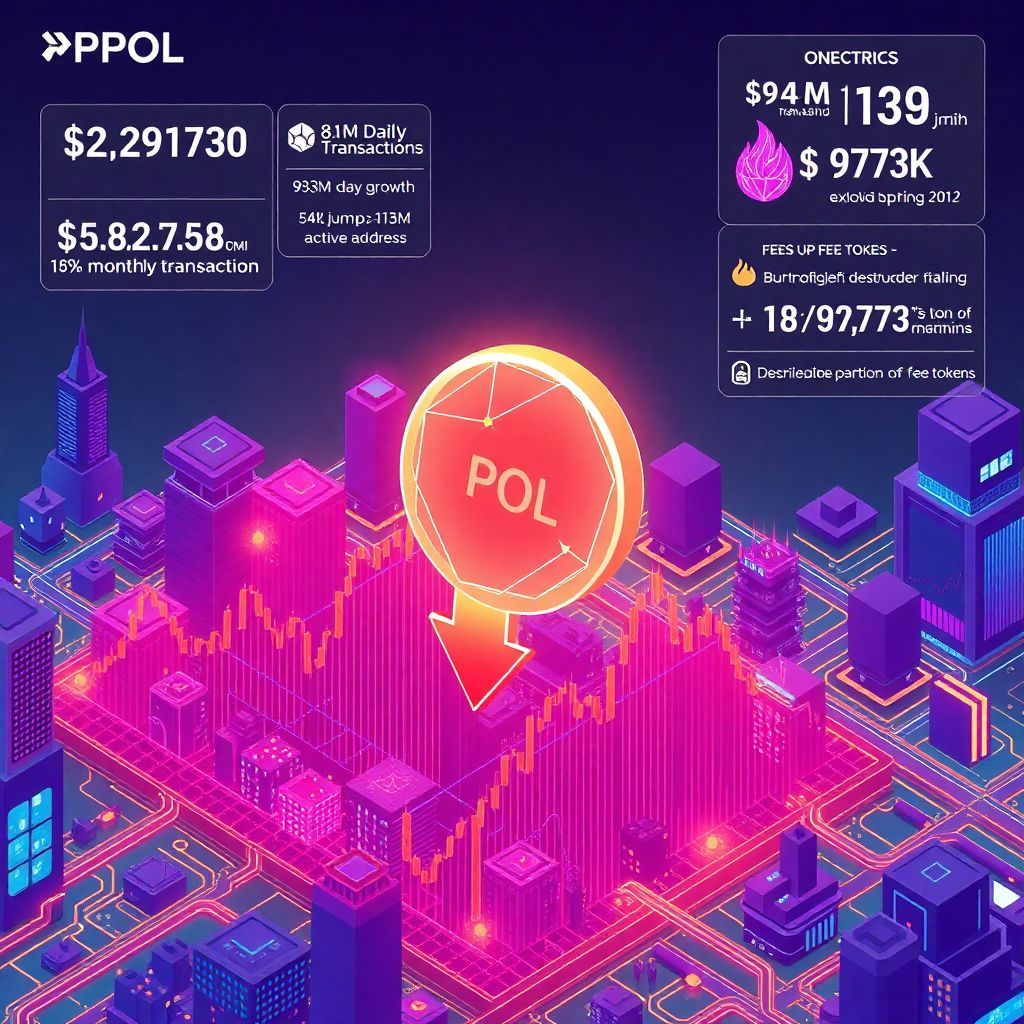
On-chain data shows the impact of these changes has been immediate. In the 24 hours following the Madhugiri upgrade, Polygon processed over 8.1 million transactions in a single day — its highest activity in roughly three months. Over the last 30 days, transactional activity has climbed by approximately 93%, surpassing 158 million transactions. By this growth rate, Polygon is currently the second-fastest-expanding chain in the market, trailing only Monad.
User participation has risen in parallel. The number of active addresses on Polygon has jumped roughly 54% across the past month, reaching about 13 million. As activity has climbed, so have protocol revenues: fees collected on the network are up around 27% over the same period, reaching approximately $778,000.
This revenue growth carries an additional structural benefit. Polygon follows a fee-burning model, permanently destroying a portion of the fees generated on the network. This mechanism helps counterbalance new POL issuance, potentially reducing long‑term inflation and supporting a more sustainable token economy if demand remains strong.
A major contributor to the recent surge in on-chain usage has been Polymarket, a prediction-market platform that operates on Polygon. In November alone, Polymarket facilitated about $4.33 billion in trading volume, marking its most active month to date. With the platform extending its footprint in the United States and expanding its user base, Polygon continues to benefit from steady transaction flow and growing visibility as an infrastructure layer for high-throughput applications.
Despite these tailwinds, the ongoing price collapse in POL has sparked a broader valuation debate within the crypto community. One prominent analyst highlighted stark discrepancies between Polygon’s metrics and those of Sui (SUI), another major layer‑1 and layer‑2 competitor. Based on their comparison, Polygon appears to deliver superior fundamentals across most key indicators while trading at a significantly lower valuation.
Polygon currently holds a DeFi total value locked (TVL) of around $1.19 billion, outpacing Sui’s approximately $931 million. The gap is even more dramatic in stablecoin presence: Polygon hosts roughly $2.825 billion in stablecoin supply, whereas Sui’s stablecoin base is closer to $0.5 million. Stablecoins are often regarded as a proxy for liquidity and economic activity within a network, making this discrepancy particularly noteworthy.
Revenue figures reinforce the same pattern. In a recent month, Polygon generated about $928,000 in network revenue, compared with roughly $724,000 for Sui. According to the analyst, Polygon also faces fewer token unlocks and a more moderate inflation profile than Sui. Yet, despite lagging on TVL, revenue, and stablecoin supply, Sui’s market capitalization is estimated to be about five times larger than Polygon’s, with a fully diluted valuation allegedly around fifteen times higher.
This divergence raises an uncomfortable question for investors: are markets overvaluing some newer chains with aggressive token economics while underpricing more established ecosystems like Polygon that are already generating meaningful fees and hosting mature DeFi and application layers?
From a technical perspective, POL’s price action reflects intense bearish pressure. On the daily chart, the token has been in a consistent downtrend, sliding from its September high of $0.2970 to roughly $0.12. During this fall, POL decisively broke below a key horizontal support level near $0.1520 — a zone that had previously held multiple times and acted as a floor for buyers.
The token currently trades below all major moving averages on the daily timeframe, a signal that the broader trend remains negative. Momentum indicators and oscillators also show continued weakness, suggesting sellers still dominate order flow. However, the structure of the decline is beginning to show a potentially constructive pattern for bullish traders.
Price action over recent weeks has formed a falling wedge — a classic technical pattern characterized by converging downward-sloping trendlines. As the wedge narrows, the rate of decline slows, and volatility compresses. Historically, falling wedges often precede trend reversals or at least sharp relief rallies when prices finally break to the upside.
If POL does confirm a breakout from this pattern, a plausible first target would be a retest of the broken support at $0.1520, which has now turned into a key resistance zone. From current levels around $0.12, such a move would represent close to a 30% rebound. However, for this scenario to gain traction, buyers will likely need to reclaim short-term moving averages and show sustained demand in the face of broader market weakness.
The current situation around Polygon highlights a broader dynamic in the crypto market: price is not always immediately aligned with usage, revenue, or technological progress. In risk‑off environments, liquidity often migrates toward the largest assets like Bitcoin and Ethereum, while mid‑cap tokens can suffer steep drawdowns even when their fundamentals improve. This can create valuation dislocations that either resolve through price recovery or through a deterioration in the very fundamentals that once looked attractive.
For investors and traders, the Polygon case poses a strategic dilemma. On one hand, surging transactions, growing active addresses, and rising fee revenue point to a network that continues to attract developers and users. On the other, the persistent price slide signals a lack of immediate market appetite for the token, possibly driven by macro conditions, capital rotation, or lingering uncertainty around the token migration from MATIC to POL.
Another factor worth considering is Polygon’s shifting narrative. Originally known primarily as an Ethereum scaling sidechain, Polygon has evolved into a multi‑chain ecosystem that includes zk‑powered solutions, enterprise collaborations, and modular infrastructure components. While this diversification strengthens the long‑term story, it can also complicate how investors value the asset in the short term, as not all of these elements are fully priced into standard metrics like TVL or daily transaction counts.
Tokenomics remain central to this discussion. The burn mechanism associated with network fees gives POL a potentially deflationary element over time, particularly if transaction volumes remain high or increase further. However, the benefits of this structure depend on net issuance, unlock schedules, and the balance between speculative demand and real usage. If broader market sentiment is weak or capital is drawn to other narratives, even relatively sound tokenomics may not be enough to buoy price in the near term.
Comparisons with chains like Sui also underscore how heavily narratives and investor expectations can influence valuations. Sui has captured attention as a newer high‑performance network with a strong focus on developer tools and novel programming paradigms. That excitement, combined with aggressive token distribution strategies, can inflate market cap relative to fundamentals — at least until the market reassesses growth expectations or the data more clearly supports or refutes the premium.
For builders and users, however, Polygon’s current pricing may matter less than its reliability, fees, and ecosystem depth. A chain capable of routinely clearing millions of transactions per day, with low costs and fast finality, provides a compelling platform for DeFi protocols, gaming applications, prediction markets, and consumer‑facing apps. The Madhugiri hard fork strengthens this value proposition by cutting block times and aligning Polygon more closely with Ethereum’s latest upgrades, which can also simplify cross‑chain development and interoperability.
In the medium to long term, the key question is whether Polygon can convert its current wave of usage into durable economic activity: more protocols deploying, higher stablecoin and liquidity depth, increased recurring revenue, and a robust developer base. If it succeeds, the argument that POL is undervalued compared with its peers will likely grow stronger, especially if competing networks face dilution from large unlocks or fail to sustain their initial hype.
For now, POL’s outlook remains a tug‑of‑war between a solid, arguably improving fundamental backdrop and a price chart that continues to show weakness. Traders will be watching closely to see whether the falling wedge formation resolves in favor of a relief rally, while longer‑term holders may focus more on whether transaction growth, fee generation, and ecosystem expansion persist over the coming quarters.
Ultimately, the Polygon story encapsulates a recurring theme in crypto markets: fundamentals can improve quietly in the background while token prices decline, creating periods of sharp divergence. Whether this gap closes through a recovery in POL or through changes in network momentum will depend on how the next phase of the market cycle unfolds — and on whether investors start to reward real usage and revenue more consistently than speculative narratives.