
Pentagon’s Project Maven emerges as AI nerve center for U.S. strikes on Iran
Pentagon planners are leaning heavily on Project Maven, the U.S. military’s flagship artificial intelligence initiative, as tensions with Iran drive one of the most intense strike campaigns in recent years. What began as a narrow experiment in automating video analysis has matured into a core decision-support system that helps commanders move from detection to destruction in a fraction of the time previously required.
From video triage tool to battlefield brain
When Project Maven was launched in 2017, its mission was modest but urgent: help human analysts cope with a flood of drone and surveillance footage pouring in from conflict zones. Intelligence teams were spending countless hours scrubbing through full-motion video, often frame by frame, trying to spot vehicles, fighters, or weapons that might only appear for seconds.
Maven’s initial promise was simple-use machine learning to highlight those fleeting moments automatically, effectively “finding the needle in the haystack” across thousands of hours of imagery. Early versions of the system were trained to recognize basic objects, track movement, and flag anomalies that might merit a human’s closer review.
Over time, however, the program expanded far beyond its original role as a visual triage tool. What began as a way to prioritize analysts’ workloads has evolved into a broader AI-assisted targeting and command platform, deeply embedded in how modern U.S. operations are planned and executed.
Compressing the kill chain
Military officials increasingly describe Maven as a central driver in compressing the so‑called “kill chain” – the process that runs from identifying a potential target, confirming its value and legality, assigning a weapon system, and finally executing a strike. Tasks that might once have required hours of coordination, cross-checks, and manual data fusion can now be condensed into minutes or even seconds.
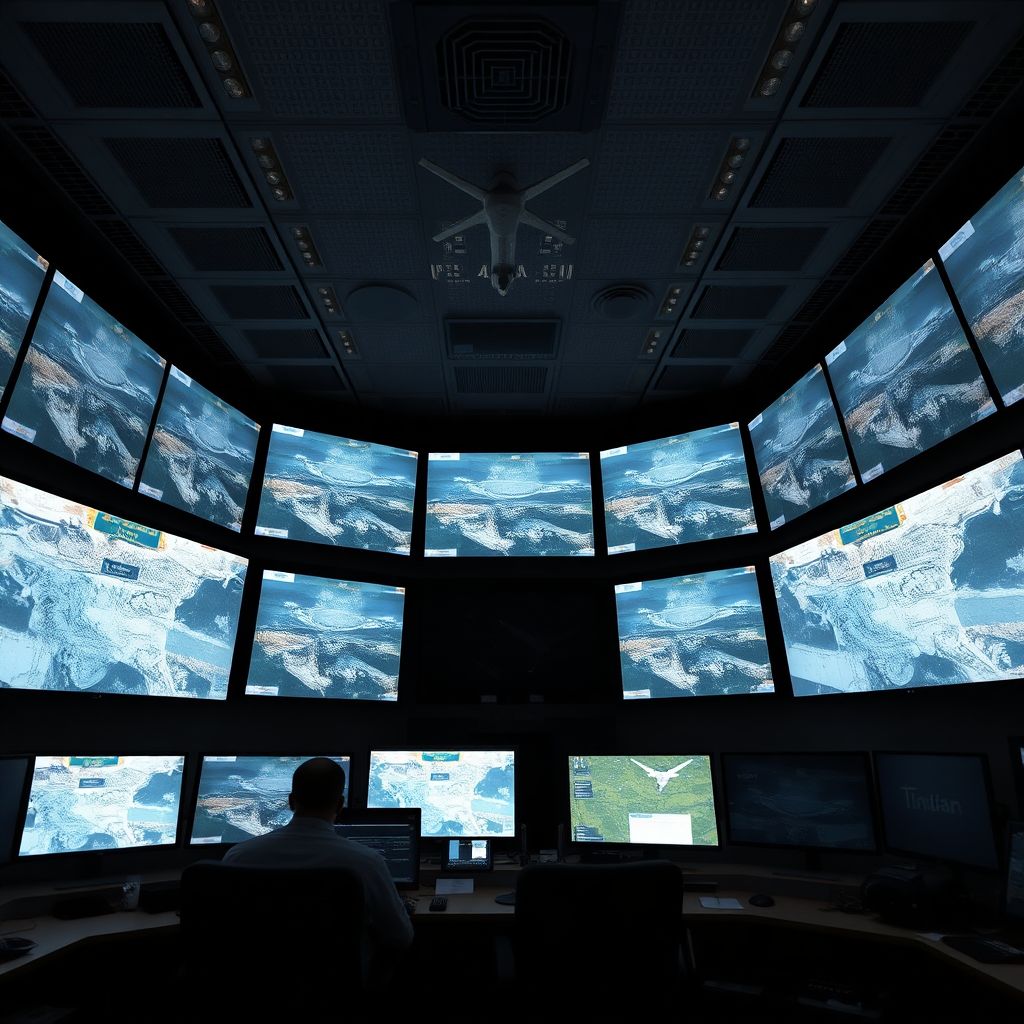
Maven sits at the center of this process as a kind of AI-enabled battle manager. It ingests large volumes of real-time data and transforms them into an integrated operational picture. Rather than watching a single feed, commanders can see an AI-constructed snapshot of an entire battlespace, with probable targets and threats highlighted, context added, and suggested options displayed.
According to accounts from recent demonstrations, the system can take an observed threat-say, a convoy or suspected missile launcher-and rapidly turn it into a structured targeting workflow. It maps available aircraft, missiles, and other assets, estimates time-to-target, evaluates potential collateral damage, and surfaces what it calculates to be the most viable choices for action.
Data fusion at unprecedented scale
At the technical level, Maven acts like an overlay across the military’s sprawling sensor network. It draws from satellite imagery, drone video, signals intelligence, radar and other sensor inputs, as well as battlefield reports on enemy force disposition and friendly troop locations.
By fusing these traditionally siloed data streams, the system can identify patterns that would be difficult for any single analyst or team to recognize in real time. Troop movements across wide areas, unusual activity near known weapons depots, changes in communications traffic-Maven can correlate and score these signals faster than humans, then flag potential targets for additional scrutiny.
In operational terms, this means U.S. units connected to Maven can react more quickly to fleeting targets. A missile launcher that might previously have moved before a strike package could be tasked and cleared can now, in theory, be engaged while it is still in position. Supporters inside the Pentagon argue this speed advantage could be decisive in any high-intensity conflict.
Generative AI and natural language control
Recent advances in generative AI have changed how operators interact with the system. Instead of relying solely on specialized interfaces or manual queries, personnel can now use natural language prompts to pull up information, pose “what if” questions, or ask the system to generate courses of action.
Technologies similar to large language models allow Maven-linked tools to answer queries like, “Show me high-priority missile threats within range of our carrier group in the last 30 minutes,” or, “What are the best options to disable this radar site while minimizing civilian risk?” This makes highly complex data more accessible to commanders who may not be technical specialists.
One such interface was reportedly developed in partnership with an advanced model provider, enabling more conversational interaction with the underlying intelligence picture. That collaboration, however, has been strained by disagreements over how far AI should be allowed to go in facilitating autonomous strikes and broad, persistent surveillance-disputes that highlight the ongoing tension between tech companies and defense users over acceptable use of generative AI.
Google’s exit and the Silicon Valley split
Maven’s path through the private sector has been turbulent. Google was initially the key AI partner on the project, providing machine learning expertise and infrastructure in its early years. But in 2018, internal resistance exploded into public view when thousands of Google employees signed a letter objecting to the company’s involvement in systems that could be linked to lethal targeting.
That internal revolt led to high-profile resignations and ultimately to Google’s decision not to renew its Maven contract. The company later formalized AI principles that placed strict limits on direct participation in weapons systems, sending a signal that at least part of Silicon Valley saw autonomous targeting as a line it was unwilling to cross.
The episode underscored a deeper divide in the tech world. On one side are engineers and ethicists who argue that embedding AI in the mechanics of war risks eroding human accountability and increasing the likelihood of deadly mistakes. On the other are national security officials and defense-industry leaders who insist that adversaries are racing ahead with similar technologies, making it dangerous for the U.S. to hold back.
Return of Big Tech and the rise of Palantir
Despite the earlier backlash, some large tech firms have gradually moved back toward more open engagement with defense work, arguing that they can help shape the ethical use of AI from the inside. Google has softened its posture, signaling a willingness to support certain military and security applications, even as it maintains public commitments around prohibited uses.
In the current phase, multiple AI companies-including high-profile labs and emerging players-are reported to be vying for a role in Maven’s next generation, especially as generative AI and advanced models become more central to battlefield decision support.
Amid this shifting landscape, Palantir Technologies has secured a dominant position within Maven. Known for its longstanding relationships with intelligence and security agencies, Palantir now supplies core components of the system’s analytical and decision-support backbone. Its software is believed to underpin much of the data integration, visualization, and operational orchestration that make Maven usable at scale.
Palantir’s chief executive has described the emerging AI-enabled battlefield in starkly binary terms, portraying the world as divided between those with advanced kill-chain compression capabilities and those without. In his framing, the ability to shrink decision cycles from hours to seconds can render opponents effectively powerless to respond.
Maven and the Iran strikes: speed, scale, and controversy
Officials have been tight-lipped about the precise role Maven has played in the current U.S. operations linked to the Iran confrontation. But the tempo of the campaign offers clues about how heavily the military may be relying on AI-enabled targeting and coordination.
Analyses of strike patterns indicate that after an intense opening salvo, U.S. forces settled into a sustained rhythm of roughly 300 to 500 targets attacked per day. During the initial 24 hours of Operation Epic Fury, reports suggest more than 1,000 targets were hit, an extraordinary level of activity that would be difficult to plan and synchronize using only traditional, largely manual processes.
One of the most controversial incidents in that opening period was a strike on a school housed in a building that had previously served as a military complex. Iranian authorities claimed the attack killed over 100 children and injured many more. U.S. officials have not publicly detailed the target-development process behind that strike, but the episode has intensified scrutiny of systems like Maven and the broader question of how AI-driven recommendations intersect with rules of engagement and efforts to protect civilians.
Accountability in an accelerated battlespace
The central dilemma posed by Maven is not simply whether AI can identify targets more quickly-it clearly can-but how responsibility is assigned when those targets turn out to be misidentified, or when intelligence is incomplete or outdated. As the “kill chain” compresses, the time available for human cross-checks and deliberation shrinks, even if a human formally remains in the loop.
This raises uncomfortable questions for both militaries and policymakers:
– When AI surfaces a target with high confidence and recommends a strike, to what extent do commanders feel pressured to accept that judgment?
– If multiple steps in the targeting process are automated, does human oversight become a rubber stamp rather than a substantive safeguard?
– How easily can investigators reconstruct what the system “saw” and how it weighed various inputs if something goes wrong?
Advocates argue that AI can actually improve accountability by providing detailed logs of its reasoning process and making it easier to review what intelligence was available at the time. Critics counter that many current systems operate as black boxes, with outputs that are hard to interpret and even harder to contest in the heat of combat.
The evolving ethics of AI in warfare
The ethical debate around Project Maven reflects broader anxieties about the future of conflict as AI permeates every layer of military planning. Even if systems like Maven stop short of fully autonomous weapons, they can still shift the balance between caution and aggression simply by making it far easier and faster to act.
Human rights organizations and independent experts have warned that such tools may lower the political and psychological threshold for the use of force, particularly in regions where there is already intense pressure to respond quickly to perceived threats. If decision-makers come to view AI-enabled precision as a guarantee of acceptable collateral damage, they may authorize strikes more readily-even when the underlying data is imperfect.
There are also questions about how far such technology will spread. Once developed and fielded at scale, AI targeting frameworks have a tendency to diffuse-whether through alliances, arms sales, or covert acquisition. States with weaker safeguards and fewer transparency norms could adapt similar tools in ways that are far less constrained than current U.S. practice, multiplying the risks.
Strategic implications and the arms race in military AI
Beyond the immediate Iran context, Maven is a bellwether for an emerging AI arms race. Rival powers are investing heavily in comparable capabilities: automated satellite analysis, AI-enabled air defense, and decision-support systems designed to help their own commanders keep pace with rapidly unfolding crises.
This dynamic creates a feedback loop. As U.S. forces accelerate their kill chain, potential adversaries feel compelled to shorten theirs, or to develop countermeasures such as AI-assisted deception, spoofing, and misinformation designed to confuse or overload opposing systems. Battlefields may become spaces where dueling algorithms constantly probe, mislead, and adapt in real time.
Strategists warn that when both sides possess fast-reacting, AI-augmented command systems, the risk of miscalculation can increase. Ambiguous movements or sensor errors might be interpreted as imminent threats, triggering rapid escalations before diplomats have time to intervene or verify what actually occurred.
The future of Maven: more autonomy, more oversight?
Looking ahead, Project Maven is likely to become even more deeply embedded in U.S. military operations. The integration of advanced models, better natural language interfaces, and more sophisticated pattern recognition will expand its role from targeting support to broader operational planning, logistics, and force protection.
At the same time, the controversy surrounding its use in conflicts like the Iran campaign is pushing governments, militaries, and technology providers to refine the guardrails around such systems. Potential reforms under discussion in policy circles include:
– Clearer rules defining which decisions must always remain under slow, human-led review
– Technical architectures that make AI recommendations explainable and auditable
– Independent red-teaming of AI tools to probe failure modes before deployment
– International norms or agreements limiting the degree of autonomy in lethal systems
Ultimately, Project Maven sits at the intersection of two powerful imperatives: the military’s drive for speed and dominance, and society’s insistence on maintaining human responsibility for the gravest decisions a state can make. How the U.S. manages that tension in the coming years-on battlefields like the Iran theater and beyond-will shape not only the future of war, but also the evolving relationship between artificial intelligence and state power.