
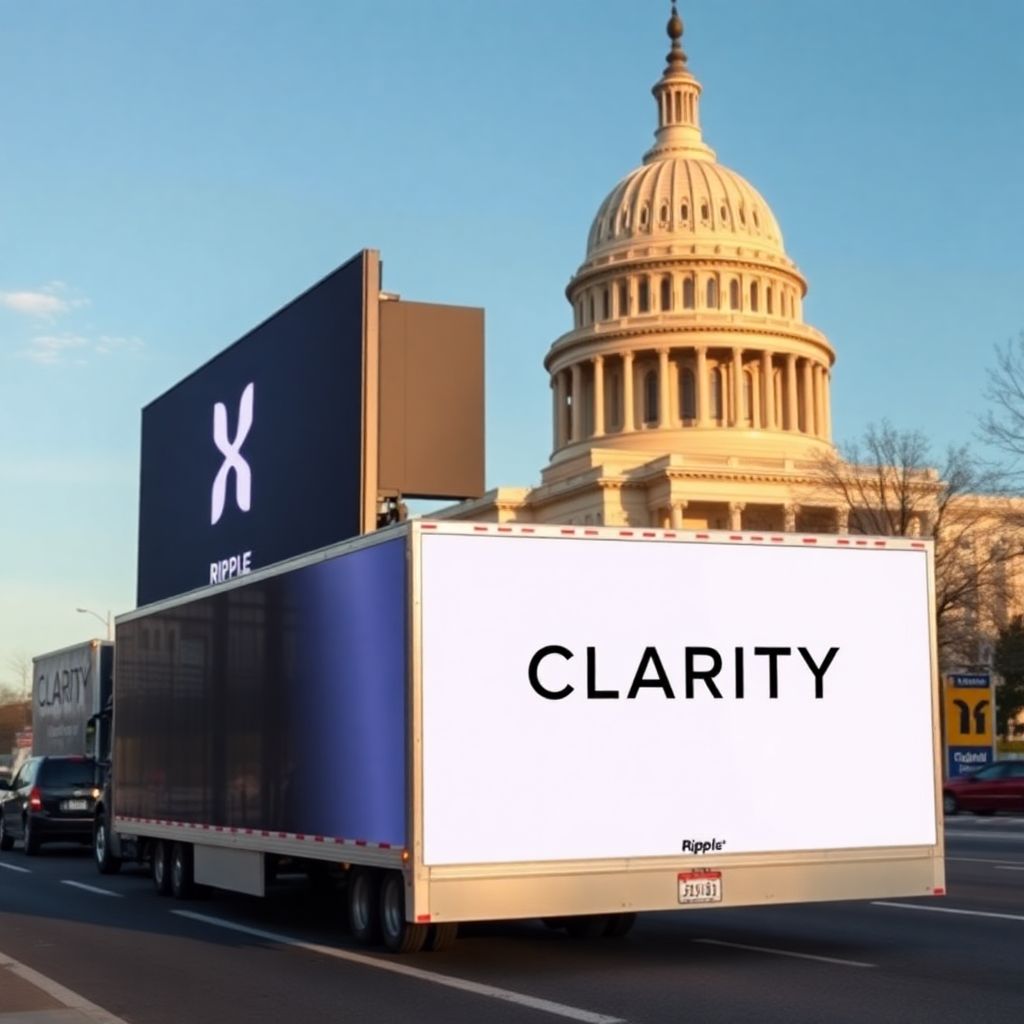
Ripple rolls out “CLARITY” truck in Washington as Senate schedule squeezes crypto bill
Ripple has escalated its push for clearer U.S. crypto regulation, rolling a branded “CLARITY” truck through the streets around Capitol Hill just as the legislative window for the CLARITY Act narrows in the Senate.
The campaign centers on a mobile digital billboard truck circulating near the U.S. Capitol, plastered with Ripple’s logo and the slogan “On the road to Clarity.” The displays promote the CLARITY Act as a blueprint for transparent, predictable rules for digital assets, at a time when Congress is still wrestling with how to regulate the sector.
According to the company, the goal is straightforward: keep the CLARITY Act in front of lawmakers and staffers while broader crypto policy talks continue. Ripple frames the bill as a way to protect consumers, foster responsible innovation, and ensure the United States doesn’t fall behind in the global competition for digital asset leadership.
In a July 25 post on X, Ripple said its CLARITY truck is touring Washington, D.C., as Congress works on “transparent rules of the road” for crypto. The message, repeated across the campaign, is that a clear regulatory framework can both safeguard users and give legitimate projects the confidence to build in the U.S. rather than move offshore.
Lauren Belive, Ripple’s co‑head of public policy and government, amplified the initiative on social media, describing it as taking Ripple’s “road to clarity” message directly to the nation’s capital. Her comments underline a broader shift: major crypto firms are no longer limiting themselves to behind‑the‑scenes lobbying but are increasingly willing to wage visible, public policy campaigns.
A shrinking legislative window
Ripple’s push comes at an awkward time for the CLARITY Act. The bill has made progress, but the congressional calendar has turned into its biggest enemy.
Earlier this week, Senate Majority Leader John Thune adjourned the Senate until July 13 under a unanimous consent agreement. That decision chopped several working days off the already tight timeline before lawmakers leave again for the August recess. Each lost day means fewer opportunities to move complex, sometimes controversial legislation like crypto regulation.
The move drew criticism from some members of Congress. Representative Anna Paulina Luna blasted the decision, saying she would not support reopening the House floor until senators returned to Washington. She argued that the upper chamber departed before advancing key legislation ahead of the Independence Day holiday, leaving important bills in limbo.
The time crunch is compounded by competing legislative priorities. President Donald Trump recently delayed signing the bipartisan 21st Century ROAD to Housing Act, even though it cleared Congress with broad support. Instead, he signaled he would wait for Congress to make headway on the SAVE AMERICA Act. While the housing bill is unrelated to the CLARITY Act on a procedural level, it absorbs valuable political attention and floor time at a moment when multiple large policy initiatives are competing for space.
For the CLARITY Act, the sequencing matters. The bill has already been placed on the Senate Legislative Calendar after clearing committee earlier in the month, a necessary but not sufficient step for final passage. On the House side, the Financial Services Committee is also expected to continue reviewing the proposal before it can move to a full floor vote. Every delay elsewhere makes it harder for leadership to prioritize a complex, technical measure like crypto regulation.
Law enforcement worries and DOJ reassurance
Even as the clock ticks down, debate over the CLARITY Act’s implications for financial crime enforcement has intensified.
Several law enforcement groups have voiced concern that certain sections of the bill might inadvertently weaken their ability to track and investigate illicit activity involving digital assets. The fear is that changes to regulatory definitions or compliance standards could open gaps criminals might exploit, especially in areas like money laundering, drug trafficking, human smuggling, or terrorist financing.
The U.S. Department of Justice moved to calm those fears. A DOJ spokesperson stated that the legislation would not curtail prosecutors’ or investigators’ authority. According to the department, law enforcement’s access to relevant information would remain intact under the bill, and existing tools for pursuing federal investigations and prosecutions involving digital assets would not be rolled back.
In essence, the DOJ’s message is that the CLARITY Act aims to clarify the regulatory perimeter for lawful market participants without erecting new barriers to tracking criminal behavior. That distinction is crucial if the bill is to maintain bipartisan support in a political environment where anything seen as “soft” on financial crime can quickly become toxic.
Treasury’s stance and the broader policy context
At the same time, Treasury Secretary Scott Bessent has kept up pressure for Congress to act on digital asset legislation. He has reiterated that a U.S. central bank digital currency is “off the table” under the current administration, seeking to reassure skeptics wary of direct government‑issued retail money.
Instead, Bessent has encouraged lawmakers to move ahead with a broader regulatory framework for crypto, explicitly including the CLARITY Act as part of that effort. His position dovetails with the view held by many in the industry: that the U.S. should create clear, technology‑neutral rules rather than rely on ad‑hoc enforcement actions and ambiguous guidance.
This stance also reflects a strategic concern. Other major jurisdictions are not waiting. While the article does not dive into international specifics, the subtext is clear: if Congress stalls for too long, the U.S. risks ceding innovation, capital, and talent to countries that offer a more predictable environment.
Why Ripple is going public with its campaign
Ripple’s decision to send a CLARITY‑branded truck through Washington is more than a marketing stunt; it’s a visible sign of how high the stakes have become for large crypto companies.
For years, digital asset firms complained of “regulation by enforcement,” particularly in the U.S., where agencies have clashed over jurisdiction and definitions. The CLARITY Act is part of an attempt to move beyond that patchwork, giving companies a better sense of which agency they fall under, what rules apply, and how to stay compliant without guessing at regulators’ expectations.
By investing in a public campaign, Ripple is signaling that it sees this bill as foundational for its long‑term ability to operate and grow in its home market. The company’s own history of regulatory conflict – including multi‑year litigation over whether XRP is a security – underscores why it is particularly sensitive to the issue of legal clarity.
The emphasis on consumer protection in Ripple’s messaging is also deliberate. Politically, crypto regulation that appears to benefit industry alone is a tough sell. Framing the CLARITY Act as a tool to shield everyday users from fraud and confusion, while still supporting innovation, is designed to appeal both to skeptical lawmakers and to regulators focused on investor safety.
What CLARITY could mean for the U.S. crypto market
Although the article does not lay out the full legal text, the positioning of the CLARITY Act suggests several likely impacts if it passes:
– More predictable compliance obligations: Exchanges, custodians, and infrastructure providers would have clearer guidelines on registrations, disclosures, and risk controls. That can reduce legal uncertainty and compliance costs over time.
– Better separation of responsibilities between regulators: One of the thorniest issues in U.S. crypto oversight has been the overlap between securities and commodities regulators. A statute that draws sharper lines could lower the risk of duplicate or conflicting enforcement.
– Improved consumer safeguards: Rules on custody, transparency, and conflict‑of‑interest management can be codified, making it harder for bad actors to exploit regulatory gray zones.
– Increased institutional participation: Pension funds, asset managers, and large banks often hesitate to engage deeply with digital assets in the absence of clear rules. A stronger legal framework could change that calculus.
For market participants, this translates into a tradeoff: more structure and compliance demands, but also a broader base of potential users and partners.
Implications specifically for Ripple and XRP holders
Although the CLARITY Act is not tailored to any single project, Ripple’s vocal support invites a closer look at what it might mean for the company and, indirectly, for XRP.
If the bill successfully clarifies how various digital assets are classified and which activities fall under which regulator, Ripple could benefit from a more stable environment in which to expand its payment and liquidity services. The long‑running uncertainty around XRP’s status has been a key overhang for both the company and the token’s holders.
A clearer framework might also make it easier for U.S.‑based institutions to engage with Ripple’s technology stack, including products that leverage XRP for cross‑border payments and liquidity. Even if the legislation does not directly address individual tokens, a more coherent regulatory perimeter tends to lower perceived legal risk.
However, investors should temper expectations. Regulation rarely produces dramatic, overnight market moves. Instead, it changes the medium‑term landscape: who is willing to build, where capital flows, and how conservative institutions evaluate risk. For XRP holders, the more important benefit could be the gradual normalization of crypto infrastructure within mainstream finance rather than a single legislative “catalyst.”
Why timing matters so much for this bill
The legislative calendar often matters as much as the substance of a bill. Crypto regulation is a technically dense subject that competes with issues that are more immediately visible to the public, such as housing, immigration, or national security.
With the Senate recessed until mid‑July and another recess looming in August, there is a narrow window for leadership to prioritize the CLARITY Act. If the bill does not advance far enough before lawmakers leave town, it risks being pushed into a more crowded or politically charged period later in the year.
That is why Ripple and other supporters are pressed to keep the issue in the spotlight now. Their calculation is that sustained visibility can help nudge the bill onto the agenda when leadership is choosing what to move next.
Balancing innovation and enforcement
A central tension running through the CLARITY debate is how to weigh innovation against enforcement power.
On one side, industry advocates argue that ambiguity is itself a risk: it pushes legitimate actors out of the U.S. and leaves users exposed to unregulated platforms abroad. On the other, law enforcement and skeptical policymakers worry that missteps could weaken tools they rely on to combat serious crime.
The DOJ’s reassurance that its investigative authority will remain intact is therefore pivotal. If lawmakers accept that the bill preserves core enforcement powers while clarifying rules for compliant actors, it becomes easier to build the bipartisan coalition needed for passage.
Ultimately, the CLARITY Act is part of a larger question: can the U.S. design a regime where regulated, transparent crypto activity flourishes while illegal behavior is aggressively targeted? How Congress answers that question will shape not only Ripple’s future, but the trajectory of the entire American digital asset ecosystem.
What to watch next
As Congress returns in mid‑July, several developments will signal where the CLARITY Act stands:
– Whether Senate leadership schedules meaningful floor time for the bill.
– Progress in the House Financial Services Committee and any amendments introduced there.
– Additional statements from Treasury, the DOJ, and other agencies clarifying how they interpret the bill’s provisions.
– The intensity of industry and public campaigns, like Ripple’s truck initiative, which can keep political pressure from fading.
Ripple’s “road to clarity” campaign underscores a growing recognition: for crypto to move beyond cycles of hype and crackdown, it must secure a durable place within the formal legal framework. The outcome of the CLARITY Act debate will be an important test of whether U.S. lawmakers are ready to provide that foundation – or whether regulatory uncertainty will continue to cloud the sector’s future.