
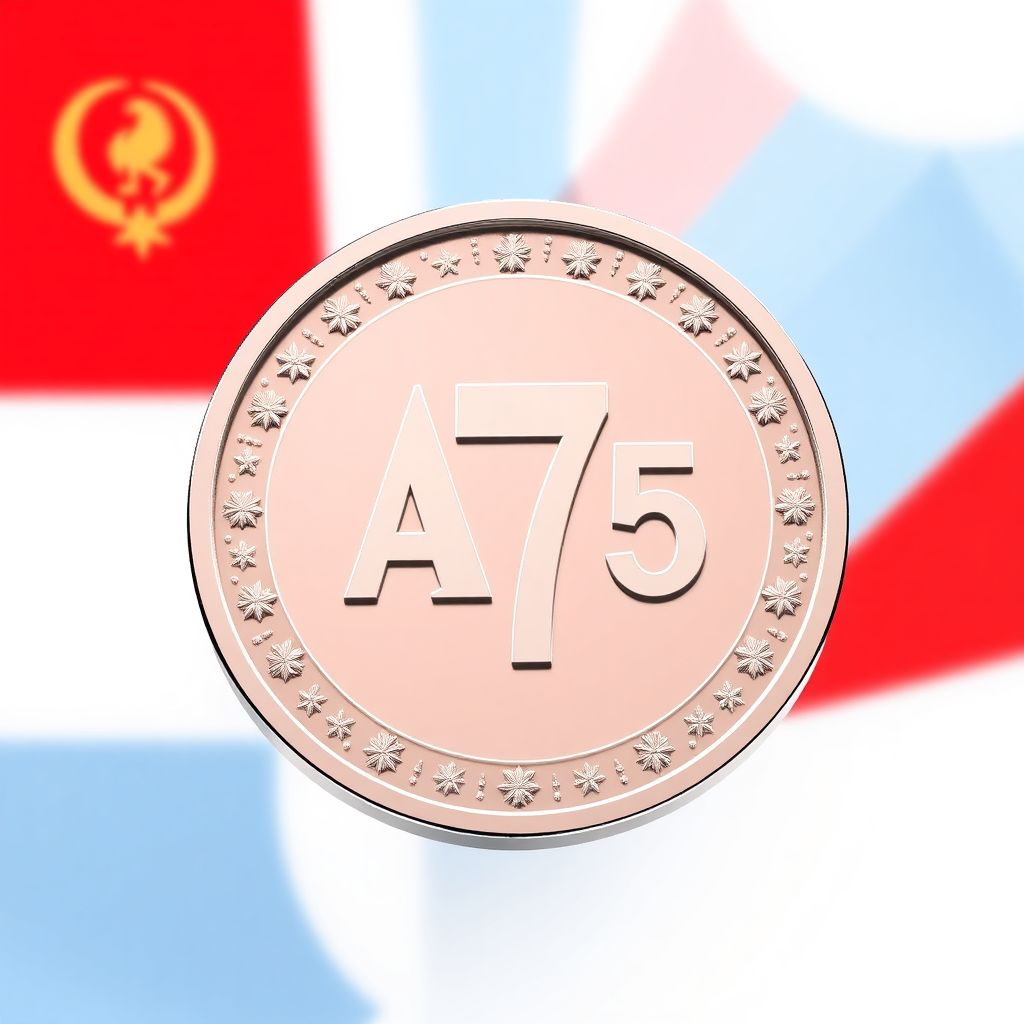
Ruble-pegged stablecoin A7A5 has officially ascended to the top spot among non-USD stablecoins, surpassing Circle’s euro-backed EURC and reaching a market capitalization approaching $500 million. Issued under Kyrgyz jurisdiction, this digital asset has seen a meteoric rise, gaining 43% in value within just 24 hours and establishing itself as a dominant force in the broader stablecoin ecosystem.
According to recent data, A7A5 now represents approximately 40.79% of the total market share for non-USD stablecoins, a significant jump that signals growing interest in alternatives to dollar-denominated tokens. The total market cap of non-USD stablecoins currently stands at $1.16 billion, making A7A5’s surge a defining moment in the sector’s evolution.
The creators of A7A5 took to Telegram to celebrate the milestone, stating their belief that non-USD stablecoins will constitute up to 20% of the global stablecoin market by 2028. They emphasized the token’s role not only as a financial instrument but as part of a broader movement toward de-dollarization in digital finance. “We’ve demonstrated that a national digital currency can serve both as an alternative to the US dollar and as a catalyst for systemic change,” the project declared.
The timing of this growth aligns closely with A7A5’s participation in the high-profile Token2049 conference in Singapore. During the event, Oleg Ogienko, the company’s Director of International Development, outlined the project’s roadmap. Plans include tools for seamless conversion between fiat currencies and A7A5, as well as the introduction of Russian debit and credit cards linked to the stablecoin. These cards aim to enable foreign users to directly access ruble-backed digital assets, making cross-border transactions easier and potentially bypassing traditional financial systems.
Ogienko expressed strong confidence in the future dominance of non-dollar stablecoins: “We believe the next wave of financial innovation will be led by stablecoins not tied to the US dollar, and A7A5 intends to be at the forefront of that transformation.”
However, A7A5’s rapid expansion hasn’t gone unnoticed by global regulators. Questions have emerged regarding the token’s compliance and its potential use in circumventing international sanctions. Since August 2025, reports suggest that over $6 billion has been processed via A7A5 across borders, despite key figures behind the project being affected by Western sanctions.
The token’s backers claim it is fully collateralized on a 1:1 basis with Russian rubles held across a diversified network of banks in Kyrgyzstan. It also promises daily passive income to holders, derived from half the interest generated by its reserve deposits. Initially launched on Ethereum and Tron blockchains, A7A5 has positioned itself as a high-utility digital asset with ambitions beyond traditional stablecoin frameworks.
Shortly after its February debut, analysts observed strong connections between A7A5 and Grinex, a crypto exchange seen as the successor to Garantex, which was previously sanctioned by the U.S. Treasury along with Russia’s Promsvyazbank (PSB). Blockchain data revealed that over 80% of A7A5 tokens were burned and reissued shortly after new sanctions targeted Grinex-linked wallets, indicating a reactive strategy to maintain liquidity and compliance optics.
The United Kingdom has since placed sanctions on several Kyrgyz banks, citing their involvement in facilitating transactions through A7A5 to evade financial restrictions. The European Union is also considering imposing its own sanctions that would bar EU-based individuals and entities from indirectly interacting with the token.
Despite regulatory scrutiny, A7A5 continues to gain traction, particularly in Russia, Belarus, and Central Asia, where financial institutions reportedly see the token as a viable vehicle for conducting international transactions outside the scope of Western financial oversight.
This growing prominence of A7A5 highlights a significant shift in the global stablecoin narrative. While the USD remains the dominant currency in the crypto-backed finance world, the success of ruble-linked A7A5 may encourage other nations under sanctions or facing currency volatility to explore similar digital alternatives. The trend could lead to a more fragmented but diversified stablecoin landscape, where national currencies are increasingly represented in blockchain-based financial systems.
Furthermore, A7A5’s growth raises questions about the future of monetary policy in a decentralized financial environment. If more countries adopt stablecoins tied to their national currencies, traditional central banks may need to reconsider how they regulate money supply, interest rates, and cross-border capital flows in a world where digital liquidity can move freely outside their control.
Another key implication lies in the realm of geopolitical finance. As countries seek to sidestep the dominance of the dollar in international trade, digital assets like A7A5 could become tools of economic realignment. They offer a method of preserving sovereignty in financial transactions, especially for states that view Western sanctions as a threat to their domestic stability.
In terms of technology, A7A5’s dual deployment on Ethereum and Tron illustrates the growing trend of multi-chain stablecoins, designed for maximum interoperability and user accessibility. This allows for broader adoption across DeFi platforms and ensures resilience against potential network disruptions or regulatory crackdowns on a single blockchain.
Looking ahead, if A7A5 continues to grow in market cap and user base, it could pave the way for a new class of stablecoins that are not only currency-backed but also embedded in national strategic interests. The blending of financial innovation, state influence, and blockchain technology may redefine the very concept of what a stablecoin is—and what it can do.
Ultimately, A7A5’s rise is not just a financial milestone; it’s a reflection of a rapidly transforming global financial system, one where digital tokens are increasingly challenging the traditional roles of fiat currencies and reshaping how value moves across borders.