
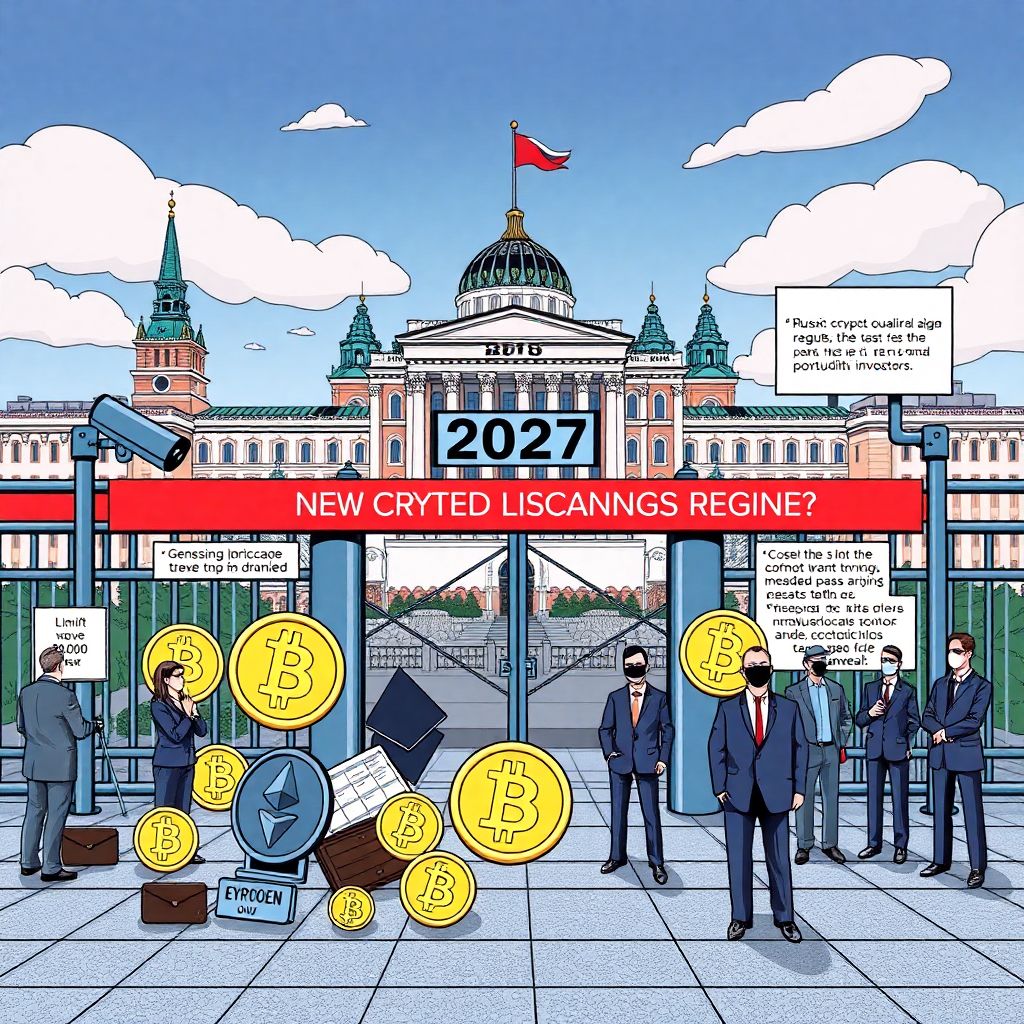
Russia sets 2027 start date for tough new crypto licensing regime
Russian lawmakers are moving ahead with one of the country’s most far‑reaching attempts to control the digital asset market, preparing a bill that would tightly regulate cryptocurrency exchanges, sharply limit retail investing and effectively sideline privacy coins.
According to Anatoly Aksakov, head of the State Duma’s Financial Market Committee, the lower house of parliament is expected to vote on the draft law by late June. If adopted, the rules would come into force on July 1, 2027, giving regulators, businesses and investors roughly three years to prepare for a radically different landscape.
Mandatory licensing for all crypto exchanges
At the heart of the proposal is a strict licensing and registration framework for any platform that facilitates cryptocurrency trading. All exchanges, whether newly created or already operating, would be required to obtain official approval and comply with detailed operational standards set by regulators.
Exchanges that continue to operate without a license after the law takes effect would be treated similarly to entities conducting illegal banking activity. Under Russia’s criminal code, such offenses can trigger heavy fines and even prison sentences. The bill signals that authorities intend to treat unregistered crypto businesses not as minor regulatory offenders, but as full‑scale financial law violators.
The forthcoming regime is likely to touch all major parts of the domestic crypto infrastructure: trading platforms, certain wallet providers, and possibly brokers that intermediate crypto transactions. Those firms would be expected to implement rigorous anti‑money‑laundering and customer‑verification procedures, maintain detailed reporting to state bodies and segregate client funds from company assets.
Qualification tests and strict caps for retail investors
The draft legislation draws a sharp line between professional participants and ordinary citizens. Retail investors would not be able to freely purchase digital assets; instead, they would first have to pass a qualification test to prove they understand the risks, mechanics and legal specifics of crypto investing.
Even after passing the test, individuals would still face hard caps on how much they can buy. The bill sets a maximum annual limit of 300,000 rubles per person—roughly 4,000 US dollars at current exchange rates. Lawmakers say this is designed to protect inexperienced investors from excessive speculation and large financial losses, particularly in highly volatile assets such as Bitcoin and altcoins.
The cap marks a clear policy choice: crypto is being treated not as a mainstream investment class for the general public, but as a restricted, high‑risk product that should remain tightly controlled and secondary to traditional financial instruments.
Privacy coins in the crosshairs
One of the most consequential elements of the bill is its stance on privacy‑focused cryptocurrencies. The proposed law targets assets designed to obscure sender and recipient identities or transaction amounts—coins that rely on advanced encryption or mixing techniques to maximize anonymity.
These privacy coins would be subjected to severe restrictions and, in practice, could be pushed out of the regulated Russian market altogether. Policymakers argue that such assets are inherently incompatible with anti‑money‑laundering and counter‑terrorism‑financing rules, making them a natural priority for regulation or prohibition.
By drawing a red line around anonymity‑enhancing cryptocurrencies, Russia is aligning itself with a broader global trend: many jurisdictions view privacy coins as posing a disproportionate compliance risk compared with more transparent blockchains like Bitcoin or Ethereum.
Ban on domestic crypto payments remains in place
Despite the increased openness to some forms of crypto activity, the bill does not relax the existing ban on using digital currencies for everyday payments inside Russia. Crypto assets would remain off‑limits as legal tender for goods and services on Russian territory.
This means businesses will still be unable to legally accept Bitcoin, stablecoins or other digital assets at the checkout counter, and individuals will not be permitted to settle domestic transactions in crypto. The authorities clearly intend to preserve the ruble’s exclusive role as the country’s official means of payment, even as they make room for limited crypto use in other areas.
Stablecoins and cross‑border payments
Where the draft law shows flexibility is in the sphere of international trade. The legislation envisions a controlled role for stablecoins and certain cryptocurrencies in cross‑border transactions and foreign trade settlements.
Russian entities would be able to use approved digital assets as a tool for settling international obligations, particularly with foreign partners willing to accept crypto payments. This aligns with Moscow’s broader effort to reduce its exposure to the US dollar and traditional Western‑dominated payment systems.
However, this cross‑border use will not translate into free movement of crypto within Russia’s domestic economy. The bill makes a clear distinction: digital assets can serve as an auxiliary settlement instrument abroad, but inside the country, the ruble and state‑approved financial infrastructure remain central.
Central Bank gains decisive power over which coins are allowed
A notable feature of the proposal is the expanded authority it grants the Central Bank of Russia. Under the draft rules, the central bank would have the final say on which specific cryptocurrencies and tokens can be legally traded by regulated platforms.
This represents a significant shift from the central bank’s earlier hardline approach. For years, the regulator advocated for an almost total ban on cryptocurrency circulation, arguing that digital assets threaten financial stability and facilitate illegal activity. The new framework stops short of such a blanket prohibition.
Instead, the central bank is positioned as a gatekeeper: it can approve a narrow list of assets—such as Bitcoin and possibly a few other major coins or select stablecoins—while excluding those it deems excessively risky, opaque or speculative. This allows the regulator to calibrate market access over time, tightening or loosening the list as circumstances change.
Years of internal disputes lead to a compromise framework
The path to this bill has been long and contentious. Efforts to build a comprehensive regulatory regime for cryptocurrencies in Russia have repeatedly stalled, largely due to disagreements between the Ministry of Finance and the Central Bank.
The finance ministry has generally pushed for a legal framework that would bring crypto out of the shadows, tax it and channel it through regulated institutions. The central bank, by contrast, long favored a near‑zero tolerance approach, arguing that any legalization would encourage capital flight and speculative bubbles.
The current proposal reflects a compromise between these starkly different positions. It recognizes the economic and geopolitical motivations for allowing limited crypto use—especially in international settlements—while still granting authorities extensive control over who can access digital assets, in what volume and through which platforms.
Limited but formalized access to Bitcoin by mid‑2027
If the law passes on the timeline described by Aksakov, both retail and institutional investors would gain strictly regulated access to Bitcoin and other approved digital assets by mid‑2027.
For institutional participants—such as banks, large companies or professional investors—this could open up new channels for diversification, hedging and participation in international crypto‑denominated deals, all within a formal legal framework.
For ordinary citizens, however, access will likely remain narrow and highly regulated. The qualification tests and annual purchasing cap are designed to keep retail involvement modest and prevent the kind of mass speculative mania seen in other markets during previous crypto bull runs.
Implications for Russian crypto businesses and miners
The proposed regime will have profound implications for domestic crypto businesses. Exchanges and brokers that wish to operate legally will have to restructure their operations to comply with licensing, reporting and capital requirements. Smaller or semi‑informal platforms may find these demands prohibitive, accelerating consolidation in the industry and favoring larger, more professional players.
Crypto mining, which has grown significantly in Russia due to relatively low energy costs in some regions, is not the explicit focus of this bill, but miners will inevitably be affected. To convert mined coins into fiat or use them for cross‑border settlements, miners will likely have to interact with licensed exchanges and abide by the central bank’s list of permitted assets. This could gradually push miners toward more transparent, regulated off‑ramp channels.
Positioning amid global regulatory trends
Russia’s move fits into a broader international pattern: governments are moving away from ignoring or outright banning cryptocurrencies and toward tightly supervising them. The common denominator across many jurisdictions is the same:
– Exclude or heavily constrain privacy‑enhancing assets.
– Demand strict licensing and oversight of trading platforms.
– Protect retail investors from large losses and scams.
– Use or allow crypto selectively for cross‑border payments or institutional operations.
Russia’s draft law falls squarely within this logic. It does not seek to turn the country into a crypto hub in the liberal sense, but rather to build a ring‑fenced, state‑controlled environment where digital assets can exist only on the state’s terms.
Interaction with the digital ruble and traditional finance
The new framework is also likely to coexist with the rollout of the digital ruble, Russia’s central bank digital currency (CBDC). While the bill does not focus on the CBDC, the authorities’ insistence on banning domestic crypto payments while enabling digital ruble development suggests a deliberate strategy: keep private cryptocurrencies in a strictly regulated corner, while promoting a state‑issued digital alternative for everyday use.
Banks and traditional financial institutions will be central to this architecture. With their compliance systems and access to central bank infrastructure, they are the most likely candidates to become licensed intermediaries for crypto operations, blurring the line between the banking sector and the regulated segment of the digital asset market.
What comes next
Before the law can take effect, it must successfully pass all readings in the State Duma, then be approved by the Federation Council and signed by the president. The broad outlines, however, are already clear:
– Crypto exchanges will be allowed, but only under tight state supervision.
– Retail investors will face testing requirements and a strict annual purchase ceiling.
– Privacy coins will be severely constrained, if not functionally excluded.
– Domestic crypto payments will remain banned, while carefully controlled cross‑border use will be permitted.
– The Central Bank of Russia will retain decisive control over the list of legal digital assets.
For Russia, this marks a transition from years of ambiguity and internal disagreement to a defined, if restrictive, framework. For investors and businesses, it offers a roadmap: crypto in Russia is not disappearing, but it is being reshaped into a limited, state‑managed segment of the financial system, with full implementation targeted for mid‑2027.