
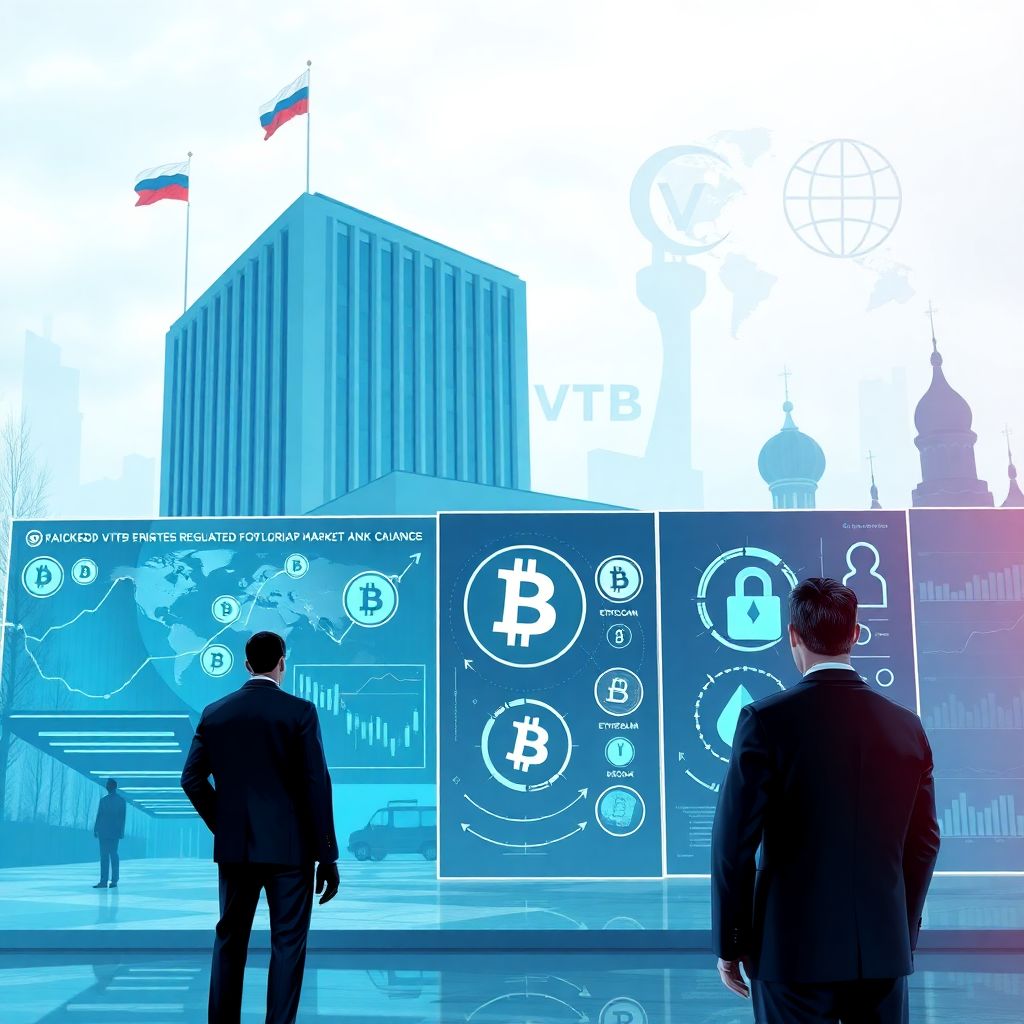
Sanctioned Russia’s VTB Bank prepares regulated spot crypto trading for wealthy clients
Russia’s second‑largest lender, VTB Bank, is preparing to become the first major Russian bank to enter the spot cryptocurrency market, with a rollout aimed at wealthy clients in 2026. The move signals a new phase in Moscow’s cautious shift toward regulated access to digital assets, even as the country remains heavily sanctioned and largely isolated from Western financial infrastructure.
Targeting high‑net‑worth and “qualified” investors
According to statements cited in Russian media, VTB does not intend to open spot crypto trading to the general public. Instead, access will be tightly restricted to “qualified investors” – a regulatory category that typically requires a minimum portfolio size, verifiable income, or professional investment experience.
Bank representatives say trial operations are already underway with a limited pool of high‑net‑worth customers. This pilot phase is expected to test both technical infrastructure and compliance procedures before a wider launch within the affluent client segment in 2026. Officials have emphasized that there are no plans to create a broad retail product, underscoring that the initiative is designed as a niche service rather than a mass‑market offering.
From hostility to controlled experimentation with crypto
Russia’s stance on cryptocurrency has shifted notably over the past few years. Authorities initially treated digital assets with suspicion, warning of speculative risks, capital flight, and money laundering. In parallel, regulators pushed for heavy restrictions on trading and a near‑complete separation of the domestic financial system from open global crypto markets.
That posture has softened as international sanctions have drastically curtailed Russia’s access to global banking and payment rails. Policymakers have acknowledged that millions of Russians already use cryptocurrencies for payments, savings, and cross‑border transfers, often in defiance of earlier restrictive rhetoric. Rather than attempting an outright ban, authorities are now moving toward a model of tightly managed, partially legalized crypto use.
Within this model, banks like VTB would act as intermediaries, providing regulated gateways into digital assets instead of leaving Russians to rely exclusively on offshore exchanges and opaque over‑the‑counter channels.
Crypto as a tool in sanctioned trade flows
Reports indicate that Russia has already experimented with using cryptocurrencies in certain segments of its international trade, particularly in energy transactions with countries such as China and India. While details remain opaque and the scale limited, these efforts highlight how digital assets are being explored as a workaround to restrictions on dollar‑ and euro‑denominated payments.
By authorizing selected banks to handle cryptocurrency operations under defined rules, Russian authorities appear to be attempting a balance: leveraging digital assets as a parallel channel for trade and finance, while still maintaining state oversight and avoiding uncontrolled capital flight.
Senior officials from the Central Bank of Russia have suggested that more banks could be allowed to operate in the crypto space under a licensing or authorization framework. VTB’s pilot is therefore likely to serve as a template or proof‑of‑concept for how traditional institutions can be integrated into a digital asset regime without fully liberalizing the market.
Why VTB is moving into spot crypto now
VTB officials have said that client interest is a primary driver of the initiative. Wealthy Russians, like their counterparts elsewhere, are looking for diversified exposure to digital assets through familiar, regulated institutions rather than little‑known offshore platforms.
Global crypto markets saw renewed growth and institutionalization in recent years, and VTB appears intent on ensuring that its wealth management business is not left behind. By introducing spot crypto trading, the bank can offer portfolio diversification, speculative opportunities, and potential hedging tools to clients who are already active in high‑risk asset classes.
Although VTB did not disclose specific figures, the bank remains one of the country’s financial heavyweights, with extensive assets and a substantial market presence. The decision to integrate cryptocurrency services into its product lineup thus carries symbolic and practical significance in Russia’s evolving digital asset landscape.
Narrow access by design: why the public will likely be excluded
Despite the growing use of crypto by ordinary Russians, VTB and regulators appear determined to keep this particular service constrained to affluent, vetted clients. Several reasons explain this cautious stance:
– Investor protection: Authorities remain concerned about the volatility and speculative nature of cryptocurrencies. Limiting access to qualified investors is seen as a way to reduce exposure for less financially literate citizens.
– Compliance and sanctions risk: As a sanctioned institution, VTB must carefully manage how crypto products interact with existing restrictions and anti–money laundering rules. A smaller, known client base is easier to monitor.
– Systemic risk control: Allowing widespread retail access through large domestic banks could accelerate capital outflows and destabilize the ruble, particularly under sanctions.
– Political and regulatory uncertainty: Russia’s legal framework for digital assets is still being built. Regulators may prefer to test the waters with a narrow segment, refine rules, and then decide how far to expand access.
In practice, this means that while VTB may become a pioneer among Russian banks in spot crypto trading, the benefits will be concentrated among high‑net‑worth individuals rather than ordinary savers.
How Russia’s move compares with global banking trends
VTB’s planned rollout places it in line with a broader international trend: traditional banks selectively embracing digital assets under strict oversight. In Europe and Asia, several major institutions—including large international lenders—have already introduced crypto‑related services such as spot trading, custody, and tokenization solutions for institutional and wealthy clients.
However, the Russian context is distinct. In many other markets, banks are integrating crypto to capture new revenue streams and meet client demand within relatively open financial systems. In Russia, the push toward regulated digital assets is intertwined with geopolitical pressure, sanctions, and a drive to build alternative financial pathways less dependent on Western infrastructure.
This dual nature—part innovation strategy, part geopolitical necessity—makes Russia’s approach to crypto particularly complex and heavily politicized.
Regulatory architecture: what “regulated conditions” likely mean
When Russian officials speak of banks operating under “regulated conditions” in cryptocurrency markets, several elements are likely to be involved:
– Licensing or special permissions for banks to handle digital assets and offer trading services.
– Mandatory identity verification and source‑of‑funds checks on all clients using crypto services.
– Limits on cross‑border flows, potentially restricting how and where digital assets can be sent or received.
– Reporting obligations to Russia’s financial intelligence units and tax authorities.
– Integration with a domestic digital asset framework, possibly including state‑approved exchanges or tokenization platforms.
For wealthy clients, this setup could offer a perceived increase in safety and legal clarity compared with transacting via unregulated offshore platforms. At the same time, it ensures that the state retains visibility into major flows of digital wealth.
Opportunities and risks for wealthy Russian investors
For high‑net‑worth individuals in Russia, VTB’s planned spot crypto service presents both potential advantages and notable risks:
Opportunities:
– Access to cryptocurrencies through a familiar domestic bank and existing private banking relationships.
– Potential portfolio diversification and exposure to an asset class that has shown strong, if volatile, growth cycles.
– Custody and technical handling taken care of by the bank, reducing operational and security burdens on the client.
Risks:
– Regulatory risk if Russia abruptly tightens or reshapes its digital asset laws.
– Market volatility, with the possibility of sharp price swings and sustained downturns.
– Additional visibility to domestic authorities, which may be a concern for some wealthy individuals who preferred the relative opacity of foreign exchanges and decentralized wallets.
– The constraints of sanctions, which may limit international convertibility or the ability to move assets abroad.
Each of these factors will influence how enthusiastically VTB’s affluent clientele embraces the new offering once it is fully launched.
What VTB’s move signals for Russia’s financial strategy
The decision by a sanctioned, systemically important bank to prepare spot crypto trading is more than a niche product announcement. It reflects a broader strategic pivot:
– Russia is gradually formalizing a domestic crypto infrastructure instead of fighting a losing battle against its usage.
– The state is opting for controlled integration—using major banks as gateways—rather than wild‑west liberalization.
– Digital assets are being evaluated not just as speculative tools but as potential components of trade, payments, and economic resilience under sanctions.
While retail Russians are unlikely to gain easy, regulated access to crypto through institutions like VTB in the near term, the architecture being tested for wealthy investors could lay the groundwork for broader services down the line if political and economic conditions change.
Outlook toward 2026 and beyond
As VTB continues testing with a select group of high‑net‑worth clients, several questions will shape the trajectory of Russia’s crypto banking experiment:
– How comfortable will regulators ultimately be with banks offering exposure to volatile digital assets?
– Will the use of cryptocurrencies in sanctioned trade quietly expand, increasing the strategic value of a domestic crypto infrastructure?
– Could other large Russian banks follow VTB’s lead, creating a competitive market for regulated crypto services among the country’s financial giants?
– And perhaps most crucially, will authorities ever open up regulated access beyond the wealthy elite, or will crypto within the banking system remain an exclusive tool for a small segment of the population?
For now, VTB’s planned 2026 rollout positions it as a key player in Russia’s attempt to reconcile heavy sanctions, global financial isolation, and the unstoppable rise of digital assets—on the country’s own terms and under tight regulatory control.